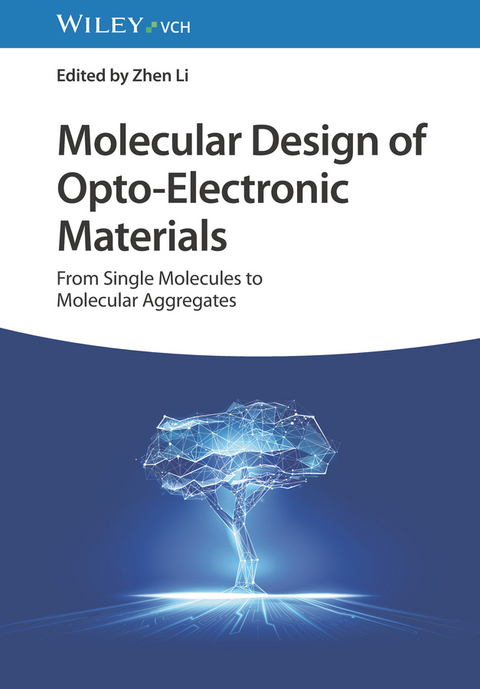
Molecular Design of Opto-Electronic Materials
Wiley-VCH (Verlag)
978-3-527-34939-5 (ISBN)
- Noch nicht erschienen (ca. Mai 2026)
- Versandkostenfrei
- Auch auf Rechnung
- Artikel merken
Zhen Li received his BSc and PhD degrees from Wuhan University (WHU) in China in 1997 and 2002, respectively, under the supervision of Prof. Jingui Qin. In 2003-2004, he worked at the Hong Kong University of Science and Technology in the group of Prof. Ben Zhong Tang. In 2010, he worked at the Georgia Institute of Technology in the group of Prof. Seth Marder. He has been a full professor at WHU since 2006 and a chair professor at Tianjin University since 2018. His research interests are in the development of organic molecules and polymers with new structures and new functions for organic electronics and photonics. He has authored over 200 scientific publications and has received numerous scientific awards, including Chinese Chemical Society Award for Outstanding Young Chemist (2007), National Science Foundation for Distinguished Young Scholars (2013), Young and Middle-aged Innovation Leading Talents (2015), Ten Thousand People Plan of Central Organization Department (2017), and Fellow of Royal Society of Chemistry (2017). Qianqian Li received her BSc degree from Hubei University, China, in 2004 and then obtained her PhD degree under the supervision of Prof. Zhen Li at Wuhan University in 2009. After two years postdoc research at Department of Physics, she became a faculty at College of Chemistry and Molecular Sciences in Wuhan University, and was promoted to full professor in 2018. In 2016-2017, she worked as a visiting scholar in University of California, Los Angeles. Her research interests focus on the design and synthesis of new opto-electronic functional materials.
1. Introduction
1.1 Motivation
1.2 Overarching objective of this book
1.3 A brief history
1.4 Basic knowledge of organic compounds in the aggregated state
1.5 Overview of topics covered
2. The Molecular Engineering and Fabrication Processes for Molecular Aggregates
2.1 Crystal engineering
2.2 Self-assembly system
2.3 Gel system
2.4 Cross-linking system
2.5 Host-guest system
3. The Research Methodology of Molecular Aggregation Science
3.1 The theoretical calculation
3.2 The crystal structures
3.3 Atom force microscope (AFM)
3.4 The X-ray diffraction
3.5 2D grazing incidence wide-angle X-ray scattering (GIWAXS)
3.6 Nuclear magnetic resonance spectrum
3.7 Other methods
4. Photoluminescence of Molecular Aggregates
4.1 The internal mechanism and principle
4.2 Fluorescence materials
4.3 Phosphorescence materials
5. Mechanoluminescence of Molecular Aggregates
5.1 The internal mechanism
5.2 Fixed emission
5.3 Dynamic emission
6. Molecular Aggregates as Hole-Transporting Layer in Perovskite Solar Cells
6.1 Construction and work principle
6.2 Doped hole-transporting materials
6.3 Doped-free hole-transporting materials
7. Molecular Aggregates as Active Layer in Organic Photovoltaics
7.1 Construction and work principle
7.2 Organic solar cells
7.3 Polymer solar cells
8. Molecular Aggregates in Organic Light-Emitting Transistor (OLET) Devices
8.1 Construction and Work Principle
8.2 Organic semiconductor materials
8.2.1 Polymers
8.2.2 Oligomers
8.2.3 Small molecules
9. Molecular Aggregates for Second-Order Non-Linear Optical Effect
9.1 Microscopic and macroscopic nonlinearities of organic systems
9.2 Organic molecules for second-order nonlinear optics
9.3 Polymers for second-order nonlinear optics
10. Other Opto-Electronic Materials in Aggregate
10.1 Magnetic Materials
10.2 Metal-Organic Frameworks
10.3 Covalent-Organic Frameworks
11. The Relation Between Macroscopic Functions and Microscopic Structures
11.1 Molecular packing
11.2 Intermolecular interactions
11.2.1 p-p interactions
11.2.2 Hydrogen bonding
12. Conclusions and Future Prospects
| Erscheinungsdatum | 05.01.2024 |
|---|---|
| Verlagsort | Berlin |
| Sprache | englisch |
| Maße | 170 x 244 mm |
| Themenwelt | Naturwissenschaften ► Chemie ► Physikalische Chemie |
| Technik ► Elektrotechnik / Energietechnik | |
| Technik ► Maschinenbau | |
| Schlagworte | Chemie • Chemistry • Electronic materials • Elektronische Materialien • Energie • Energy • Materials Science • Materialwissenschaften • Physical Chemistry • Physikalische Chemie • Solarenergie u. Photovoltaik • Solar Energy & Photovoltaics |
| ISBN-10 | 3-527-34939-1 / 3527349391 |
| ISBN-13 | 978-3-527-34939-5 / 9783527349395 |
| Zustand | Neuware |
| Informationen gemäß Produktsicherheitsverordnung (GPSR) | |
| Haben Sie eine Frage zum Produkt? |
aus dem Bereich