Fundamentals of Conservation Biology (eBook)
John Wiley & Sons (Verlag)
978-1-119-14417-5 (ISBN)
'This book is about hope in the face of forces that would degrade our world. This book is about the rich tapestry of life that shares our world now and about how we can maintain it, sometimes in places that we protect and set aside, more often in places where we share the lands and waters with a wide range of other species.'
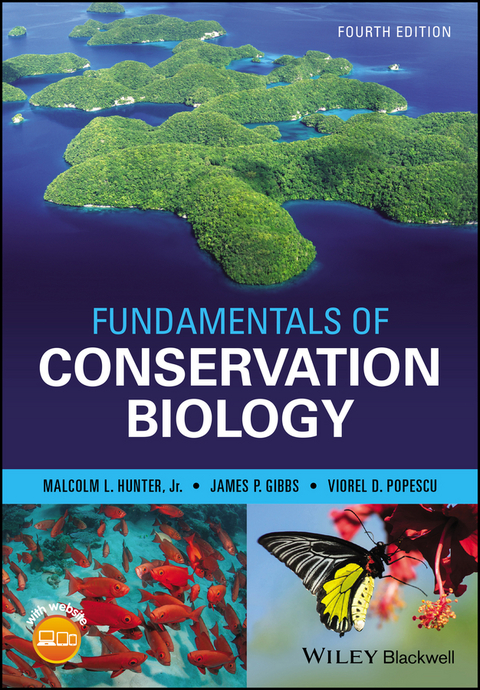
For more than 30 years, Fundamentals of Conservation Biology has been a valued mainstay of the literature, serving both to introduce new students to this ever-changing topic, and to provide an essential resource for academics and researchers working in the discipline. In the decade since the publication of the third edition, concerns about humanity's efforts to conserve the natural world have only grown deeper, as new threats to biodiversity continue to emerge.
This fourth edition has taken into account a vast new literature, and boasts nearly a thousand new references as a result. By embracing new theory and practice and documenting many examples of both conservation successes and the hard lessons of real-world 'wicked' environmental problems, Fundamentals of Conservation Biology remains a vital resource for biologists, conservationists, ecologists, environmentalists, and others.
Malcolm L. Hunter, Jr. is the Libra Professor of Conservation Biology at the University of Maine and the former President of the Society for Conservation Biology.
James P. Gibbs is Distinguished Professor of Conservation Biology at the State University of New York College of Environmental Science and Forestry, and Conservation Scientist at the Galapagos Conservancy.
Viorel D. Popescu is Assistant Professor of Conservation Biology at Ohio University, Athens and Research Associate at University of Bucharest's Center for Environmental Research, Romania.
FUNDAMENTALS OF CONSERVATION BIOLOGY This book is about hope in the face of forces that would degrade our world. This book is about the rich tapestry of life that shares our world now and about how we can maintain it, sometimes in places that we protect and set aside, more often in places where we share the lands and waters with a wide range of other species. For more than 30 years, Fundamentals of Conservation Biology has been a valued mainstay of the literature, serving both to introduce new students to this ever-changing topic, and to provide an essential resource for academics and researchers working in the discipline. In the decade since the publication of the third edition, concerns about humanity s efforts to conserve the natural world have only grown deeper, as new threats to biodiversity continue to emerge.This fourth edition has taken into account a vast new literature, and boasts nearly a thousand new references as a result. By embracing new theory and practice and documenting many examples of both conservation successes and the hard lessons of real-world wicked environmental problems, Fundamentals of Conservation Biology remains a vital resource for biologists, conservationists, ecologists, environmentalists, and others.
Malcolm L. Hunter, Jr. is the Libra Professor of Conservation Biology at the University of Maine and the former President of the Society for Conservation Biology. James P. Gibbs is Distinguished Professor of Conservation Biology at the State University of New York College of Environmental Science and Forestry, and Conservation Scientist at the Galapagos Conservancy. Viorel D. Popescu is Assistant Professor of Conservation Biology at Ohio University, Athens and Research Associate at University of Bucharest's Center for Environmental Research, Romania.
Preface
1. Conservation and Conservation Biology
2. What is Biodiversity?
3. Species Diversity
4. Ecosystem Diversity
5. Genetic Diversity
6. Global Change: Past and Future
7. Extinction Processes
8. Ecosystem Degradation and Loss
9. Overexploitation
10. Exotic Species
11. Protecting Ecosystems
12. Sustaining Ecosystems
13. Managing Populations
14. Conservation near people
15. Social Factors
16. Economics
17. Taking action
Glossary
Literature cited and author index
Species index
Subject index
CHAPTER 1
Conservation and Conservation Biology
What Is Conservation?
Since the beginning of humanity people have been concerned about their environment and especially its ability to provide them with food, water, and other resources. As our numbers have grown and our technology has developed, so has the impact we are having on our environment, and thus we are becoming increasingly concerned. Media everywhere proclaim the current issues:
- “Conservationists call for tighter fishing regulations.”
- “Ecologists describe consequences of warmer climates.”
- “Environmentalists criticized by chemical industry.”
- “Preservationists seek more wilderness.”
These headlines also reveal an ambiguous terminology. Are we talking about conservation or preservation? Are the issues ecological or environmental? Students deciding which university to attend and which major to select are faced with a bewildering array of choices – soil and water conservation, environmental studies, natural resource management, conservation biology, wildlife ecology, human ecology, and more – that intertwine with one another. In this chapter we will try to resolve these ambiguities by examining how they are rooted in human history and ethics. To start on common ground we explore the key differences and similarities among conservationists, preservationists, environmentalists, and ecologists. In the second part of the chapter we will see where conservation biology fits into this picture.
A conservationist is someone who advocates or practices the sustainable and careful use of natural resources. Foresters who prudently manage forests, hunters and fishers who harvest wild animal populations sustainably, and farmers who practice the wise use of soil and water are all conservationists. Citizens who are concerned about the use of natural resources are also conservationists and sometimes they assert that the activities of foresters, fishers, farmers, and other natural resource users are not prudent, sustainable, or wise. In theory, arguments over who is, or is not, a conservationist should turn on the issue of what is sustainable. In practice, most foresters, farmers, ranchers, and others – many of whom are careful stewards of the lands and waters they control – have ceded the title “conservationist” to their critics.
A preservationist advocates allowing some places and some creatures to exist without significant human interference. Most people accept the idea that conservation encompasses setting aside certain areas as parks and protecting certain species without harvesting them. The divisive issues are: how many and which areas, and which species. Many resource users believe that enough areas have already been closed to economic use, and they use “preservationist” as a negative term for people they consider to be extremists. Ironically, in the case of some set asides, like marine reserves, their preservation boosts fish harvests in surrounding areas. Nevertheless, because of this pejorative use, relatively few people call themselves preservationists. People who find themselves labeled preservationists by others usually prefer to think of preservation as just one plank in their platform as conservationists.
An environmentalist is someone who is concerned about the impact of people on environmental quality in general. Air and water pollution are often the proximate concerns; human overpopulation and wasteful use of resources are the ultimate issues. There is enormous overlap between environmentalists and conservationists. Many environmentalists would say that environmentalism encompasses conservation, while many conservationists would say the reverse. The difference is a matter of emphasis. By focusing on air and water pollution and their root causes, environmentalists often emphasize urban, suburban, and agricultural situations where human‐induced problems and human well‐being are paramount. Because conservationists focus on natural resource use, they tend to emphasize the rural areas and wildlands where natural resources are most abundant, as well as associated ecosystems and organisms, including people who might live there.
Traditionally, an ecologist is a scientist who studies the relationships between organisms and their environments. However, in the 1970s when concern for the environment first bloomed widely around the planet, the term developed a second meaning when the public failed to distinguish between environmentalists (activists) and the scientists (ecologists) who provided the scientific basis for the environmental movement. Now “ecologist” is often used in the popular press as a synonym for “environmentalist.” Given this, a broader definition of an ecologist is a person who is concerned about the relationships between organisms (including people) and their environments.
Recently, these distinctions have become controversial and fuzzy, following a call for a “new conservation” that focuses on the benefits that nature provides for people (Kareiva and Marvier 2012) and the ways that people and nature depend on one another. This “conservation for people” movement is controversial because other people believe that conservation should also recognize the intrinsic value of nature (see next section). It is fuzzy because people on both sides of the argument have lost sight of the fact that the origins of conservation (also see next section) were largely centered on human welfare (Hunter et al. 2014).
In summary, ever‐evolving attitudes and perceptions are at the root of the confusion over who are conservationists, preservationists, environmentalists, and ecologists; each term persists because it has some utility in describing the diverse ways people interact with their environment.
A Brief History of Conservation
The roots of conservation are lost in prehistory (Fig. 1.1). No doubt there was a time when human reason, growing ever more sophisticated through the millennia, began to extend the idea of deferred gratification (“save this fruit to eat tomorrow rather than now”) over much longer periods. Keep in mind that for 99% of our history as a species we were living in small, self‐regulating groups of humans entirely dependent on wild species. Thus conservation has long been intrinsic to our welfare as expressed in the form of edicts and practices such as “Leave these tubers so there will be more next year when we pass this place.” Or “Do not kill the pregnant females in this herd of peccaries so next year we will have even more to eat.” Or “Nobody shall hunt in that sacred area near our home grounds.” Certainly, such practices were simple, almost analogous to the food caching exhibited by many animals, but they were widespread and effective in governing human activity and represent conservation nevertheless. They remain relevant to this day, most notably in the practices of indigenous people who still live subsistence lifestyles in self‐regulating societies using wild species (Berkes and Turner 2006).
Figure 1.1 The roots of conservation can probably be found among the earliest Homo sapiens such as the people who painted this mural in the Lascaux cave in France.
(Thipjang/Shutterstock)
Leaping forward, history records many examples of conservation throughout the ages and across cultures. For example, the biblical story of Noah's ark remains a popular metaphor for conservation, and the Bible also codifies the first‐known game conservation law:
If you come on a bird's nest, in any tree or on the ground, with fledglings or eggs, with the mother sitting on the fledglings or on the eggs, you shall not take the mother with the young. Let the mother go, taking only the young for yourself, in order that it may go well with you and you may live long. (Deuteronomy 22:6–7)
(In other words: don't kill mother birds.)
A far broader law was promulgated by Asoka, emperor of India 274–232 BCE:
Twenty‐six years after my coronation I declared that the following animals were not to be killed: parrots, mynahs, … wild geese, … cranes, bats, queen ants, terrapins, … tortoises, and porcupines, squirrels, twelve‐antler deer, … rhinoceroses, … and quadrupeds which are not useful or edible…. Forests must not be burned.
Many laws focused on regulating rather than prohibiting the exploitation of species. For example, Middle Eastern pharaohs issued waterfowl hunting licenses, and night hunting was banned in the city‐states of ancient Greece (Alison 1981). Early regulations emphasized trees and birds, mammals, and fish caught for food, but all species and whole ecosystems benefitted from the popularity of declaring preserves. Starting at least 3000 years ago with Ikhnaton, king of Egypt, and continuing with the royalty of Assyria, China, India, and Europe, as well as with the Greeks, Romans, Mongols, Aztecs, and Incas, history has recorded many decrees setting aside land to protect its flora and fauna (Alison 1981).
Conservation was an issue during the period when European states were colonizing the rest of the world because colonization often led to disruption of traditional systems of natural resource use and rapid overexploitation. Freedom from European game laws was a significant stimulus to colonization, and hunting was a major...
| Erscheint lt. Verlag | 9.3.2021 |
|---|---|
| Sprache | englisch |
| Themenwelt | Naturwissenschaften ► Biologie ► Ökologie / Naturschutz |
| Naturwissenschaften ► Geowissenschaften ► Geologie | |
| Schlagworte | Angewandte Ökologie • Applied Ecology • Biowissenschaften • Conservation Science • Ecology & Organismal Biology • Life Sciences • Naturschutzbiologie • Ökologie • Ökologie u. Biologie der Organismen |
| ISBN-10 | 1-119-14417-5 / 1119144175 |
| ISBN-13 | 978-1-119-14417-5 / 9781119144175 |
| Informationen gemäß Produktsicherheitsverordnung (GPSR) | |
| Haben Sie eine Frage zum Produkt? |
 EPUB (Adobe DRM)
Kopierschutz: Adobe-DRM
Adobe-DRM ist ein Kopierschutz, der das eBook vor Mißbrauch schützen soll. Dabei wird das eBook bereits beim Download auf Ihre persönliche Adobe-ID autorisiert. Lesen können Sie das eBook dann nur auf den Geräten, welche ebenfalls auf Ihre Adobe-ID registriert sind.
Details zum Adobe-DRM
Dateiformat: EPUB (Electronic Publication)
EPUB ist ein offener Standard für eBooks und eignet sich besonders zur Darstellung von Belletristik und Sachbüchern. Der Fließtext wird dynamisch an die Display- und Schriftgröße angepasst. Auch für mobile Lesegeräte ist EPUB daher gut geeignet.
Systemvoraussetzungen:
PC/Mac: Mit einem PC oder Mac können Sie dieses eBook lesen. Sie benötigen eine
eReader: Dieses eBook kann mit (fast) allen eBook-Readern gelesen werden. Mit dem amazon-Kindle ist es aber nicht kompatibel.
Smartphone/Tablet: Egal ob Apple oder Android, dieses eBook können Sie lesen. Sie benötigen eine
Geräteliste und zusätzliche Hinweise
Buying eBooks from abroad
For tax law reasons we can sell eBooks just within Germany and Switzerland. Regrettably we cannot fulfill eBook-orders from other countries.
aus dem Bereich