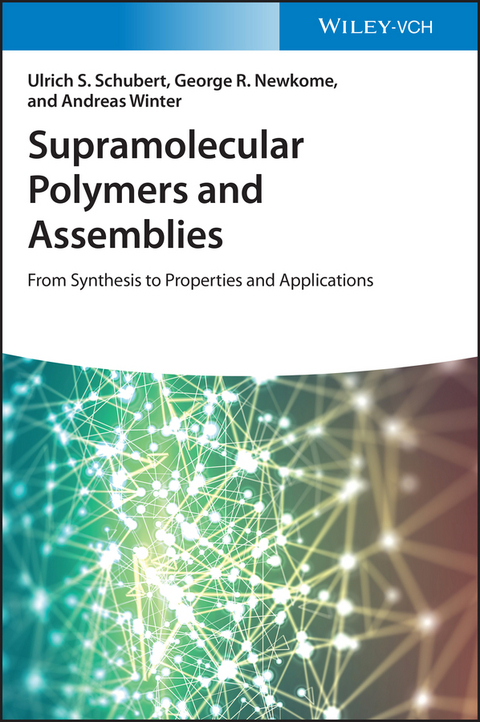
Supramolecular Polymers and Assemblies (eBook)
Explore modern characterization methods and new applications in this modern overview of supramolecular polymer chemistry
Supramolecular Polymers and Assemblies: From Synthesis to Properties and Applications delivers a superlative summary and description of general concepts and definitions in the field. The book offers informative and accessible treatments of crucial concepts like metal-containing compounds, hydrogen bonding, ionic interactions, pi-pi stacking, and more.
Characterization remains a primary focus of the book throughout, making it extremely useful for practitioners in the field. Emphasis is also placed on metallo-supramolecular polymers and materials which have found applications in areas like smart or intelligent materials and systems with special photochemical and photophysical properties, like LEDs and solar cells. Applications, including self-healing materials, opto-electronics, sensing, and catalysis are all discussed as well.
The book details many of the exciting developments in the field of supramolecular chemistry that have occurred since the 1987 Nobel Prize was awarded to pioneers in this rapidly developing field. Readers will also benefit from the inclusion of:
- A thorough introduction to supramolecular assemblies based on ionic interactions
- Explorations of supramolecular polymers based on hydrogen-bonding interactions, metal-to-ligand interactions, p-Electronic interactions, crown-ether recognition, cucurbiturils, and host-guest chemistry of calixarenes
- A discussion of cyclodextrins in the field of supramolecular polymers
- Examinations of supramolecular polymers based on the host-guest chemistry of pillarenes, and those formed by orthogonal non-covalent interactions
- A treatment of the characterization of supramolecular polymers
Supramolecular Polymers and Assemblies: From Synthesis to Properties and Applications will earn a place in the libraries of researchers and practitioners of the material science, as well as polymer chemists seeding a one-stop reference for supramolecular polymers.
Ulrich S. Schubert, PhD, is Full-Professor at the Friedrich-Schiller-University Jena (Chair of Organic and Macromolecular Chemistry) in Germany. He has published over 530 scholarly papers, 20 patents, and edited or written 5 scientific books.
George R. Newkome, PhD, is Affiliate Research Professor at the Center for Molecular Biology and Biotechnology in Jupiter, Florida, USA.
Andreas Winter, PhD, joined the group of Professor U. S. Schubert at the Eindhoven University of Technology in The Netherlands and the Friedrich-Schiller University Jena, Germany. His research is focused on the synthesis of emissive and luminescent metallo-supramolecular assemblies.
Ulrich S. Schubert was born in Tübingen (Germany) in 1969. He studied chemistry in Frankfurt and Bayreuth (both Germany) and at the Virginia Commonwealth University, Richmond (USA). His Ph.D. studies were performed at the Universities of Bayreuth and South Florida. After a postdoctoral training with J.-M. Lehn at the University of Strasbourg (France), he moved to the TU Munich (Germany) and obtained his Habilitation in 1999. During 1999-2000, he was Professor at the University of Munich and during 2000-2007 Full-Professor at the TU Eindhoven (the Netherlands). Since 2007, he is Full-Professor at the Friedrich Schiller University Jena, Germany. Prof. Schubert is founder and director of the Jena Center for Soft Matter (JCSM) and the Center for Energy and Environmental Chemistry Jena (CEEC Jena). He received a VICI award of the Netherlands Organization for Scientific Research (NWO) and is Fellow of the ACS Division of Polymer Chemistry, Polymer Division (USA), the Royal Society of Chemistry (FRSC, UK), and the National Academy of Inventors (NAI, USA). Prof. Schubert is Elected Member of the German National Academy of Science and Engineering (acatech) and External Scientific Member of the Max Planck Society (MPI for Colloid & Interfaces, Golm). He has currently an h-Index of 107 and since 2016 is listed as ISI "Highly cited researcher". Andreas Winter was born in Herne (Germany) and studied chemistry at the University of Dortmund (Germany) where he graduated in organic chemistry in 1999. In 2003 he received his Ph.D. in chemistry (University of Paderborn, Germany) for work on applications of the Mannich reaction in the synthesis of pyridine derivatives under supervision of Professor N. Risch, and stayed on as a postdoc. Subsequently, in 2005 he joined the group of Prof. U. S. Schubert (Eindhoven University of Technology, The Netherlands and Friedrich-Schiller University Jena, Germany). His research is focused on the synthesis of emissive and luminescent metallo-supramolecular assemblies. George R. Newkome received his B.S. and Ph.D. in chemistry from Kent State University. He joined Louisiana State University in 1968, becoming a full professor in 1978 and Distinguished Research Master in 1982. In 1986, he moved to the University of South Florida as Vice President for Research and Professor of Chemistry, becoming a Distinguished Research Professor in 1992. In 2001, he was appointed as Oelschlager Professor of Science and Technology at the University of Akron, where he is also Professor of Polymer Science and Chemistry, Vice President for Research, Dean of the Graduate School, and President of the University's Research Foundation. He has published over 450 papers as well as 50+ U. S. patents, 9 books, and 16 edited books and journals. His research is focused on supramacromolecular chemistry, molecular dendritic and fractal assemblies, nanochemistry, inorganic-organic interfaces, molecular inclusion chemistry, molecular electronics, and photonics.
Supramolecular Polymers: General Considerations
Supramolecular Assemblies Based on Ionic Interactions
Supramolecular Polymers, Based on Hydrogen-Bonding Interactions
Supramolecular Polymers, Based on Metal-to-Ligand Interactions
Supramolecular Polymers, Based on p-Electronic Interactions
Supramolecular Polymers, Based on Crown-ether Recognition
Supramolecular Polymers Based on Cucurbiturils
Supramolecular Polymers, Based on the Host-Guest Chemistry of Calixarenes
Cyclodextrins in the Field of Supramolecular Polymers
Supramolecular Polymers, Based on the Host-Guest Chemistry of Pillarenes
Supramolecular Polymers, Formed by Orthogonal Non-covalent Interactions
Characterization of Supramolecular Polymers
Abbreviations
| 18C6 | 18‐crown‐6 |
| A | adenine or absorbance |
| A2 | second virial coefficient |
| acac | acetoacetate |
| ACQ | aggregation‐caused quenching |
| AFM | atomic force microscopy |
| AF4 | asymmetric flow field flow fractionation |
| AIE | aggregation‐induced emission |
| Alq3 | tris(8‐hydroxyquinolinato)aluminium |
| ATP | adenosine triphosphate |
| ATRP | atom transfer radical polymerization |
| AUC | analytical ultracentrifugation |
| bdt | 1,2‐benzenedithiolate |
| bFGF | basic fibroblast growth factor |
| Bn | benzyl |
| BODIPY | boron‐dipyrromethene |
| BMP32C10 | bis(m‐phenylene)‐32‐crown‐10 |
| BPP34C10 | bis(p‐phenylene)‐34‐crown‐10 |
| BSA | Bovine serum albumin |
| B21C7 | benzo‐21‐crown‐7 |
| cac | critical aggregation concentration |
| CB[n] | cucurbit[n]uril; n = number of glycuril units |
| CD | circular dichroism or cyclodextrin |
| CDSA | crystallization‐driven self‐assembly |
| ceff | effective concentration |
| Ce6 | chlorin‐e6 |
| cgc | critical gelation concentration |
| Ch+ | cycloheptatrienyl cation |
| ChE | cholinesterase |
| CIA | calixarene‐induced aggregation |
| CIE | commission Internationale de l′Éclairage |
| CLSM | confocal laser scanning microscopy |
| cmc | critical micellar concentration |
| CNT | carbon nanotube |
| CONASH | coordination nanosheet |
| cpc | critical polymerization concentration |
| CPK (models) | 3D molecular models |
| CS | cold spray |
| CT | charge transfer |
| CuCAAC | Cu(I)‐catalyzed azide‐to‐alkyne cycloaddition |
| CV | cyclic voltammetry |
| CVD | chemical vapor deposition |
| DABCO | 1,4‐diazabicyclo[2.2.2]octane |
| DBU | 1,8‐diazabicyclo[5.4.0]undec‐7‐ene |
| DB24C8 | Dibenzo‐24‐crown‐8 |
| DCC | dynamic covalent chemistry |
| DEB | diethyl barbiturate |
| DHP | dihexyldecylphosphonate |
| DLS | dynamic light scattering |
| DMAc | dimethyl acetamide |
| DMF | dimethyl formamide |
| DMSO | dimethylsulfoxide |
| DNA | deoxyribonucleic acid |
| DP | degree of polymerization |
| DPP | diphenylphenanthrene or diketopyrrolopyrrole |
| DOSY | diffusion‐ordered (NMR) spectroscopy |
| DOX | doxorubicin |
| DQ | (1H) double quantum |
| DSC | differential scanning calorimetry |
| Ð | dispersity |
| E | molar absorptivity |
| EDTA | ethylenediamine tetraacetic acid |
| EPR | electron paramagnetic resonance |
| EM | effective molarity |
| ESI | electrospray ionization |
| exTTF | π‐extended tetrathiafulvalene |
| f | packing factor |
| fH | host molar fraction |
| FAB | fast atom bombardment |
| Fc+ | ferrocenium cation |
| FDA | U.S. Food and Drug Administration |
| FE | field emission |
| FEB | frequency‐domain electric birefringence |
| FF | fill factor |
| FRET | Föster‐type resonance energy transfer |
| FRP | free‐radical polymerization |
| FTICR | Fourier‐transform ion cyclotron resonance |
| FT‐IR | Fourier‐transform infrared |
| GAL1 | Galectin‐1 |
| gMS2 | gradient tandem MS2 |
| ΔG0 | Gibbs free energy |
| HBC | hexabenzocoronene |
| HDPE | high‐density polyethylene |
| HEEDTA | hydroxyethylethylenediaminetriacetic acid |
| HER | hydrogen‐evolution reaction |
| HETPHEN | heteroleptic phenanthroline |
| HFIP | 1,1,1,3,3,3‐hexafluoroisopropanol |
| HG | host–guest complex |
| HPLC | high‐performance liquid chromatography |
| HOMO | highest occupied molecular orbital |
| HOPG | highly‐ordered pyrolytic graphite |
| HSAB | hard and soft acid and bases |
| HSCT | host‐stabilized charge transfer |
| I | scattered intensity |
| IDP | isodesmic supramolecular polymerization |
| IM | ion mobility |
| IR | infrared |
| ISA | ionic self‐assembly |
| ITC | isothermal titration calorimetry |
| ITO | indium tin oxide |
| Ka | association constant |
| Kd | dissociation constant |
| L | persistence length of polymer |
| LB | Langmuir–Blodgett |
| LC | liquid crystal (or liquid crystalline) |
| LCD | liquid crystal display |
| LCST | lower critical solution temperature |
| LED | light‐emitting diode |
| LSI | liquid secondary ion |
| LT | low temperature |
| LUMO | lowest unoccupied molecular orbital |
| Mn | molar mass |
| Mw | molecular weight |
| MALDI | matrix‐assisted laser desorption/ionization |
| MALS | multi‐angle light scattering |
| MAS | magic angle spinning |
| Mb | myglobin |
| MDI | methylenediphenyl‐4,4′‐diisocyanate |
| mebip | 2,6‐bis(1‐methyl‐1H‐benzo[d]imidazole‐2‐yl)pyridine |
| MFP | molecular force probe |
| MLCT | metal‐to‐ligand charge transfer |
| MMLCT | metal‐metal‐to‐ligand charge transfer |
| MM2 | molecular modeling 2... |
| Erscheint lt. Verlag | 1.3.2021 |
|---|---|
| Sprache | englisch |
| Themenwelt | Naturwissenschaften ► Chemie ► Organische Chemie |
| Schlagworte | Chemie • Chemistry • Materialeigenschaften • Materials Science • Materialwissenschaften • Polymere • Polymer Science & Technology • Polymersynthese • polymer synthesis • Polymerwissenschaft u. -technologie • properties of materials • supramolecular assembly characterization • supramolecular chemistry • supramolecular polymer applications • supramolecular polymer characterization • Supramolecular polymeric chemistry • supramolecular polymer properties • supramolecular polymer synthesis • Supramolekulare Chemie |
| ISBN-10 | 3-527-83240-8 / 3527832408 |
| ISBN-13 | 978-3-527-83240-8 / 9783527832408 |
| Informationen gemäß Produktsicherheitsverordnung (GPSR) | |
| Haben Sie eine Frage zum Produkt? |
 EPUB (Adobe DRM)
Kopierschutz: Adobe-DRM
Adobe-DRM ist ein Kopierschutz, der das eBook vor Mißbrauch schützen soll. Dabei wird das eBook bereits beim Download auf Ihre persönliche Adobe-ID autorisiert. Lesen können Sie das eBook dann nur auf den Geräten, welche ebenfalls auf Ihre Adobe-ID registriert sind.
Details zum Adobe-DRM
Dateiformat: EPUB (Electronic Publication)
EPUB ist ein offener Standard für eBooks und eignet sich besonders zur Darstellung von Belletristik und Sachbüchern. Der Fließtext wird dynamisch an die Display- und Schriftgröße angepasst. Auch für mobile Lesegeräte ist EPUB daher gut geeignet.
Systemvoraussetzungen:
PC/Mac: Mit einem PC oder Mac können Sie dieses eBook lesen. Sie benötigen eine
eReader: Dieses eBook kann mit (fast) allen eBook-Readern gelesen werden. Mit dem amazon-Kindle ist es aber nicht kompatibel.
Smartphone/Tablet: Egal ob Apple oder Android, dieses eBook können Sie lesen. Sie benötigen eine
Geräteliste und zusätzliche Hinweise
Buying eBooks from abroad
For tax law reasons we can sell eBooks just within Germany and Switzerland. Regrettably we cannot fulfill eBook-orders from other countries.
aus dem Bereich