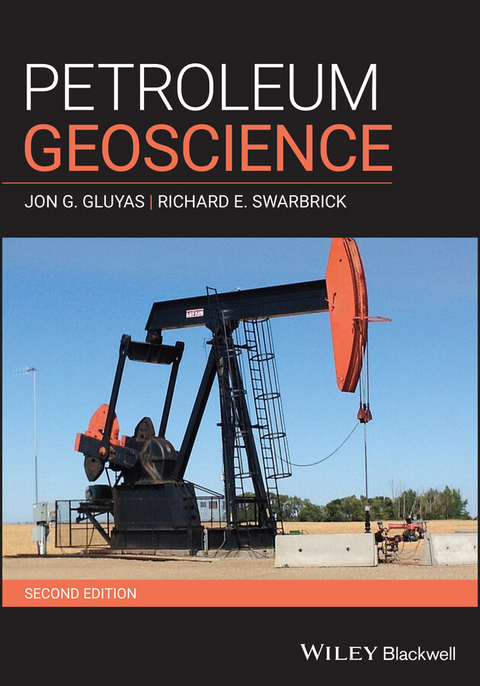
Petroleum Geoscience (eBook)
John Wiley & Sons (Verlag)
978-1-119-23233-9 (ISBN)

Petroleum Geoscience, 2nd edition?is a comprehensive introduction to the application of geology and geophysics to the search for and production of oil and gas. The aim this updated second edition remains the same - to provide a comprehensive grounding in the geological sciences as applied to exploration for and production of oil and gas.
Uniquely, this book is structured to reflect the sequential and cyclical processes of exploration, appraisal, development and production. Chapters dedicated to each of these aspects are further illustrated by new case histories drawn from the authors' experiences. Petroleum Geoscience, 2nd edition has a global and 'geo-temporal' backdrop, drawing examples and case histories from around the world and from petroleum systems ranging in age from late-Pre-Cambrian to Pliocene.
In order to show how geoscience is integrated at all levels within the industry, the authors stress throughout the links between geology and geophysics on the one hand, and drilling, reservoir engineering, petrophysics, petroleum engineering, facilities design, and health, safety and the environment on the other.
Discovery and production of petroleum underpinned global development throughout the twentieth century but times are changing. Combustion of fossil fuels and release of greenhouse gases, mainly carbon dioxide, is driving climate change. The skills and knowledge of the petroleum geoscientist also find application in carbon storage in and heat recovery (geothermal energy) from the Earth. This second edition addresses such technologies in the newly added Chapter 7.
The target readership is mainly final year undergraduates and postgraduates in the earth sciences together with little-experienced technical staff within the petroleum industry. The book draws on a large variety of examples from many basins around the world and as a consequence should appeal to those interested in petroleum geoscience, whether they be in Aberdeen or Abu Dhabi, Houston or Ho Chi Min.
JON G. GLUYAS is Ørsted/Ikon Chair in Geoenergy, Carbon Capture and Storage in the Department of Earth Sciences, Durham University, UK, and Executive Director of Durham Energy Institute.
RICHARD E. SWARBRICK is Honorary Professor in the Department of Earth Sciences, Durham University, UK.
Petroleum Geoscience, 2nd edition is a comprehensive introduction to the application of geology and geophysics to the search for and production of oil and gas. The aim this updated second edition remains the same - to provide a comprehensive grounding in the geological sciences as applied to exploration for and production of oil and gas. Uniquely, this book is structured to reflect the sequential and cyclical processes of exploration, appraisal, development and production. Chapters dedicated to each of these aspects are further illustrated by new case histories drawn from the authors' experiences. Petroleum Geoscience, 2nd edition has a global and 'geo-temporal' backdrop, drawing examples and case histories from around the world and from petroleum systems ranging in age from late-Pre-Cambrian to Pliocene. In order to show how geoscience is integrated at all levels within the industry, the authors stress throughout the links between geology and geophysics on the one hand, and drilling, reservoir engineering, petrophysics, petroleum engineering, facilities design, and health, safety and the environment on the other. Discovery and production of petroleum underpinned global development throughout the twentieth century but times are changing. Combustion of fossil fuels and release of greenhouse gases, mainly carbon dioxide, is driving climate change. The skills and knowledge of the petroleum geoscientist also find application in carbon storage in and heat recovery (geothermal energy) from the Earth. This second edition addresses such technologies in the newly added Chapter 7. The target readership is mainly final year undergraduates and postgraduates in the earth sciences together with little-experienced technical staff within the petroleum industry. The book draws on a large variety of examples from many basins around the world and as a consequence should appeal to those interested in petroleum geoscience, whether they be in Aberdeen or Abu Dhabi, Houston or Ho Chi Min.
JON G. GLUYAS is Ørsted/Ikon Chair in Geoenergy, Carbon Capture and Storage in the Department of Earth Sciences, Durham University, UK, and Executive Director of Durham Energy Institute. RICHARD E. SWARBRICK is Honorary Professor in the Department of Earth Sciences, Durham University, UK.
Cover 1
Title Page 5
Copyright 6
Contents 7
Preface to Second Edition 17
Preface to First Edition 19
Acknowledgments 21
Chapter 1 Introduction 23
1.1 The Aim and Format of the Book 23
1.2 Background 23
1.3 What Is in this Book 24
1.4 What Is Not in this Book 24
1.5 Key Terms and Concepts 25
1.5.1 Petroleum 25
1.5.2 The Source 25
1.5.3 The Seal 26
1.5.4 The Trap 26
1.5.5 The Reservoir 26
1.5.6 The Timing of Petroleum Migration 26
1.5.7 Porous Rock and Porosity 27
1.5.8 Permeable Rock and Permeability 27
1.5.9 Relative Permeability 27
1.5.10 Net to Gross and Net Pay 27
1.5.11 Water Saturation 27
1.5.12 Formation Volume Factor 27
1.5.13 The Gas to Oil Ratio 28
1.5.14 Timescales 28
1.5.15 The Units Used in this Book 28
1.6 The Chemistry of Petroleum 28
1.6.1 Alkanes (Paraffins) 31
1.6.2 Naphthenes (Cycloalkenes) 32
1.6.3 Aromatics 33
1.6.4 Asphaltenes 33
1.7 Geoscience and the Value Chain 34
1.7.1 Exploration (Chapters 3 and 4) 34
1.7.2 Appraisal (see Chapter 5) 35
1.7.3 Development (see Chapter 6) 35
1.7.4 Production (see Chapter 6) 36
1.7.5 Reserves Additions and Reserves Growth (see Chapter 6) 36
1.7.6 Field Abandonment and Reactivation (see Chapter 6) 36
1.7.7 Gas Storage (see Chapter 7) 37
1.7.8 Unconventional Petroleum (see Chapter 7) 37
1.8 Geoscience Activity 37
1.9 Oil, Gas, and Geoscientists – A Global Resource! 38
Further Reading 41
Chapter 2 Tools 43
2.1 Introduction 43
2.2 Satellite Images and Other Remote Sensing Data 43
2.2.1 Introduction 43
2.2.2 Satellite Images 43
2.2.3 Gravimetric Data 44
2.2.4 Magnetic Data 46
2.2.5 Electromagnetic Surveys 47
2.3 Seismic Data 47
2.3.1 Introduction 47
2.3.2 The Seismic Method 49
2.3.3 Seismic Acquisition 51
2.3.3.1 Land 51
2.3.3.2 Water 51
2.3.3.3 Collection of Seismic Data: Receivers 52
2.3.4 Seismic Processing 52
2.3.5 Seismic Interpretation 52
2.4 Wireline Log Data 54
2.4.1 Introduction 54
2.4.2 Rock Tools 54
2.4.3 Seismic Enhancement 57
2.4.4 Porosity and Permeability Tools 59
2.4.5 Fluid Tools 62
2.4.6 Pressure Tool 64
2.5 Core and Cuttings 65
2.5.1 Introduction 65
2.5.2 Conventional Core Analysis (Porosity and Permeability) 67
2.5.2.1 Sample Acquisition 67
2.5.2.2 Sample Cleaning 67
2.5.2.3 Sample Drying 67
2.5.2.4 Porosity Measurements 69
2.5.2.5 Permeability Measurements 69
2.5.3 Core Logging 71
2.5.4 Petrography 71
2.5.4.1 Provenance 71
2.5.4.2 The Depositional Environment 73
2.5.4.3 Reservoir Quality 73
2.5.5 Geochemistry 74
2.5.6 Biostratigraphy 74
2.5.6.1 Sampling 75
2.5.6.2 Correlation 75
2.5.6.3 Age Dating 75
2.5.6.4 The Depositional Environment 75
2.6 Fluid Samples From Wells 76
2.6.1 Introduction 76
2.6.2 The Sampling of Fluids 76
2.6.3 Petroleum 77
2.6.3.1 Gas Chromatography and Gas Chromatography (GC) Fingerprinting 77
2.6.3.2 Molecular Maturity 78
2.6.3.3 Rhenium–Osmium Dating 78
2.6.4 Water 78
2.7 Outcrop Data 79
2.7.1 Introduction 79
2.7.2 Maps 79
2.7.3 Reservoir Analogs 81
2.7.4 Rock Sampling and Analysis 81
2.8 Seepage of Petroleum 82
Further Reading 83
Chapter 3 Frontier Exploration 85
3.1 Introduction 85
3.2 Acquisition of Acreage 88
3.2.1 Early Access to Acreage 88
3.2.2 The Licensing Process 89
3.2.3 License Areas 90
3.2.4 Farm?Ins, Farm?Outs, and Other Deals 91
3.3 Direct Petroleum Indicators 91
3.3.1 Introduction 91
3.3.2 Petroleum Leakage and Seepage 91
3.3.2.1 Seal Failure 92
3.3.2.2 Tertiary Migration 93
3.3.2.3 Dissipation in the Near Surface 94
3.3.3 The Identification of Petroleum on Seismic Data 94
3.4 Basin Types 98
3.4.1 Introduction 98
3.4.2 Extensional Basins, Generated by Divergent Plate Motion 100
3.4.2.1 Intracratonic Basins: Sags 100
3.4.2.2 Rift Basins 100
3.4.2.3 Passive Margins 101
3.4.3 Basins Generated During Convergent Plate Motion 104
3.4.3.1 Arc Systems 105
3.4.3.2 Foreland Basins 105
3.4.4 Strike?Slip Basins 106
3.5 Basin Histories 106
3.5.1 Introduction 106
3.5.2 Subsidence 107
3.5.3 Sediment Supply 110
3.5.4 Burial History 111
3.5.5 Thermal History 113
3.5.6 Uplift 114
3.5.7 Pressure History 115
3.5.8 Integrated Basin Modeling 117
3.6 Stratigraphy 118
3.6.1 Introduction 118
3.6.2 Chronostratigraphy 119
3.6.3 Biostratigraphy 119
3.6.4 Lithostratigraphy 122
3.6.5 Seismic Stratigraphy 124
3.6.5.1 Rift Basins 126
3.6.5.2 Passive Margins 126
3.6.5.3 Foreland Basins 127
3.6.5.4 Wrench Systems 127
3.6.6 Sequence Stratigraphy 128
3.6.7 Chemostratigraphy and Magnetostratigraphy 133
3.6.8 Stratigraphic Tests 133
3.7 Source Rock 134
3.7.1 Introduction 134
3.7.2 The Origin of Petroleum from Living Organisms 134
3.7.2.1 Organic Matter 134
3.7.2.2 Preservation of Organic Matter 134
3.7.3 Kerogen 136
3.7.3.1 Kerogen Type 136
3.7.3.2 The Quantity and Quality of Kerogen 137
3.7.4 Maturation of Source Rocks: Kerogen to Oil to Gas 138
3.7.4.1 Temperature 138
3.7.4.2 The Kinetics of Hydrocarbon Generation 138
3.7.4.3 Reaction Products 139
3.7.4.4 Maturation in the Reservoir 139
3.7.4.5 Bitumen and Tar Mats 139
3.8 Jubilee Field, Ghana, West Africa 141
3.8.1 Introduction 141
3.8.2 Basin Setting 142
3.8.3 Pre?Drill Assessment 142
3.8.4 Jubilee Field 143
3.8.5 Implications for West African and South American Margins 144
3.9 Johan Sverdrup Oilfield, Norwegian North Sea 144
3.9.1 Introduction 144
3.9.2 Location 144
3.9.3 Early Exploration History 145
3.9.4 Renewed Interest 145
3.9.5 Major Discovery 147
3.9.6 Petroleum Geology 147
3.9.7 Learning 148
Further Reading 149
Chapter 4 Exploration and Exploitation 151
4.1 Introduction 151
4.2 The Seal 151
4.2.1 Introduction 151
4.2.2 The Membrane Seal 152
4.2.3 The Hydraulic Seal 153
4.2.4 Faults 154
4.2.5 Trap Fill 155
4.2.6 The Pressure Seal 156
4.3 The Reservoir 157
4.3.1 Introduction 157
4.3.2 Intrinsic Properties 158
4.3.2.1 Net to Gross 158
4.3.2.2 Porosity 159
4.3.2.3 Permeability 161
4.3.2.4 Water, Oil, and Gas Saturation 161
4.3.3 Reservoir Lithologies 162
4.3.4 The Reservoir: Sandstone Depositional Systems 165
4.3.4.1 Alluvial Fans 165
4.3.4.2 Aeolian Dunes 166
4.3.4.3 Lakes 167
4.3.4.4 Fluvial Systems 167
4.3.4.5 Deltas 170
4.3.4.6 Shallow?Marine Systems 170
4.3.4.7 Submarine Fans 172
4.3.5 The Reservoir: Limestone and Dolomite 173
4.3.5.1 Shelfal and Ramp Carbonates 174
4.3.5.2 Reefs 174
4.3.5.3 Deep?Water Carbonates 176
4.3.5.4 Dolomite 176
4.3.5.5 Karst 177
4.3.6 Fractured Reservoirs 178
4.4 Migration 179
4.4.1 Introduction 179
4.4.2 Primary Migration 180
4.4.3 Secondary Migration 183
4.4.4 Tertiary Migration 189
4.5 The Trap 190
4.5.1 Introduction 190
4.5.2 Migration and Trap Formation 195
4.5.3 Structural Traps 195
4.5.3.1 Traps Formed by Compressive Tectonic Processes 195
4.5.3.2 Traps Formed by Extensional Tectonic Processes 197
4.5.3.3 Traps Formed by Diapiric Processes 198
4.5.3.4 Traps Formed by Compactional Processes 204
4.5.3.5 Traps Formed by Gravity Processes 205
4.5.4 Stratigraphic Traps 207
4.5.4.1 Traps Formed by Depositional Pinchout 207
4.5.4.2 Traps Formed by Unconformities 208
4.5.4.3 Traps Formed by Diagenetic Processes 212
4.5.5 Hydrodynamic Traps 213
4.6 Play and Play Fairway 215
4.6.1 Play 215
4.6.2 Play Fairway 215
4.7 Lead and Prospect 217
4.7.1 Introduction 217
4.7.2 Lead, Prospect, and Prospect Evaluation 217
4.7.3 The Prospect Inventory 220
4.7.4 Well Prognosis 220
4.7.5 Failure Analysis 221
4.8 Yet to Find 221
4.8.1 Introduction 221
4.8.2 Areal Richness and Prospect Summation 222
4.8.3 Pool Size Distribution 223
4.8.4 Creaming Curves and Destruction of Value 225
4.9 Risk and Uncertainty 226
4.9.1 Introduction 226
4.9.2 Risk 227
4.9.3 Uncertainty 229
4.9.3.0 Case Histories 230
4.10 Thunder Horse Field, Gulf of Mexico, USA 230
4.10.1 Introduction 230
4.10.2 Geology 231
4.10.3 Deep Water Subsalt Exploration 233
4.10.4 Discovery, Appraisal, and Field Start?Up 234
4.11 Clyde Field, UK North Sea 235
4.11.1 Introduction 235
4.11.2 Great Expectations 236
4.11.3 Reality Dawns 236
4.11.4 A Change of Owner 237
Further Reading 239
Chapter 5 Appraisal 241
5.1 Introduction 241
5.2 The Trap Envelope 243
5.2.1 Depth Conversion 243
5.2.2 Mapping Surfaces and Faults 245
5.2.3 Spill Points 250
5.3 Fluid Distribution and Contacts 252
5.3.1 Fluid Contacts and Transition Zones 252
5.3.2 Intra?Field Variations in Petroleum Composition 255
5.3.3 Intra?Field Variations in Water Composition 259
5.4 Field Segmentation 260
5.4.1 Introduction 260
5.4.2 Barriers to Lateral Flow 260
5.4.3 Barriers to Vertical Flow 263
5.4.4 Identification of Flow Barriers 263
5.5 Reservoir Property Distribution 265
5.5.1 Introduction 265
5.5.2 Lithofacies and Lithotypes 265
5.5.3 Reservoir Body Geometry 267
5.5.4 Reservoir Correlation 269
5.6 Reservoir Quality 271
5.6.1 Introduction 271
5.6.2 More Intrinsic Reservoir Properties 271
5.6.2.1 Relative Permeability 272
5.6.2.2 Wettability 274
5.6.2.3 Resistivity, Cementation, and Tortuosity Factors 274
5.6.3 Controls on Reservoir Quality 274
5.6.4 Compaction and Cementation in Sandstones 275
5.6.4.1 Sand Compaction 275
5.6.4.2 Sand Cementation 276
5.6.5 Compaction and Cementation in Limestones 279
5.6.5.1 Near?Surface Processes 279
5.6.5.2 Compaction and Burial Processes 284
5.7 Reservoir Description from Seismic Data 285
5.7.1 Introduction 285
5.7.2 Lithology Description 286
5.7.3 Porosity Determination 287
5.7.4 Lateral Variations and Reservoir Heterogeneity 287
5.7.5 Reservoir Correlation 289
5.7.6 Identification of Fluid Type and Contacts 290
5.8 Petroleum in Place, Reservoir Models, and Reserves 290
5.8.1 Introduction 290
5.8.2 Petroleum in Place 290
5.8.3 Geologic Models 291
5.8.4 Reservoir Models 296
5.8.5 Reserves 297
5.8.5.0 Case Histories 299
5.9 Kadanwari Field, Pakistan 299
5.9.1 Introduction 299
5.9.2 Re?Evaluation of Seismic Data over Kadanwari 302
5.10 Pedernales Field, Venezuela 303
5.10.1 Introduction 303
5.10.2 Geology of the Area 303
5.10.3 History of Exploration and Production 305
5.10.4 Field Reactivation, 1990s 307
Further Reading 309
Chapter 6 Development and Production 311
6.1 Introduction 311
6.2 Well Planning and Execution 312
6.2.1 Facilities Location and Well Numbers 312
6.2.2 Well Geometries 316
6.2.3 Well Types 320
6.2.4 Drilling Hazards 320
6.2.5 Well Completion and Stimulation 322
6.2.6 Formation Damage 322
6.2.7 Well Logging and Testing 325
6.3 Reservoir Management 329
6.3.1 Reservoir Description from Production Data 329
6.3.2 Reservoir Visualization 331
6.3.3 Time?Lapse Seismic 334
6.3.4 Managing Decline and Abandonment 337
6.4 Reserves Revisions, Additions, and Field Reactivation 338
6.4.1 Introduction 338
6.4.2 Reserves Revisions 338
6.4.3 Reserves Additions 339
6.4.4 Field Rehabilitation and Reactivation 340
Case Histories 341
6.5 Thistle Field, North Sea – Improving Late Field Life Oil Production 341
6.5.1 Introduction 341
6.5.2 Field Production Profiles 342
6.5.3 Water Cut and Ultimate Oil Recovery 343
6.5.4 Voidage Replacement, Pressure Maintenance, and Sweep 345
6.5.5 Conclusions 347
6.6 Ardmore Field, UKCS 348
6.6.1 Introduction 348
6.6.2 Location and History 348
6.6.3 Structure and Stratigraphy 349
6.6.3.1 Devonian 349
6.6.3.2 Permian – Rotliegend and Zechstein 349
6.6.3.3 Upper Jurassic Humber Group 351
6.6.3.4 Upper Cretaceous – Paleocene Chalk Group 351
6.6.3.5 Paleocene/Eocene – Recent Stronsay, Westray, and Nordland Groups 352
6.6.4 Reservoirs 352
6.6.4.1 Upper Devonian 352
6.6.4.2 Rotliegend 352
6.6.4.3 Zechstein 353
6.6.4.4 Upper Jurassic 353
6.6.5 Source 353
6.6.6 STOIIP and Reserves 353
6.6.7 Argyll Production 354
6.6.8 Ardmore Development and Production 354
6.6.9 Conclusions 357
6.6.10 Postscript 357
Further Reading 357
Chapter 7 Unconventional Petroleum, Gas Storage, Carbon Storage, and Secondary Products 359
7.1 Introduction 359
7.1.1 Unconventional Gas 359
7.1.2 Unconventional Oil 361
7.1.3 Gas Storage 362
7.2 Unconventional Gas 362
7.2.1 Tight Gas Reservoirs 362
7.2.2 Shale Gas 364
7.2.3 Low Saturation Gas 368
7.2.4 Shallow Gas 369
7.2.5 Basin?Center Gas 370
7.2.6 Gas Hydrates 371
7.2.7 Coal Bed Methane 372
7.2.8 Coal Mine Methane 373
7.3 Unconventional Oil 373
7.3.1 Heavy Oil and Tar Sand 373
7.3.2 Shale Oil and Oil Shale 374
7.4 Underground Coal Gasification 376
7.5 Gas Storage 378
7.6 Carbon Storage 379
7.7 Heat, Helium, and Other Secondary Products 382
7.7.1 Heat Recovery 382
7.7.2 Lithium and Other Solutes 384
7.7.3 Helium 385
7.7.3.0 Case Histories 386
7.8 Dunlin Field, UK North Sea, Opportunities for Power Generation from Unconventional Gas and/or Co?Produced Water 386
7.8.1 Introduction 386
7.8.2 Deep (Shale) Gas 388
7.8.3 Shallow Gas 388
7.8.4 Co?Produced Hot Water 389
7.9 Clipper South Field, UK North Sea – Development of a Tight Gas Field 393
7.9.1 Introduction 393
7.9.2 Re?Evaluation of the Field 393
7.9.3 Analysis of Well Test Data 394
References 397
Index 423
EULA 435
| Erscheint lt. Verlag | 13.1.2021 |
|---|---|
| Sprache | englisch |
| Themenwelt | Naturwissenschaften ► Geowissenschaften ► Geologie |
| Schlagworte | earth sciences • Erdöl • Geowissenschaften • Igneous & Metamorphic Petrology and Volcanology • Petrologie u. Vulkanologie eruptiver u. metamorpher Systeme |
| ISBN-10 | 1-119-23233-3 / 1119232333 |
| ISBN-13 | 978-1-119-23233-9 / 9781119232339 |
| Informationen gemäß Produktsicherheitsverordnung (GPSR) | |
| Haben Sie eine Frage zum Produkt? |
 PDF (Adobe DRM)
Kopierschutz: Adobe-DRM
Adobe-DRM ist ein Kopierschutz, der das eBook vor Mißbrauch schützen soll. Dabei wird das eBook bereits beim Download auf Ihre persönliche Adobe-ID autorisiert. Lesen können Sie das eBook dann nur auf den Geräten, welche ebenfalls auf Ihre Adobe-ID registriert sind.
Details zum Adobe-DRM
Dateiformat: PDF (Portable Document Format)
Mit einem festen Seitenlayout eignet sich die PDF besonders für Fachbücher mit Spalten, Tabellen und Abbildungen. Eine PDF kann auf fast allen Geräten angezeigt werden, ist aber für kleine Displays (Smartphone, eReader) nur eingeschränkt geeignet.
Systemvoraussetzungen:
PC/Mac: Mit einem PC oder Mac können Sie dieses eBook lesen. Sie benötigen eine
eReader: Dieses eBook kann mit (fast) allen eBook-Readern gelesen werden. Mit dem amazon-Kindle ist es aber nicht kompatibel.
Smartphone/Tablet: Egal ob Apple oder Android, dieses eBook können Sie lesen. Sie benötigen eine
Geräteliste und zusätzliche Hinweise
Buying eBooks from abroad
For tax law reasons we can sell eBooks just within Germany and Switzerland. Regrettably we cannot fulfill eBook-orders from other countries.
aus dem Bereich