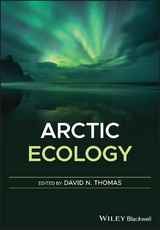
The Arctic is often portrayed as being isolated, but the reality is that the connectivity with the rest of the planet is huge, be it through weather patterns, global ocean circulation, and large-scale migration patterns to name but a few. There is a huge amount of public interest in the 'changing Arctic', especially in terms of the rapid changes taking place in ecosystems and exploitation of resources. There can be no doubt that the Arctic is at the forefront of the international environmental science agenda, both from a scientific aspect, and also from a policy/environmental management perspective.
This book aims to stimulate a wide audience to think about the Arctic by highlighting the remarkable breadth of what it means to study its ecology. Arctic Ecology seeks to systematically introduce the diverse array of ecologies within the Arctic region. As the Arctic rapidly changes, understanding the fundamental ecology underpinning the Arctic is paramount to understanding the consequences of what such change will inevitably bring about.
Arctic Ecology is designed to provide graduate students of environmental science, ecology and climate change with a source where Arctic ecology is addressed specifically, with issues due to climate change clearly discussed. It will also be of use to policy-makers, researchers and international agencies who are focusing on ecological issues and effects of global climate change in the Arctic.
About the Editor
David N. Thomas is Professor of Arctic Ecosystem Research in the Faculty of Biological and Environmental Sciences, University of Helsinki. Previously he spent 24 years in the School of Ocean Sciences, Bangor University, Wales. He studies marine systems, with a particular emphasis on sea ice and land-coast interactions in the Arctic and Southern Oceans as well as the Baltic Sea. He also edited a related book: Sea Ice, 3rd Edition (2017), which is also published by Wiley-Blackwell.
About the Editor
DAVID N. THOMAS is Professor of Arctic Ecosystem Research in the Faculty of Biological and Environmental Sciences, University of Helsinki. Previously he spent 24 years in the School of Ocean Sciences, Bangor University, Wales, where he is now an Honorary Professor. He studies marine systems, with a particular emphasis on sea ice and land-coast interactions in the Arctic and Southern Oceans as well as the Baltic Sea. He also edited a related book: Sea Ice, 3rd Edition (2017), which is also published by Wiley-Blackwell.
The Arctic is often portrayed as being isolated, but the reality is that the connectivity with the rest of the planet is huge, be it through weather patterns, global ocean circulation, and large-scale migration patterns to name but a few. There is a huge amount of public interest in the changing Arctic , especially in terms of the rapid changes taking place in ecosystems and exploitation of resources. There can be no doubt that the Arctic is at the forefront of the international environmental science agenda, both from a scientific aspect, and also from a policy/environmental management perspective. This book aims to stimulate a wide audience to think about the Arctic by highlighting the remarkable breadth of what it means to study its ecology. Arctic Ecology seeks to systematically introduce the diverse array of ecologies within the Arctic region. As the Arctic rapidly changes, understanding the fundamental ecology underpinning the Arctic is paramount to understanding the consequences of what such change will inevitably bring about. Arctic Ecology is designed to provide graduate students of environmental science, ecology and climate change with a source where Arctic ecology is addressed specifically, with issues due to climate change clearly discussed. It will also be of use to policy-makers, researchers and international agencies who are focusing on ecological issues and effects of global climate change in the Arctic. About the Editor David N. Thomas is Professor of Arctic Ecosystem Research in the Faculty of Biological and Environmental Sciences, University of Helsinki. Previously he spent 24 years in the School of Ocean Sciences, Bangor University, Wales. He studies marine systems, with a particular emphasis on sea ice and land-coast interactions in the Arctic and Southern Oceans as well as the Baltic Sea. He also edited a related book: Sea Ice, 3rd Edition (2017), which is also published by Wiley-Blackwell.
About the Editor DAVID N. THOMAS is Professor of Arctic Ecosystem Research in the Faculty of Biological and Environmental Sciences, University of Helsinki. Previously he spent 24 years in the School of Ocean Sciences, Bangor University, Wales, where he is now an Honorary Professor. He studies marine systems, with a particular emphasis on sea ice and land-coast interactions in the Arctic and Southern Oceans as well as the Baltic Sea. He also edited a related book: Sea Ice, 3rd Edition (2017), which is also published by Wiley-Blackwell.
Cover 1
Title Page 5
Copyright Page 6
Contents 7
Preface 15
List of Contributors 17
Chapter 1 What Is the Arctic? 21
1.1 Setting the Scene 21
1.2 In Which Ways Is the Arctic Different? 22
1.3 How Was the Arctic Discovered? 23
1.4 How Large Is the Arctic? 24
1.5 What Is in the Arctic? 24
1.5.1 Arctic Haze and Ice Fog 24
1.5.2 Aurora Borealis 25
1.6 Climate and Weather 25
1.7 Ice and Snow 26
1.8 Permafrost, Polygons, Pingos, and Palsas 26
1.9 Animals, Plants, and Fungi 27
1.10 Arctic Ecosystems 29
1.10.1 Terrestrial Ecosystems 30
1.10.2 Freshwater Ecosystems 32
1.10.3 Marine Ecosystems 34
1.10.4 Humans 35
1.11 Which Natural Resources and Ecosystem Services does the Arctic Offer? 37
1.12 Biotic Changes in the Arctic 39
References 42
Chapter 2 Arctic Ecology – A Paleoenvironmental Perspective 43
2.1 Introduction 43
2.2 The Distant Past 45
2.2.1 Bones, DNA, and Megafauna 46
2.2.2 Beringian Biota 47
2.2.3 Ancient DNA 49
2.3 Rings and Things: Examining Paleoenvironmental and Paleoclimatic Change Using Dendrochronology 50
2.3.1 Dendrochronology in Action: Examples from the Field 52
2.4 Lake Sediments: Continuous Archives of Environmental Change 53
2.5 Paleolimnology and Arctic Climate Change 57
2.5.1 Subfossil Pollen, Stomata, and Macrofossils for Tracking Vegetation Change 58
2.5.2 Charcoal and Past Wildfires 59
2.5.3 Using Past Assemblage Changes in Lake Biota to Reconstruct Past Climatic Trends 59
2.5.4 Using Paleolimnology to Study the Source and Fate of Contaminants 63
2.5.5 Linking Paleolimnology and Archeology: Tracking the Limnological Effects of Early Peoples in the Arctic 68
2.6 Concluding Remarks 69
References 70
Chapter 3 Climate Change in the Arctic 77
3.1 Introduction to Arctic Climates – Datasets Available for Analyzing Climate Change 77
3.2 Atmospheric Aspects of Arctic Climate Change: Arctic Amplification and Global Warming, Changes in Air Temperature and Precipitation, and Changes in Atmospheric Circulation 79
3.3 Oceanic Aspects of Arctic Climate Change, Including Surface and Deep Ocean Circulation Changes 81
3.4 Climate Change Impacts on Arctic Sea Ice and Greenland Ice Sheet – The Unprecedented Recent Decline in Late Summer Sea-Ice Cover and Record Greenland Ice Sheet Surface Melt and Mass Loss 85
3.5 Feedbacks in the Arctic Climate System and Global Impacts – the Ice/Albedo Feedback and Ice Insulation Feedbacks – the “Warm Arctic, Cold Continents” Hypothesis 91
3.6 Concluding Remarks 93
References 95
Chapter 4 Arctic Permafrost and Ecosystem Functioning 101
4.1 Permafrost and Ecosystems in the Arctic 101
4.2 Permafrost Shapes the Landscape 103
4.2.1 Permafrost Specific Landforms and Their Importance for Ecosystems 103
4.2.2 Permafrost Specific Landforms and Effects of a Changing Climate 106
4.3 The Biology of Permafrost 107
4.3.1 Microbes 107
4.3.2 Vegetation 108
4.4 Ecosystem Function – Carbon Cycling in Permafrost Environments 111
4.4.1 General Carbon Cycling 111
4.4.2 Methane Emissions 112
4.5 Concluding Remarks 114
References 115
Chapter 5 Arctic Tundra 123
5.1 Distribution and Description of Arctic Tundra 123
5.2 Tundra Organisms: A Typical Food Web 125
5.3 Flora and Fauna: Diversity and Communities 126
5.4 Primary Production and Organic Matter Stocks in the Low and High Arctic 130
5.5 Primary Production and Organic Matter Stocks 132
5.6 Adaptations to the Arctic Tundra 132
5.6.1 Plant Adaptations 133
5.6.2 Microbial Activity and Soil Carbon and Nitrogen 135
5.6.3 Invertebrates: Diversity, Freeze-Tolerance, and Freeze-Avoidance 136
5.6.4 Vertebrates of the Tundra: Wintertime Survival Strategies 137
5.7 Reproductive Strategies 138
5.8 Populations and Communities of the Tundra 140
5.8.1 Diversity and Interactions: The Case of Beringia 140
5.8.2 Development of Arctic Tundra Food Webs: Complexity, Insects 141
5.8.3 Belowground Arctic Food Web: Bacteria, Mycorrhizal Fungi, Nitrogen, and Carbon Cycling 143
5.9 Tundra Ecosystem Analysis 144
5.9.1 Why Nutrient Limitation? 144
5.9.2 Nitrogen Budget: Pools of Nitrogen, Rates of Transport, and Transformations 145
5.9.3 Carbon Budget: Pools, Gross Photosynthesis and Respiration, Accumulation and Feedbacks 146
5.9.4 Insights from Manipulation Experiments: Control of Net Primary Production and Herbivory by Nutrients, Light, and Heat 147
5.10 Expected Future Changes and Responses in Arctic Tundra 148
5.10.1 Effects of Increased Shrubs 149
5.10.2 Pest Outbreaks, Changes in Phenology and Species Interactions 149
References 150
Chapter 6 Ecology of Arctic Glaciers 153
6.1 Introduction 153
6.2 The Biodiversity and Food Webs of Glacial Habitats 156
6.2.1 Ice Shelves 156
6.2.2 Supraglacial or Cryolakes 158
6.2.3 Cryoconite Material, Cryoconite Holes, and Wet Ice Surfaces 159
6.2.4 Snow on the Surface of Ice 161
6.2.5 Life Within Ice 161
6.2.6 Life in Subglacial Environments 163
6.3 Quantification of Microbial Processes in Glaciers and Export of Material to Adjacent Ecosystems 164
6.3.1 Supraglacial Habitats: Ice Shelf Lakes, Ponds, Cryoconites 164
6.3.2 Subglacial Habitats 169
6.4 Anthropogenic Impacts 171
References 172
Chapter 7 Ecology of Arctic Lakes and Ponds 179
7.1 Introduction 179
7.2 Physical and Chemical Characteristics of Arctic Lakes and Ponds 180
7.3 Biological Communities and Production 182
7.3.1 Phytoplankton and Phytobenthos 182
7.3.2 Macrophytes 184
7.3.3 Microbial Loop 185
7.3.4 Zooplankton and Zoobenthos 185
7.3.5 Fish 188
7.3.6 Food Webs 189
7.4 Global Climate Change and Arctic Lakes 191
References 194
Chapter 8 Ecology of Arctic Streams and Rivers 201
8.1 Introduction 201
8.1.1 What Is an Arctic River? 201
8.2 A Primer on Stream Ecology: General and Arctic Perspectives 203
8.2.1 The Longitudinal Dimension 204
8.2.2 The Vertical Dimension 222
8.2.3 The Lateral Dimension 227
8.3 Concluding Remarks 229
References 231
Chapter 9 Ecology of Arctic Pelagic Communities 239
9.1 Introduction 239
9.2 The Arctic Marine Highways: The Transpolar Drift and the Interconnected Current Systems 240
9.3 Members and Key Players of Arctic Pelagic Communities 244
9.3.1 At the Base – Primary Producers and Microbial Communities 244
9.3.2 In the Middle – Resident Consumers and Life Strategies of Arctic Zooplankton 249
9.3.3 At the Top – Pelagic Predators 259
9.4 A Lipid-Driven Food Chain 261
9.5 Effects of Climate Change 262
9.5.1 Timing 263
9.5.2 Changes in Species Distribution 263
References 266
Chapter 10 Ecology of Arctic Sea Ice 281
10.1 Introduction to Sea Ice 281
10.2 Types of Habitats 282
10.3 Food Webs and Carbon Flow 284
10.4 Physical Environment 288
10.5 Colonization of Sea Ice and Winter Survival 290
10.6 Adaptations to and Relationships with Environmental Conditions 292
10.6.1 Temperature and Salinity 292
10.6.2 Space and Permeability 295
10.6.3 Light 296
10.7 Climate Change and the Ice-Associated Ecosystem 298
References 299
Chapter 11 Ecology of Arctic Shallow Subtidal and Intertidal Benthos 309
11.1 Introduction 309
11.2 The Physical Environment 310
11.2.1 Temperature 310
11.2.2 Light 310
11.2.3 Waves 311
11.2.4 Ice Cover 311
11.2.5 Freshwater Discharge and Salinity 313
11.3 Biomes 314
11.3.1 Origins and Distribution of Sediments 314
11.3.2 Soft-Sediment Communities 315
11.3.3 Hard Substrate 317
11.3.4 Vegetated Substrate 320
11.4 Disturbance Regimes and Succession 322
11.4.1 Ice Scour 322
11.4.2 Strudel Scour 324
11.4.3 Natural Gas Seepage and Petroleum Extraction 325
11.4.4 Large-Mammal Feeding Pits 325
11.4.5 Recolonization of Arctic Benthos 326
11.4.6 Human Impacts 327
11.5 Trophic Interactions 328
11.5.1 Feeding Strategies in Arctic Shallow Benthos 328
11.5.2 Food Sources for Benthic Fauna 329
11.5.3 Benthos as a Food for Top Predators in the Arctic 330
11.5.4 Carbon and Nutrient Cycling 334
11.6 Reproduction in Coastal Benthos 335
11.7 Effects of Global Climate Change on Shallow Arctic Benthos 336
11.7.1 Reduced Ice Cover 337
11.7.2 Documented Effects on Natural Systems in the Intertidal Zone 338
11.7.3 Coastal Erosion 340
References 341
Chapter 12 Ecology of Arctic Shelf and Deep Ocean Benthos 345
12.1 Introduction 345
12.2 The Physical Environment 346
12.2.1 Light 347
12.2.2 Temperature 347
12.2.3 Sea Ice 348
12.2.4 Sediment Characteristics 348
12.3 Biodiversity, Community Structure, and Functioning of Shelf and Deep Sea Benthos 350
12.3.1 Benthic Definitions 350
12.3.2 Brief Overview of Major Taxa in Benthic Communities 351
12.3.3 Biodiversity 355
12.3.4 Functional Diversity 357
12.3.5 Arctic Commercial Benthic Species 358
12.4 Productivity and Food Webs of Shelf and Deep Sea Benthos 359
12.4.1 Primary Production and Food Sources 359
12.4.2 Pelagic–Benthic Coupling 361
12.4.3 Benthic Community Structure and Food Webs 363
12.4.4 Benthic Communities as a Food Source for Benthic-Feeding Upper Trophic Levels 366
12.5 Impact of Global Climate Change on Shelf and Deep Sea Benthic Communities 368
References 369
Chapter 13 Fat, Furry, Flexible, and Functionally Important: Characteristics of Mammals Living in the Arctic 377
13.1 Introduction 377
13.2 The Mammal Assemblage in the Arctic Today 378
13.2.1 Terrestrial Mammals 378
13.2.2 Herbivores 378
13.2.3 Predators 379
13.2.4 Marine Mammals 380
13.3 Arctic Mammals and Adaptations to Life in the Arctic 386
13.3.1 Fur, Fat and Extremities 387
13.3.2 Behavioral Adaptations to Life in the Arctic 388
13.4 The Role of Mammals in Arctic Ecosystems 389
13.4.1 Removal of Plant Material by Terrestrial Herbivores 391
13.4.2 Transport of Nutrients and Seeds by Arctic Mammals 392
13.4.3 Mammal Predator–Prey Dynamics 394
13.5 The Future for Arctic Mammals in a Changing Climate 394
13.6 Concluding Remarks 397
References 397
Chapter 14 Ecology of Arctic Birds 405
14.1 Introduction: The Bird Species and Their Feeding Ecology 405
14.2 Traveling to Breed 406
14.3 Long Distance Migrations 408
14.4 Reproduction 409
14.5 Survival 414
14.6 Population Change 416
14.7 Climate Change 417
14.8 Endangered Species 419
14.9 Concluding Remarks 422
References 423
Chapter 15 Arctic Ecology, Indigenous Peoples and Environmental Governance 429
15.1 Introduction 429
15.2 The Impacts of Social and Environmental Change 430
15.3 Traditional Ecological Knowledge and Wildlife Management 433
15.4 Arctic Ecology and Community-Based Monitoring 435
15.5 Indigenous Peoples and Environmental Policy: The Case of the Inuit Circumpolar Council 438
15.6 Concluding Remarks 439
References 440
Index 443
EULA 464
| Erscheint lt. Verlag | 31.12.2020 |
|---|---|
| Sprache | englisch |
| Themenwelt | Naturwissenschaften ► Biologie ► Ökologie / Naturschutz |
| Schlagworte | Arktis • Arktis /Natur, Ökologie • Biowissenschaften • Conservation Science • Ecology & Organismal Biology • Life Sciences • Marine Ecology • Naturschutzbiologie • Ökologie • Ökologie / Salzwasser • Ökologie u. Biologie der Organismen |
| ISBN-10 | 1-118-84657-5 / 1118846575 |
| ISBN-13 | 978-1-118-84657-5 / 9781118846575 |
| Informationen gemäß Produktsicherheitsverordnung (GPSR) | |
| Haben Sie eine Frage zum Produkt? |
 PDF (Adobe DRM)
Kopierschutz: Adobe-DRM
Adobe-DRM ist ein Kopierschutz, der das eBook vor Mißbrauch schützen soll. Dabei wird das eBook bereits beim Download auf Ihre persönliche Adobe-ID autorisiert. Lesen können Sie das eBook dann nur auf den Geräten, welche ebenfalls auf Ihre Adobe-ID registriert sind.
Details zum Adobe-DRM
Dateiformat: PDF (Portable Document Format)
Mit einem festen Seitenlayout eignet sich die PDF besonders für Fachbücher mit Spalten, Tabellen und Abbildungen. Eine PDF kann auf fast allen Geräten angezeigt werden, ist aber für kleine Displays (Smartphone, eReader) nur eingeschränkt geeignet.
Systemvoraussetzungen:
PC/Mac: Mit einem PC oder Mac können Sie dieses eBook lesen. Sie benötigen eine
eReader: Dieses eBook kann mit (fast) allen eBook-Readern gelesen werden. Mit dem amazon-Kindle ist es aber nicht kompatibel.
Smartphone/Tablet: Egal ob Apple oder Android, dieses eBook können Sie lesen. Sie benötigen eine
Geräteliste und zusätzliche Hinweise
Buying eBooks from abroad
For tax law reasons we can sell eBooks just within Germany and Switzerland. Regrettably we cannot fulfill eBook-orders from other countries.
aus dem Bereich