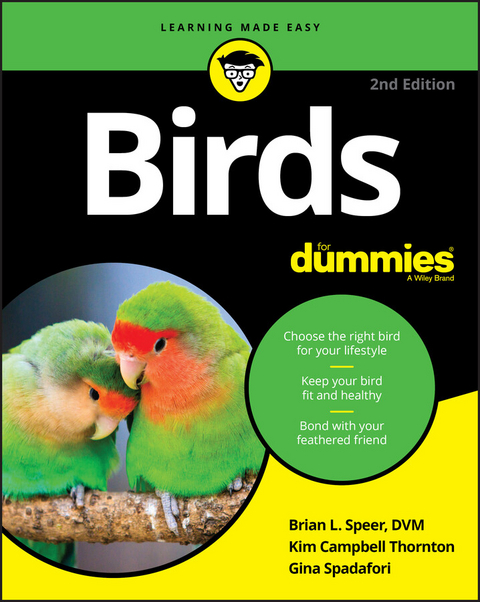
Birds For Dummies (eBook)
John Wiley & Sons (Verlag)
978-1-119-64325-8 (ISBN)
Your one-stop guide to caring for your avian companion
Pet birds are intelligent, affectionate, and rewarding companions. No matter what bird you choose, you need to set up a happy home for him with the right stuff. You also need to keep your bird healthy by performing routine care and knowing what a healthy bird looks like and how he behaves.
This friendly guide describes the birds that make the best pets, explains how to select the bird that's best for you, offers tips on bonding with your feathered friend, and provides expert advice on feeding and environmental enrichment that will keep these intelligent pets engaged.
- Benefit from a full-color guide to pet birds
- Choose the right bird based on your budget and lifestyle
- Create a bird-friendly environment that minimizes noise and mess
- Bond with your winged pet
If you're ready for your love of birds to take flight, this book has everything you need.
Brian L. Speer, DVM, is the owner and director of the Medical Center for Birds in Oakley, California, and an active member in and former president of the Association of Avian Veterinarians. Kim Campbell Thornton has been writing about animals since 1985 and is a recipient of multiple awards from the Cat Writers Association, Dog Writers Association of America, and American Society of Journalists and Authors. Gina Spadafori is the award-winning author of Dogs For Dummies and Cats For Dummies.
Your one-stop guide to caring for your avian companion Pet birds are intelligent, affectionate, and rewarding companions. No matter what bird you choose, you need to set up a happy home for him with the right stuff. You also need to keep your bird healthy by performing routine care and knowing what a healthy bird looks like and how he behaves. This friendly guide describes the birds that make the best pets, explains how to select the bird that's best for you, offers tips on bonding with your feathered friend, and provides expert advice on feeding and environmental enrichment that will keep these intelligent pets engaged. Benefit from a full-color guide to pet birds Choose the right bird based on your budget and lifestyle Create a bird-friendly environment that minimizes noise and mess Bond with your winged pet If you re ready for your love of birds to take flight, this book has everything you need.
Brian L. Speer, DVM, is the owner and director of the Medical Center for Birds in Oakley, California, and an active member in and former president of the Association of Avian Veterinarians. Kim Campbell Thornton has been writing about animals since 1985 and is a recipient of multiple awards from the Cat Writers Association, Dog Writers Association of America, and American Society of Journalists and Authors. Gina Spadafori is the award-winning author of Dogs For Dummies and Cats For Dummies.
Chapter 1
Birds and Humans: It’s Only Natural!
IN THIS CHAPTER
Appreciating the history of the human–bird relationship
Considering whether owning a bird is right for you
Who among us hasn’t looked up with awe and even envy at the sight of a soaring hawk or the V formation of migratory waterfowl? Who hasn’t smiled at the clever capering of chickadees or the luminescent colors of a hovering hummingbird? And what about the sweet song of the canary or the clever mimicry of the parrot? For as long as our collective consciousness can remember, we’ve shared our environment with birds, creatures of myth and magic, soaring spirits who remind us of a dimension beyond our own. Look up, they remind us, and in so doing we gain both perspective and inspiration.
Perhaps humans have always wondered what it would be like to bring birds closer to us, out of the heavens and into our lives. And in response to the immense and primeval appeal of these flighted creatures, we’ve done exactly that, enjoying their song and their beauty in our homes. Ancient civilizations in China, Egypt, and Rome, among others, found pleasure in bird keeping, a joy that follows us to modern times as more people than ever discover the benefits of sharing their lives with avian companions. According to the latest statistics from the American Pet Products Association, approximately 5.7 million U.S. households live with a pet bird.
But have we done birds any favors by taking them under our wings? Clipped and caged, often admired more for their ornamental presence than for their companion qualities, these marvelous creatures are too often sold short. When we treat them with less respect than they deserve, we can make our birds miserable and sick, and we deny ourselves the full pleasure of their company. Even worse, through greed and ignorance, we decimate their numbers in the wild, driving some incredible species to extinction in our quest for their uniqueness and their habitat.
Fortunately, knowledge of how to properly care for pet birds — physically and emotionally — has grown in the last several decades, thanks to pioneering avian veterinarians, researchers, breeders, and bird lovers themselves who are no longer satisfied to allow birds to be second-class compared to pet dogs or cats. We’re part of an evolving society that increasingly appreciates the creatures with which we share our world.
The changing times are exciting, and by buying this book you’re claiming your interest in becoming part of the new and improved perspective on pet birds. Finding out how to care for them properly is a wonderful first step on the road to bird keeping. First steps lead to lots of new territory, and in this chapter we help you explore a promising trail of information.
As with all companion animals, doing your homework is essential to success as a bird parent. You need to know what you’re getting into and where to find the bird of your dreams. And you need to know how to care for your bird and what to do when things go wrong (and they will, sometimes!). So, don’t rush! Enjoy discovering details about birds, and you can expect to be better prepared for the time you bring home a bird of your own.
Getting to Know the History of Birds
Birds For Dummies isn’t a history book, and we aren’t historians — and we certainly don’t want to bore you! But we think some historical perspective is both important and interesting. And besides, sometimes looking back helps clear the vision of what’s ahead. So, read on! We promise: You won’t face a test at the end of this section.
BIRD TALK
Because birds have been a big part of our lives and cultures for so long, many of the words we use when we talk about our feathered fellows are ancient in origin, derived from avis, the Latin word meaning “bird.” Count in this group the words avian (having to do with birds), aviculture (the keeping of birds, especially for breeding purposes), and aviary (a place to house birds). And what about aviation, aviator, and avionics? You got it: When you see the letters avi– at the beginning of a word, you can figure a connection to birds or to one of their most notable qualities — flight!
Food, feathers, and (finally!) friendship
Our earliest ancestors didn’t have the luxury of enjoying birds as pets — they needed them for food, and they hunted birds and collected eggs to meet their most basic sustenance needs. Before long, though, humankind started to realize the benefits of domestication (changing wild creatures so that they not only provide us with food, but also serve as helpers and companions). These changes began 10,000 to 12,000 years ago and haven’t stopped since. The worldwide growth of fried-chicken fast-food chains is just a modern milestone on the road that began in the jungles of Asia, where people first discovered the tasty ancestor of domestic chickens, the red jungle fowl.
Domestic fowl were admired and worshipped for their fertility, their courage, and even their role as the earliest alarm clocks. With so much going for them, birds quickly graduated to a place of honor for their nonmeat attributes — their beauty became reason enough to keep them around.
Although many of the world’s cultures are horrified at the very idea of eating dogs and cats, the use of birds for food is nearly universally accepted (with the exception of individuals who abstain for philosophical or religious reasons). Why is it that some birds are prized as family members and others are best appreciated when served with orange sauce? We don’t know, but in Chapter 2 we show you how some of the birds we routinely consider “food” really have decent pet potential!
Humans’ enduring involvement
People keep birds today for many of the same reasons Egyptian pharaohs or ancient Romans captured them — for beauty — as well as for some reasons bird fanciers of times past probably never gave much thought to. Figuring out what attracts you to birds can give you an understanding of the trade-offs you can live with (and those you can’t). And those realizations are bound to set you up for success in choosing your avian companion.
The beauty of birds
Let’s face it: Humans are plain. Oh sure, we have some different skin tones and different hair and eye colors, but put us next to birds, and we have to admit to being pretty dull. And that’s probably one reason why humans appreciate the beauty of birds and why our history with them in close company spans hundreds of years — we just want to be able to gaze upon (or wear) their glorious feathers.
Is it any surprise that some of the more popular pet birds are also the flashiest? The beautiful macaws — the scarlet, the blue-and-gold, and the giant blue hyacinth — are breathtaking to behold, as are their glorious smaller relatives, such as the dazzling sun conure, with a beautiful complement of sun-yellow feathers. And non-parrot species are not to be left out! Just consider the beauty of some of our fancy chicken and waterfowl breeds, as well as prize pigeons. Even smaller birds are prized for their plumage. From a simple singer discovered on a far island, the canary has been bred into all kinds of fancy feathered forms.
The lust for beauty spelled extinction for more than a few species of birds, ruthlessly slaughtered for feathers to adorn ladies’ hats in the last century — as many as five million a year died for their plumage. Among the victims: one of the only two parrot species native to the United States, the Carolina parakeet. By the turn of the century, groups such as the Audubon Society were working to stop the killings. Too late for the Carolina parakeet, though: The last one died in the Cincinnati Zoo in 1918.
How beautiful do humans consider birds? So much that if you’re trying to attract attention to a product or service, a picture of a bird typically works wonders. The eye-catching potential of birds makes them popular with the folks in the advertising and marketing businesses. Fans of the sketch comedy TV series Portlandia may recall the catchphrase “Put a bird on it,” satirizing the trend toward avian motifs. Brian, who always has his eye out for birds, has noticed that about a quarter of the booths at veterinary conferences use birds in their displays, even if birds can’t use the products!
The Latin term rara avis, meaning “rare bird,” is often used to reference an unusual or unique person or object. Roman poet Juvenal is credited with it in a sentence describing “a bird as rare upon the earth as a black swan.”
Of song and speech
Birds use song and mimicry to protect their territory, warn of danger, and attract mates, and throughout history, their fascinating music has also engaged a human audience. Such birds as the canary and the singing greenfinch have long been prized for their song, and the members of the Psittaciformes order — otherwise known as parrots — are so well known for their vocal talents that they’ve inspired a figure of speech. (To parrot something means to repeat it, whether you’re a bird or a human being.) Even finches such as the ones shown in Figure 1-1 keep up a companionable...
| Erscheint lt. Verlag | 2.12.2020 |
|---|---|
| Sprache | englisch |
| Themenwelt | Sachbuch/Ratgeber ► Natur / Technik ► Natur / Ökologie |
| Sachbuch/Ratgeber ► Natur / Technik ► Tiere / Tierhaltung | |
| Naturwissenschaften | |
| Schlagworte | Avian • Birds • Bird Species • companion birds • Haustierhaltung / Vögel • how to care for a bird • how to set up a home for a bird • keep your bird healthy • lifestyle • lifestyles • perform routine care on a bird • Pet birds • Pet Care / Birds • Vögel /Ratgeber • what does a healthy bird look like |
| ISBN-10 | 1-119-64325-2 / 1119643252 |
| ISBN-13 | 978-1-119-64325-8 / 9781119643258 |
| Informationen gemäß Produktsicherheitsverordnung (GPSR) | |
| Haben Sie eine Frage zum Produkt? |
 EPUB (Adobe DRM)
Kopierschutz: Adobe-DRM
Adobe-DRM ist ein Kopierschutz, der das eBook vor Mißbrauch schützen soll. Dabei wird das eBook bereits beim Download auf Ihre persönliche Adobe-ID autorisiert. Lesen können Sie das eBook dann nur auf den Geräten, welche ebenfalls auf Ihre Adobe-ID registriert sind.
Details zum Adobe-DRM
Dateiformat: EPUB (Electronic Publication)
EPUB ist ein offener Standard für eBooks und eignet sich besonders zur Darstellung von Belletristik und Sachbüchern. Der Fließtext wird dynamisch an die Display- und Schriftgröße angepasst. Auch für mobile Lesegeräte ist EPUB daher gut geeignet.
Systemvoraussetzungen:
PC/Mac: Mit einem PC oder Mac können Sie dieses eBook lesen. Sie benötigen eine
eReader: Dieses eBook kann mit (fast) allen eBook-Readern gelesen werden. Mit dem amazon-Kindle ist es aber nicht kompatibel.
Smartphone/Tablet: Egal ob Apple oder Android, dieses eBook können Sie lesen. Sie benötigen eine
Geräteliste und zusätzliche Hinweise
Buying eBooks from abroad
For tax law reasons we can sell eBooks just within Germany and Switzerland. Regrettably we cannot fulfill eBook-orders from other countries.
aus dem Bereich