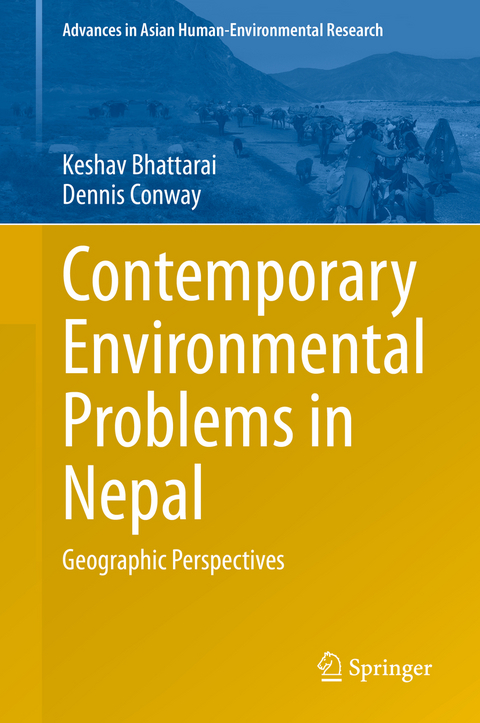
Contemporary Environmental Problems in Nepal (eBook)
XXXI, 764 Seiten
Springer International Publishing (Verlag)
9783030501686 (ISBN)
This monograph examines contemporary environmental challenges facing Nepal, this landlocked country's representativeness in the wider South Asian context is both distinct and generalizable. In large part, this is because of its extremes of physiographical structure- plains, hill ranges, mountainous massifs - and wide range of altitudinal terrains, which represent and replicate South Asian and East Asian continental conditions differing as markedly as humid tropical lowlands, sub-tropical hill ranges and temperate to sub-arctic mountainous environments. Associated forest regimes, in which deforestation and reforestation patterns have evolved in recent times, and differing densities of settlement and cleared agricultural landscapes in each of these altitudinal zones, add to the environmental diversity of Nepal. Associated fauna and exotic species are in various states of endangerment especially Bengal tigers, one horned rhinos, wild elephants, crocodile, musk deer, and peasants, to name a few- so that their forested and mountainous habitats as 'Wild Life Reserves' also deserve our attention, and are featured in this monograph's remit.
Keshav Bhattarai is Professor of Geography at the University of Central Missouri. His research interests are urban planning, demographic studies, migration, land use dynamics, tourism, terrorism, cultural geography, transportation geography, and refugee issues. He has written articles on land use and cover dynamics, tourism and terrorism, demography, urban growth, refugees, forest management, crime mapping, and transportation modeling, and book chapters on cultures, demography, and urban growth. Most of his research concentration is in Nepal. He has co-authored Historical Dictionary of Nepal with Nanda Shrestha. He has also written two books on Nepal's forest management. He did his Ph. D. under the supervision of Prof. Dennis Conway. He has received research grants from the Ford Foundation, Indian Space Grant, and University Research Council of the University of Central Missouri. He teaches Economic Geography, Geography of Asia, Geography of the Middle East, Research Methods, Conservation Geography, Political Geography, Environmental Geography, Urban Geography, Cartography, Geographic Information Systems (GIS), remote sensing, Global Positioning System courses along with the regional courses of Europe and Asia.
Dennis Conway is Professor emeritus of Geography at Indiana University, Bloomington, USA. His research interests span development geography, urban geography, population geography, transnational migration, globalization's influences on temporary, irregular and legal mobility patterns and processes and contemporary Caribbean tourism and development. He has written over 140 articles and book chapters with their regional focus being two dramatically different geographical contexts- contemporary Nepal and the Commonwealth Caribbean. In Nepal, his research has examined migration and development issues, human-environment relationships, deforestation and forest settlement dynamics. In the Caribbean, his interests were broader: Caribbean urbanization, internal and transnational migration, economic development, alternative 'Caribbean tourisms' and the geographical and environmental consequences of these processes of social change and transformation. He is co-author of nine edited books. Some of his books include The Contemporary Caribbean (with Robert B. Potter, David Barker and Thomas Klak 2004); The Experience of Return Migration: Caribbean Perspectives (with Robert B. Potter and Joan Phillips 2005); Globalization's Contradictions: Geographies of Discipline, Destruction and Transformation (with Nik Heynen 2006) and Return Migration of the Next Generations: 21st Century Transnational Mobility (with Robert B. Potter 2009). He is currently a member of the Editorial Boards of Progress in Development Studies and the Open Geography Journal. His research has been funded by the Ford/Rockefeller Foundation, the National Science Foundation, UNECLAC, Population Office, USAID/MUCIA, and the National Geographic Society's Committee for Research and Exploration. As policy input, he has acted as a consultant to UNECLAC, Port of Spain, Trinidad, specifically preparing a Caribbean Population Background Paper (with George Stolnitz) and as Co-Director of an EPAT/MUCIA Project for USAID on 'Institutional Mechanisms for Coastal Resources Protection in Small Caribbean Countries' (with Emilio F. Moran).
| Erscheint lt. Verlag | 23.11.2020 |
|---|---|
| Reihe/Serie | Advances in Asian Human-Environmental Research | Advances in Asian Human-Environmental Research |
| Zusatzinfo | XXXI, 764 p. 211 illus., 169 illus. in color. |
| Sprache | englisch |
| Themenwelt | Naturwissenschaften ► Geowissenschaften ► Geografie / Kartografie |
| Naturwissenschaften ► Physik / Astronomie | |
| Sozialwissenschaften ► Politik / Verwaltung | |
| Schlagworte | Demography • Environmental Geography • geographical information systems (GIS) • Geospatial Analytical Technology (GAT) • Human geography • Mathematical Sociology |
| ISBN-13 | 9783030501686 / 9783030501686 |
| Informationen gemäß Produktsicherheitsverordnung (GPSR) | |
| Haben Sie eine Frage zum Produkt? |
 PDF (Wasserzeichen)
DRM: Digitales Wasserzeichen
Dieses eBook enthält ein digitales Wasserzeichen und ist damit für Sie personalisiert. Bei einer missbräuchlichen Weitergabe des eBooks an Dritte ist eine Rückverfolgung an die Quelle möglich.
Dateiformat: PDF (Portable Document Format)
Mit einem festen Seitenlayout eignet sich die PDF besonders für Fachbücher mit Spalten, Tabellen und Abbildungen. Eine PDF kann auf fast allen Geräten angezeigt werden, ist aber für kleine Displays (Smartphone, eReader) nur eingeschränkt geeignet.
Systemvoraussetzungen:
PC/Mac: Mit einem PC oder Mac können Sie dieses eBook lesen. Sie benötigen dafür einen PDF-Viewer - z.B. den Adobe Reader oder Adobe Digital Editions.
eReader: Dieses eBook kann mit (fast) allen eBook-Readern gelesen werden. Mit dem amazon-Kindle ist es aber nicht kompatibel.
Smartphone/Tablet: Egal ob Apple oder Android, dieses eBook können Sie lesen. Sie benötigen dafür einen PDF-Viewer - z.B. die kostenlose Adobe Digital Editions-App.
Buying eBooks from abroad
For tax law reasons we can sell eBooks just within Germany and Switzerland. Regrettably we cannot fulfill eBook-orders from other countries.
aus dem Bereich