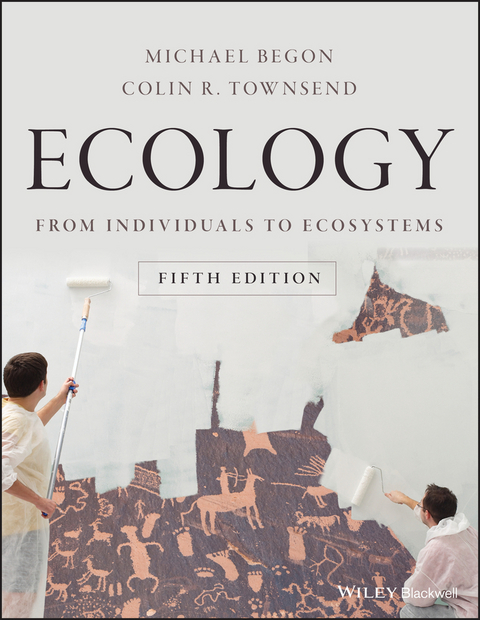
Ecology (eBook)

861 Seiten
Wiley (Verlag)
978-1-119-27937-2 (ISBN)
A definitive guide to the depth and breadth of the ecological sciences, revised and updated
The revised and updated fifth edition of Ecology: From Individuals to Ecosystems - now in full colour - offers students and practitioners a review of the ecological sciences.
The previous editions of this book earned the authors the prestigious 'Exceptional Life-time Achievement Award' of the British Ecological Society - the aim for the fifth edition is not only to maintain standards but indeed to enhance its coverage of Ecology.
In the first edition, 34 years ago, it seemed acceptable for ecologists to hold a comfortable, objective, not to say aloof position, from which the ecological communities around us were simply material for which we sought a scientific understanding. Now, we must accept the immediacy of the many environmental problems that threaten us and the responsibility of ecologists to play their full part in addressing these problems. This fifth edition addresses this challenge, with several chapters devoted entirely to applied topics, and examples of how ecological principles have been applied to problems facing us highlighted throughout the remaining nineteen chapters.
Nonetheless, the authors remain wedded to the belief that environmental action can only ever be as sound as the ecological principles on which it is based. Hence, while trying harder than ever to help improve preparedness for addressing the environmental problems of the years ahead, the book remains, in its essence, an exposition of the science of ecology. This new edition incorporates the results from more than a thousand recent studies into a fully up-to-date text.
Written for students of ecology, researchers and practitioners, the fifth edition of Ecology: From Individuals to Ecosystems is anessential reference to all aspects of ecology and addresses environmental problems of the future.
MICHAEL BEGON, PHD, is Professor of Ecology in the Department of Evolution, Ecology and Behaviour at the University of Liverpool. He specialises in the ecology of infectious diseases in wildlife populations, focusing on diseases transmissible to humans.
COLIN R. TOWNSEND, is Professor Emeritus and Founding Director of the Ecology, Conservation and Biodiversity Research Group of Otago University. His research concerns the ecology of invasions and multiple stressors in stream ecosystems.
MICHAEL BEGON, PHD, is Professor of Ecology in the Department of Evolution, Ecology and Behaviour at the University of Liverpool. He specialises in the ecology of infectious diseases in wildlife populations, focusing on diseases transmissible to humans. COLIN R. TOWNSEND, is Professor Emeritus and Founding Director of the Ecology, Conservation and Biodiversity Research Group of Otago University. His research concerns the ecology of invasions and multiple stressors in stream ecosystems.
Cover 1
Title Page 5
Copyright Page 6
Contents 9
Preface 11
About the Companion Website 13
Introduction: Ecology and its Domain 14
Chapter 1 Organisms in their Environments: the Evolutionary Backdrop 17
1.1 Introduction: natural selection and adaptation 17
1.2 Specialisation within species 18
1.2.1 Geographic variation within species: ecotypes 19
1.2.2 Genetic polymorphism 21
1.3 Speciation 24
1.3.1 What do we mean by a `species´? 24
1.3.2 Allopatric speciation 24
1.3.3 Sympatric speciation 28
1.4 The role of historical factors in the determination of species distributions 32
1.4.1 Movements of landmasses 32
1.4.2 Island history 34
1.4.3 Climatic history 35
1.5 The match between communities and their environments 40
1.5.1 Terrestrial biomes of the earth 40
1.5.2 The `life form spectra´ of communities 43
1.6 The diversity of matches within communities 46
Chapter 2 Conditions 48
2.1 Introduction 48
2.2 Ecological niches 49
2.3 Responses of individuals to temperature 55
2.3.1 What do we mean by `extreme´? 55
2.3.2 Metabolism, growth, development and size 55
2.3.3 Ectotherms and endotherms 57
2.3.4 Life at low temperatures 60
2.3.5 The genetics of cold tolerance 61
2.3.6 Life at high temperatures 62
2.3.7 Temperature as a stimulus 64
2.4 Correlations between temperature and the distribution of plants and animals 65
2.4.1 Spatial and temporal variations in temperature 65
2.4.2 Typical temperatures and distributions 65
2.4.3 Distributions and extreme conditions 67
2.4.4 Distributions and the interaction of temperature with other factors 70
2.5 pH of soil and water 70
2.6 Salinity 72
2.6.1 Conditions at the boundary between the sea and land 73
2.7 Hazards, disasters and catastrophes: the ecology of extreme events 74
2.8 Environmental pollution 75
2.9 Global change 77
2.9.1 Industrial gases and the greenhouse effect 77
2.9.2 Global warming 79
Chapter 3 Resources 81
3.1 Introduction 81
3.2 Radiation 82
3.2.1 Variations in the intensity and quality of radiation 83
3.2.2 Net photosynthesis 85
3.2.3 Sun and shade plants of an evergreen shrub 89
3.3 Water 90
3.3.1 Photosynthesis or water conservation? Strategic and tactical solutions 90
3.3.2 Roots as water foragers 91
3.4 Carbon dioxide 93
3.4.1 C3, C4 and CAM 95
3.4.2 The response of plants to changing atmospheric concentrations of CO2 99
3.5 Mineral nutrients 103
3.6 Oxygen – and its alternatives 106
3.7 Organisms as food resources 107
3.7.1 The nutritional contents of plants and animals and their extraction 109
3.8 A classification of resources, and the ecological niche 111
3.8.1 Categories of resources 112
3.8.2 Resource dimensions of the ecological niche 113
3.9 A metabolic theory of ecology 113
Chapter 4 Matters of Life and Death 118
4.1 An ecological fact of life 118
4.2 Individuals 118
4.2.1 Unitary and modular organisms 118
4.2.2 Growth forms of modular organisms 120
4.2.3 Senescence – or the lack of it – in modular organisms 120
4.2.4 Integration 122
4.3 Counting individuals 122
4.4 Life cycles 124
4.5 Dormancy 127
4.5.1 Dormancy in animals: diapause 127
4.5.2 Dormancy in plants 128
4.6 Monitoring birth and death: life tables, survivorships curves and fecundity schedules 130
4.6.1 Cohort life tables 130
4.6.2 Survivorship curves 133
4.6.3 Static life tables 134
4.6.4 The importance of modularity 137
4.7 Reproductive rates, generation lengths and rates of increase 137
4.7.1 Relationships between the variables 137
4.7.2 Estimating the variables from life tables and fecundity schedules 138
4.8 Population projection models 139
4.8.1 Population projection matrices 139
4.8.2 Life table response experiments 143
4.8.3 Sensitivity and elasticity analysis 143
Chapter 5 Intraspecific Competition 148
5.1 Introduction 148
5.1.1 Exploitation and interference 148
5.2 Intraspecific competition, and density-dependent mortality, fecundity and growth 149
5.2.1 Density-dependent mortality and fecundity 149
5.2.2 Intraspecific competition and density-dependent growth 151
5.2.3 Density or crowding? 152
5.3 Quantifying intraspecific competition 155
5.4 Intraspecific competition and the regulation of population size 157
5.4.1 Carrying capacities 157
5.4.2 Net recruitment curves 158
5.4.3 Sigmoidal growth curves 159
5.5 Mathematical models: introduction 164
5.6 A model with discrete breeding seasons 165
5.6.1 Basic equations 165
5.6.2 What type of competition? 166
5.6.3 Time lags 167
5.6.4 Incorporating a range of competition 167
5.6.5 Chaos 168
5.6.6 Stochastic models 169
5.7 Continuous breeding: the logistic equation 170
5.8 Individual differences: asymmetric competition 171
5.8.1 Size inequalities 171
5.8.2 The generation and dilution of size inequalities 173
5.8.3 Asymmetry enhances regulation 175
5.8.4 Territoriality 175
5.9 Self-thinning 177
5.9.1 Dynamic thinning lines 178
5.9.2 Species and population boundary lines 180
5.9.3 A single boundary line for all species? 180
5.9.4 An areal basis for self-thinning 181
5.9.5 A resource-allocation basis for thinning boundaries 182
Chapter 6 Movement and Metapopulations 185
6.1 Introduction 185
6.2 Patterns of migration 186
6.3 Modes of dispersal 191
6.3.1 Passive dispersal 191
6.3.2 An active–passive continuum 192
6.3.3 Clonal dispersal 194
6.4 Patterns of dispersion 195
6.4.1 Patchiness 196
6.4.2 Forces favouring aggregation 196
6.4.3 Forces diluting aggregations: density-dependent dispersal 197
6.5 Variation in dispersal within populations 200
6.5.1 Dispersal polymorphism 200
6.5.2 Sex- and age-related differences 201
6.6 The demographic significance of dispersal 202
6.6.1 Dispersal and the demography of single populations 202
6.6.2 Invasion dynamics 205
6.6.3 Modelling dispersal: the distribution of patches 208
6.7 The dynamics of metapopulations 211
6.7.1 Uninhabited habitable patches 211
6.7.2 The development of metapopulation theory: islands and metapopulations 213
6.7.3 When is a population a metapopulation? 214
6.7.4 Metapopulation dynamics 215
Chapter 7 Life History Ecology and Evolution 222
7.1 Introduction 222
7.2 The components of life histories 223
7.2.1 Reproductive value 224
7.3 Trade-offs 226
7.3.1 Observing trade-offs 227
7.3.2 The cost of reproduction 229
7.3.3 The number and fitness of offspring 229
7.4 Life histories and habitats 230
7.4.1 Options sets and fitness contours 230
7.4.2 High and low CR habitats: a comparative classification 232
7.4.3 Reproductive investment and its timing 234
7.5 The size and number of offspring 237
7.5.1 The number of offspring: clutch size 239
7.6 Classifying life history strategies 242
7.6.1 r- and K-selection 242
7.6.2 A fast–slow continuum 243
7.6.3 Grime´s CSR triangle 248
7.7 Phylogenetic and allometric constraints 248
7.7.1 Effects of size and allometry 251
7.7.2 Effects of phylogeny 253
Chapter 8 Interspecific Competition 256
8.1 Introduction 256
8.2 Some examples of interspecific competition 257
8.2.1 Competition among phytoplankton species for phosphorus 257
8.2.2 Competition among plant species for nitrogen 258
8.2.3 Coexistence and exclusion of competing salmonid fishes 259
8.2.4 Some general observations 259
8.2.5 Coexistence of competing diatoms 260
8.2.6 Coexistence of competing birds 260
8.2.7 Competition between unrelated species 261
8.3 Some general features of interspecific competition – and some warnings 263
8.3.1 Unravelling ecological and evolutionary aspects of competition 263
8.3.2 A further warning: coexistence without niche differentiation? 263
8.3.3 Exploitation and interference competition and allelopathy 264
8.4 The Lotka–Volterra model of interspecific competition 265
8.4.1 The Lotka–Volterra model 265
8.4.2 Lessons from the Lotka–Volterra model 268
8.5 Consumer-resource models of competition 269
8.5.1 A model for a single resource 269
8.5.2 A model for two resources 269
8.5.3 Models with complex dynamics 271
8.5.4 Consumer–resource competition in practice 273
8.5.5 Spatial and temporal separation of niches 276
8.6 Models of niche overlap 277
8.6.1 Combining niche overlap and competitive similarity – a route to `neutral´ coexistence 277
8.6.2 A model of limiting similarity 278
8.7 Heterogeneity, colonisation and pre-emptive competition 279
8.7.1 Unpredictable gaps: the poorer competitor is a better coloniser 280
8.7.2 Unpredictable gaps: the pre-emption of space 280
8.7.3 Fluctuating environments 281
8.7.4 Aggregated distributions 282
8.8 Apparent competition: enemy-free space 286
8.9 Ecological effects of interspecific competition: experimental approaches 290
8.10 Evolutionary effects of interspecific competition 294
8.10.1 Natural experiments 294
8.10.2 Experimenting with natural experiments 297
8.10.3 Selection experiments 298
Chapter 9 The Nature of Predation 300
9.1 Introduction 300
9.1.1 The types of predators 300
9.1.2 Patterns of abundance and the need for their explanation 301
9.2 Foraging: widths and compositions of diets 301
9.2.1 Food preferences 302
9.2.2 Switching 304
9.2.3 The optimal foraging approach to diet width 305
9.2.4 Foraging in the presence of predators 308
9.3 Plants´ defensive responses to herbivory 310
9.3.1 Plant defences 310
9.3.2 Apparency theory 314
9.3.3 The timing of defence: induced chemicals 315
9.3.4 Defending what´s most valuable 320
9.3.5 Defence when times are hard 320
9.4 Effects of herbivory and plants´ tolerance of those effects 323
9.4.1 Herbivory, defoliation and plant growth 323
9.4.2 Herbivory and plant survival 324
9.4.3 Herbivory and plant fecundity 327
9.4.4 Meta-analyses of herbivory 328
9.5 Animal defences 330
9.6 The effect of predation on prey populations 332
9.6.1 Intimidation: the non-consumptive effects of risk 334
Chapter 10 The Population Dynamics of Predation 336
10.1 The underlying dynamics of consumer-resource systems: a tendency towards cycles 336
10.1.1 The Lotka–Volterra model 336
10.1.2 Delayed density dependence 339
10.1.3 The Nicholson–Bailey model 340
10.1.4 Predator–prey cycles in nature: or are they? 341
10.2 Patterns of consumption: functional responses and interference 341
10.2.1 The type 1 functional response 341
10.2.2 The type 2 functional response 342
10.2.3 The type 3 functional response 343
10.2.4 Individual and population-level satiation 343
10.2.5 Food quality 346
10.2.6 The effects of conspecifics – interference and ratio-dependent predation 346
10.3 The population dynamics of interference, functional responses and intimidation: equations and isoclines 348
10.3.1 The population dynamics of interference 348
10.3.2 The population dynamics of functional responses 351
10.3.3 The population dynamics of intimidation 354
10.4 Foraging in a patchy environment 355
10.4.1 Behaviour that leads to aggregated distributions 355
10.4.2 The optimal foraging approach to patch use 357
10.4.3 Ideal free and related distributions: aggregation and interference 363
10.5 The population dynamics of heterogeneity, aggregation and spatial variation 365
10.5.1 Aggregative responses to prey density 365
10.5.2 Heterogeneity in predator–prey models 366
10.5.3 Patch and lattice models 367
10.5.4 Aggregation, heterogeneity and spatial variation in practice 367
10.6 Beyond predator–prey 371
Chapter 11 Decomposers and Detritivores 373
11.1 Introduction 373
11.2 The organisms 374
11.2.1 Decomposers: bacteria, archaea and fungi 374
11.2.2 Detritivores and specialist microbivores 377
11.2.3 The relative roles of decomposers and detritivores 381
11.2.4 Are local communities predisposed to deal effectively with local litter? 383
11.2.5 Ecological stoichiometry and the chemical composition of decomposers, detritivores and their resources 385
11.3 Detritivore–resource interactions 387
11.3.1 Consumption of plant detritus 387
11.3.2 Feeding on invertebrate faeces 388
11.3.3 Feeding on vertebrate faeces 389
11.3.4 Consumption of carrion 391
Chapter 12 Parasitism and Disease 394
12.1 Introduction: parasites, pathogens, infection and disease 394
12.2 The diversity of parasites 394
12.2.1 Microparasites 395
12.2.2 Macroparasites 396
12.3 Hosts as habitats 397
12.3.1 The distribution of parasites within host populations: aggregation 397
12.3.2 Host specificity: host ranges and zoonoses 398
12.3.3 Hosts as resources and reactors 400
12.3.4 Hosts as reactors: resistance and recovery 400
12.3.5 Hosts as reactors: the cost of resistance 402
12.3.6 Hosts as reactors: resistance, tolerance and virulence 404
12.3.7 Competition among parasites for host resources 404
12.3.8 The power of coinfection 408
12.4 Coevolution of parasites and their hosts 408
12.5 The transmission of parasites amongst hosts 412
12.5.1 Transmission dynamics 412
12.5.2 Contact rates: density- and frequency-dependent transmission 412
12.5.3 Host diversity and the spread of disease 415
12.6 The effects of parasites on the survivorship, growth and fecundity of hosts 415
12.7 The population dynamics of infection 418
12.7.1 The basic reproductive number and the transmission threshold 419
12.7.2 Directly transmitted microparasites: R0 and the critical population size 419
12.7.3 Epidemic curves 420
12.7.4 Dynamic patterns of different types of parasite 420
12.7.5 Immunisation and herd immunity 422
12.7.6 Crop pathogens: macroparasites viewed as microparasites 424
12.7.7 Parasites in metapopulations 424
12.8 Parasites and the population dynamics of hosts 426
12.8.1 Red grouse and nematodes 427
12.8.2 An integral role for parasites? 430
Chapter 13 Facilitation: Mutualism and Commensalism 432
13.1 Introduction: facilitation, mutualists and commensals 432
13.2 Commensalisms 433
13.3 Mutualistic protectors – a behavioural association 436
13.3.1 Cleaners and clients 437
13.3.2 Ant–plant mutualisms 438
13.4 Farming mutualisms 439
13.4.1 Human agriculture 439
13.4.2 Farming of insects by ants 440
13.4.3 Farming of fungi by beetles and ants 441
13.5 Dispersal of seeds and pollen 444
13.5.1 Seed dispersal mutualisms 444
13.5.2 Pollination mutualisms 445
13.5.3 Brood site pollination: figs and yuccas 445
13.6 Mutualisms involving gut inhabitants 448
13.6.1 Vertebrate guts 448
13.6.2 The vertebrate gut metagenome 449
13.6.3 Insect guts 450
13.7 Mutualism within animal cells: insect bacteriocyte symbioses 452
13.8 Photosynthetic symbionts within aquatic invertebrates 454
13.9 Mutualisms involving higher plants and fungi 456
13.9.1 Arbuscular mycorrhizas 457
13.9.2 Ectomycorrhizas 458
13.9.3 Ericoid mycorrhizas 458
13.9.4 Orchid mycorrhizas 459
13.9.5 Mycorrhizal networks 459
13.10 Fungi with algae: the lichens 460
13.11 Fixation of atmospheric nitrogen in mutualistic plants 462
13.11.1 Mutualisms of rhizobia and leguminous plants 462
13.11.2 Nitrogen-fixing mutualisms in non-leguminous plants 466
13.11.3 Nitrogen-fixing plants and succession 466
13.12 Models of mutualisms 467
Chapter 14 Abundance 469
14.1 Introduction 469
14.2 Fluctuation or stability? 470
14.2.1 Determination and regulation of abundance 470
14.2.2 Approaches to the investigation of abundance 471
14.3 The demographic approach 472
14.3.1 Key factor analysis 472
14.3.2 ?-contribution analysis 474
14.4 The mechanistic approach 475
14.4.1 Experimental perturbation of populations 475
14.5 The time series approach 476
14.6 Population cycles and their analysis 482
14.6.1 Red grouse 482
14.6.2 Snowshoe hares 483
14.6.3 Microtine rodents: lemmings and voles 486
14.7 Multiple equilibria: alternative stable states 490
Chapter 15 Pest Control, Harvesting and Conservation 493
15.1 Managing abundance 493
15.2 The management of pests 494
15.2.1 Economic injury levels and economic thresholds 494
15.2.2 Chemical pesticides and their unintended consequences 495
15.2.3 Evolution of resistance to pesticides 497
15.2.4 Biological control 499
15.2.5 Integrated pest management 501
15.3 Harvest management 503
15.3.1 Maximum sustainable yield 504
15.3.2 Harvesting strategies based on MSY 505
15.3.3 Economic and social factors 508
15.3.4 Instability of harvested populations: depensation and multiple equilibria 509
15.3.5 Instability of harvested populations: environmental fluctuations 511
15.3.6 Recognising structure in harvested populations: dynamic pool models 511
15.3.7 Rules of thumb for sustainable harvesting 513
15.3.8 Ecosystem-based fisheries management? 514
15.4 Conservation ecology 517
15.4.1 Introduction 517
15.4.2 Small populations 518
15.4.3 Causes of extinction 521
15.4.4 Minimum viable populations and population viability analysis 527
15.4.5 Conservation of metapopulations 531
15.4.6 Decision analysis 534
Chapter 16 Community Modules and the Structure of Ecological Communities 538
16.1 Introduction 538
16.2 The influence of competition on community structure 539
16.2.1 Demonstrable competition between species 540
16.2.2 The structuring power of competition 540
16.2.3 Evidence from community patterns: niche differentiation 541
16.2.4 Niche differentiation – apparent or real? Null and neutral models 544
16.2.5 Evidence from morphological patterns – community-wide character displacement 547
16.2.6 Evidence from negatively associated distributions 548
16.2.7 Intransitive competition 549
16.3 The influence of predation on community structure 550
16.4 Plurality in the structuring of communities 556
Chapter 17 Food Webs 560
17.1 Food chains 560
17.1.1 Trophic cascades 560
17.1.2 Top-down or bottom-up control of food webs? 564
17.1.3 Why is the world green? 565
17.2 Food web structure, productivity and stability 567
17.2.1 What do we mean by `stability´? 568
17.2.2 Strong interactors and keystone species 569
17.2.3 Complexity and stability in model communities 571
17.2.4 Relating theory to data: aggregate properties 573
17.2.5 Relating theory to data: community structure 575
17.2.6 Compartmentalisation 577
17.2.7 Organisation of trophic loops 577
17.2.8 Food chain length: the number of trophic levels 580
17.2.9 Parasites in food webs 583
17.3 Regime shifts 584
Chapter 18 Patterns in Community Composition in Space and Time 588
18.1 Introduction 588
18.2 Description of community composition 590
18.2.1 Diversity indices 590
18.2.2 Rank–abundance diagrams 591
18.2.3 Community size spectra 593
18.3 Community patterns in space 594
18.3.1 Gradient analysis 594
18.3.2 The ordination of communities 594
18.3.3 Problems of boundaries in community ecology 597
18.4 Community patterns in time 597
18.4.1 Primary and secondary successions 598
18.4.2 Primary succession on volcanic lava 599
18.4.3 Primary succession on coastal sand dunes 599
18.4.4 Secondary successions in abandoned fields 601
18.5 The mechanisms underlying succession 602
18.5.1 A species replacement model of succession 602
18.5.2 A trade-off between competition and colonisation 602
18.5.3 Successional niche models 603
18.5.4 Facilitation 603
18.5.5 The role of animals 603
18.5.6 The role of functional traits 604
18.5.7 The nature of the climax 604
18.6 Communities in a spatiotemporal context 608
18.6.1 Disturbance, gaps and dispersal 608
18.6.2 The frequency of gap formation 608
18.6.3 Formation and filling of gaps 610
18.7 The metacommunity concept 615
18.7.1 The patch dynamics metacommunity model 615
18.7.2 The neutral metacommunity model 616
18.7.3 The species-sorting metacommunity model 616
18.7.4 The mass-effects metacommunity model 616
18.7.5 Patterns in abundance and diversity predicted by metacommunity models 617
18.7.6 The value and shortcomings of metacommunity models 617
Chapter 19 Patterns in Biodiversity and their Conservation 619
19.1 Introduction 619
19.1.1 Estimating richness: rarefaction and extrapolation 622
19.2 A simple model of species richness 623
19.3 Spatially varying factors that influence species richness 624
19.3.1 Productivity and resource richness 624
19.3.2 Energy 629
19.3.3 Spatial heterogeneity 632
19.3.4 Environmental harshness 632
19.4 Temporally varying factors that influence species richness 634
19.4.1 Climatic variation 634
19.4.2 Environmental age: evolutionary time 634
19.5 Habitat area and remoteness: island biogeography 635
19.5.1 MacArthur and Wilson´s `equilibrium´ theory 635
19.5.2 Habitat diversity alone – or a separate effect of area? 637
19.5.3 Remoteness 640
19.5.4 Which species? Turnover 641
19.5.5 Which species? Disharmony 642
19.5.6 Which species? Evolution 643
19.6 Gradients of species richness 647
19.6.1 Latitudinal gradients 647
19.6.2 Gradients with elevation and depth 649
19.6.3 Gradients during community succession 654
19.7 Selecting areas for conservation 655
19.8 Managing for multiple objectives – beyond biodiversity conservation 658
Chapter 20 The Flux of Energy through Ecosystems 663
20.1 Introduction 663
20.1.1 The fundamentals of energy flux 664
20.2 Patterns in primary productivity 665
20.2.1 Latitudinal trends in productivity 667
20.2.2 Temporal trends in primary productivity 667
20.2.3 Autochthonous and allochthonous production 668
20.2.4 Variations in the relationship of productivity to biomass 671
20.3 Factors limiting primary productivity in terrestrial communities 672
20.3.1 Inefficient use of solar energy 672
20.3.2 Water and temperature as critical factors 673
20.3.3 Drainage and soil texture can modify water availability and thus productivity 674
20.3.4 Length of the growing season 675
20.3.5 Productivity may be low because mineral resources are deficient 675
20.3.6 Do community composition and species richness affect ecosystem productivity? 677
20.4 Factors limiting primary productivity in aquatic communities 680
20.4.1 Limitation by light and nutrients in streams 680
20.4.2 Lakes and estuaries: the importance of nutrients and of autochthonous production 681
20.4.3 Nutrients and the importance of upwelling in oceans 681
20.4.4 Productivity varies with depth in aquatic communities 683
20.5 The fate of energy in ecosystems 684
20.5.1 Patterns among trophic levels 684
20.5.2 Possible pathways of energy flow through a food web 687
20.5.3 The importance of transfer efficiencies in determining energy pathways 688
20.5.4 Energy flow: spatial and temporal variation 690
Chapter 21 The Flux of Matter through Ecosystems 694
21.1 Introduction 694
21.1.1 Relationships between energy flux and nutrient cycling 694
21.1.2 Biogeochemistry and biogeochemical cycles 695
21.1.3 Nutrient budgets 696
21.2 Nutrient budgets in terrestrial communities 698
21.2.1 Inputs to terrestrial communities 698
21.2.2 Outputs from terrestrial communities 700
21.2.3 Carbon inputs and outputs may vary with forest age 701
21.2.4 Importance of nutrient cycling in relation to inputs and outputs 704
21.3 Nutrient budgets in aquatic communities 705
21.3.1 Streams 705
21.3.2 Lakes 706
21.3.3 Estuaries 708
21.3.4 Continental shelf regions of the oceans 709
21.3.5 Open oceans 712
21.4 Global biogeochemical cycles 714
21.4.1 Hydrological cycle 715
21.4.2 Phosphorus cycle 718
21.4.3 Nitrogen cycle 720
21.4.4 Sulphur cycle 720
21.4.5 Carbon cycle 721
Chapter 22 Ecology in a Changing World 724
22.1 Introduction 724
22.2 Climate change 727
22.2.1 Ecological risks 729
22.3 Acidification 736
22.3.1 Interactions among drivers 738
22.4 Land-system change 740
22.4.1 Expansion of the anthromes 740
22.4.2 Perturbation of nitrogen and phosphorus cycles 741
22.4.3 Downstream effects of nutrient cycle perturbations 742
22.5 Pollution 746
22.5.1 Chlorofluorocarbons, ozone depletion and UVB radiation 746
22.5.2 Mercury and persistent organic pollutants 747
22.5.3 Plastic waste 747
22.6 Overexploitation 749
22.7 Invasions 752
22.7.1 Winners and losers among invaders under climate change 752
22.7.2 Climate change, land-use change and invasion risk 754
22.8 Planetary boundaries 754
22.9 Finale 758
References 759
Organism Index 814
Subject Index 828
EULA 861
| Erscheint lt. Verlag | 11.11.2020 |
|---|---|
| Sprache | englisch |
| Themenwelt | Naturwissenschaften ► Biologie ► Ökologie / Naturschutz |
| Schlagworte | Biowissenschaften • conditions of the ecosystem • Conservation Science • decomposers and detritivores • Ecology & Organismal Biology • ecology and ecosystems • Ecology and individuals • Life Sciences • managing populations • Metapopulations • Naturschutzbiologie • Ökologie • Ökologie / Populationen u. Lebensgemeinschaften • Ökologie u. Biologie der Organismen • organisms in the environment • parasitism and disease • Population & Community Ecology • population predation • resources and the ecosystem • Zoologie |
| ISBN-10 | 1-119-27937-2 / 1119279372 |
| ISBN-13 | 978-1-119-27937-2 / 9781119279372 |
| Informationen gemäß Produktsicherheitsverordnung (GPSR) | |
| Haben Sie eine Frage zum Produkt? |
 PDF (Adobe DRM)
Kopierschutz: Adobe-DRM
Adobe-DRM ist ein Kopierschutz, der das eBook vor Mißbrauch schützen soll. Dabei wird das eBook bereits beim Download auf Ihre persönliche Adobe-ID autorisiert. Lesen können Sie das eBook dann nur auf den Geräten, welche ebenfalls auf Ihre Adobe-ID registriert sind.
Details zum Adobe-DRM
Dateiformat: PDF (Portable Document Format)
Mit einem festen Seitenlayout eignet sich die PDF besonders für Fachbücher mit Spalten, Tabellen und Abbildungen. Eine PDF kann auf fast allen Geräten angezeigt werden, ist aber für kleine Displays (Smartphone, eReader) nur eingeschränkt geeignet.
Systemvoraussetzungen:
PC/Mac: Mit einem PC oder Mac können Sie dieses eBook lesen. Sie benötigen eine
eReader: Dieses eBook kann mit (fast) allen eBook-Readern gelesen werden. Mit dem amazon-Kindle ist es aber nicht kompatibel.
Smartphone/Tablet: Egal ob Apple oder Android, dieses eBook können Sie lesen. Sie benötigen eine
Geräteliste und zusätzliche Hinweise
Buying eBooks from abroad
For tax law reasons we can sell eBooks just within Germany and Switzerland. Regrettably we cannot fulfill eBook-orders from other countries.
aus dem Bereich