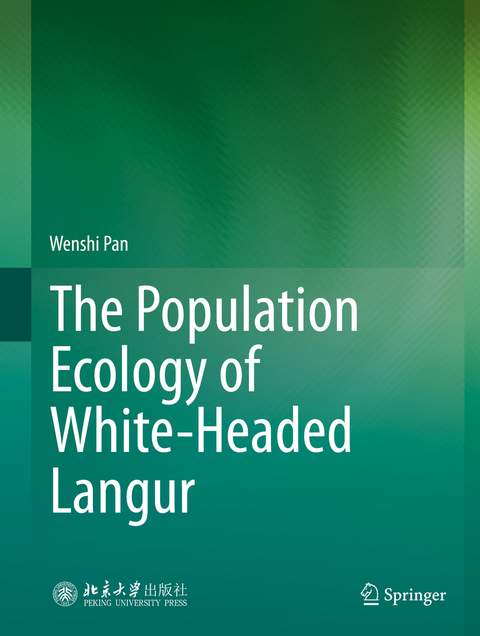
The Population Ecology of White-Headed Langur
Springer Verlag, Singapore
978-981-334-117-3 (ISBN)
From 1996 through 2016, a small research team led by Prof.Wenshi Pan from Peking University conducted studies and conservation efforts on the white-headed langur, one of the most endangered endemic species of China, in Guangxi and saved the species from extinction. With the help of conservationists’ efforts, the white-headed langur population in Nongguan Mountains, Guangxi, gradually increased from 105 to approximately 820.This book shares the success story of the unification of human development and wildlife conservation.
Wenshi Pan is an ecologist, conservation biologist, and Professor at Peking University. For the past 40 years, he has been studying 3 endangered endemic species of China, the Giant Panda, White-Headed Langur, and Chinese White Dolphin, to save them from extinction. Devoted to life history and ecology, as well as its relationship to the biotic landscape and land use policy that impacts the survival of these keystone species, Prof. Pan continues to work with small, dedicated research teams to accomplish against insurmountable odds. He still gives lectures when he is 80 years old. He hopes to pass on his sense of obligation to nature and encourage the next generation to make a difference in nature conservation. Prof. Pan authored 11 books and has 40-50 treatises published in various domestic and international journals including Nature and National Geographic. He is renowned for his academic achievements in researching the 3 near-extinct species and his Books such as “Pandas of Wolong”, “A Chance for Lasting Survival” and “Chinese White Dolphins of Qinzhou”. Emeritus Professor of the School of Life Science, Peking University, China Adjunct Researcher of the Smithsonian Institution Director of the Zoological Society of China Director of the Ecological Society of China Honorary Professor of Zhuhai Institute of Technology, China
Chapter 1. The origin of white-headed langur.- Chapter 2. From ancient Java langur to white-headed langur today.- Chapter 3. White-headed langur is an endemic species of Chongzuo.- Chapter 4. A catastrophe for the white-headed langur.- Chapter 5. White-headed langur’s habitats and natural refugees.- Chapter 6. White-Headed Langur’s Homeland in Nongguan Mountains.- Chapter 7. White-headed langur’s diets and forage behaviors.- Chapter 8. Restoration of the White-headed Langur Population in Nongguan Mountains.- Chapter 9. The behavior patterns of a white-headed langur family.- Chapter 10. The strategy of white-headed langur reproductive behaviors.- Chapter 11.The number of the white-headed langur in Nongguan Mountains.- Chapter 12. A Population Viability Analysis for the white-headed langur in Nongguan Mountains.- Chapter 13. How to conserve the white-headed langur population.
| Erscheinungsdatum | 26.03.2021 |
|---|---|
| Zusatzinfo | 101 Illustrations, color; 54 Illustrations, black and white; XI, 239 p. 155 illus., 101 illus. in color. |
| Verlagsort | Singapore |
| Sprache | englisch |
| Maße | 210 x 279 mm |
| Themenwelt | Naturwissenschaften ► Biologie ► Ökologie / Naturschutz |
| Naturwissenschaften ► Biologie ► Zoologie | |
| Schlagworte | biodiversity • Conservation Population • Human society • Population Ecology • White-headed Langur |
| ISBN-10 | 981-334-117-3 / 9813341173 |
| ISBN-13 | 978-981-334-117-3 / 9789813341173 |
| Zustand | Neuware |
| Informationen gemäß Produktsicherheitsverordnung (GPSR) | |
| Haben Sie eine Frage zum Produkt? |
aus dem Bereich