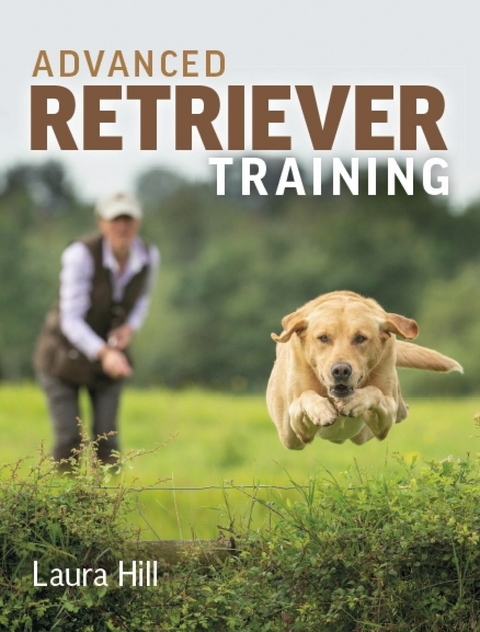
Advanced Retriever Training (eBook)
160 Seiten
Crowood (Verlag)
978-1-78500-756-9 (ISBN)
Laura Hill is founder and owner of Stauntonvale Gundogs. She has been a regular member of the England Gundog team, competing in retriever field trials and working tests. She is a field trial panel judge and has judged and trained in the UK and Europe. Laura has qualified for the IGL Retriever Championship numerous times since 2009 and, to date, has made up six Field Trial Champions (four of which are home-bred).
In Advanced Retriever Training, experienced trainer, competitor and judge, Laura Hill, takes a holistic approach to training and living with working retriever breeds. Whether your aim is to reach competition level or simply to troubleshoot your training practices, this book is the ideal follow-on to the basic commands and handling skills already established. Insightful and in-depth coverage includes reanalysing the basic pillars of breeding, feeding and training; examining your own behaviour and the effect it has on your dog and identifying your dog's psychological needs and tailoring your training accordingly. Key approaches to successful retriever work with positive, reward-based methods are covered along with training planning and management. An advanced approach to training essentials, including heelwork, marking, blind retrieves and navigating barriers are discussed as well as establishing and maintaining an enjoyable partnership with your dog. This book will improve your handling as well as your overall approach to living and working with retrievers.
INTRODUCTION
We all have dreams. But in order to make dreams come into reality, it takes an awful lot of determination, dedication, self-discipline and effort.
Jesse Owens, athlete
EARLY YEARS
My gundog journey is far from a traditional one, with no family roots or ties to a shooting background. I grew up on a pleasant suburban housing estate near Romsey in Hampshire. Both my parents worked full time, my mum as a school teacher and my dad as an electronics engineer. And whilst I always enjoyed being outside playing, roller-skating, cycling and exploring nature, due to my parents’ work commitments I was never allowed any household pets other than a pair of goldfish and some stick insects.
However, my grandparents always had a dog and a cat, and I used to relish my visits to them in rural Sussex, where grandma would take me off on long woodland walks, often foraging for mushrooms and berries, and generally teaching me about life in the country. Grandpa was an estate agent and the cattle auctioneer at Hailsham market. So I think my love of the countryside definitely had its roots with them.
I was fairly academic at school, and as I moved into the sixth form my enjoyment of language and communication began to grow. I took A levels in English Literature, English Language Studies and French, and considered university places reading either Applied Linguistics or Communications. Eventually I decided on a course at Brunel University (in west London), which included work placements giving me practical experience; in 1991 I graduated with a BSc (Hons) in Communication and Information Studies.
After graduating, I worked in central London as a trainee in Corporate PR for Guinness PLC, and after a few years moved on to a role in Consumer PR for Viners of Sheffield (also based in London). From there I decided to take a sabbatical to see a bit more of the world, and embarked on a year of independent travel, back-packing around the world, before eventually ending up in Zimbabwe in 1996. There I met my husband, Derek.
Photo: Caroline Bridges
OUT IN AFRICA
Derek was born and bred in Zimbabwe, and had always had dogs, owning his first Labrador bitch at the age of eight. She was from working lines, and later Derek went on to breed two litters of his own under the ‘Cobber Hill’ affix. I really bonded with his two old black Labradors, Sasha and her daughter Tammy. And it wasn’t long before we decided that we should have a Labrador of our own.
Phoebe was my very first dog. She was a dual-purpose Labrador, imported from South Africa as a wedding present from Derek’s brother, and with her I started to do a bit of competitive obedience, and showed her at a very amateur level. Only later did I find out about a small, keen group of people doing gundog work. So one day I drove into the bush in my open-top Sunbeam Alpine to go and see what went on at a gundog test. I watched in awe as one competitor lined up their dog and sent it away from him (on an unseen retrieve), and my jaw dropped. I thought it was incredible. I wanted to do that, but didn’t think I would ever be able to achieve that skill.
The only gundog club in Zimbabwe held occasional meetings at the local vet’s house to watch imported videos from the UK, and they would also meet every so often to train or do a test. I remember that on one such occasion I attended my first test as a competitor. It was a cold game test, and I really didn’t have much clue of what I was doing. I sent my dog on a blind retrieve into some long grass and just began calling after her ‘seek, seek, seek’, as this was the hunt command I had picked up. I was still calling nervously as the dog started to emerge from the cover, and the judge piped up behind me: ‘I think you’ll find she’s sought’! Those days were a lot of fun, but I really felt out of my depth without any formal training or structure.
BACK HOME
In 1999, with the political situation deteriorating rapidly in Zimbabwe, we left the country and returned to the UK. Initially living in rented accommodation while we found our feet, it wasn’t until 2001 that we were able to think about owning a dog again. Having had a dual-purpose Labrador in Zimbabwe, we looked to find something similar here, and ended up buying a black bitch, Slievemish Turtledove (Gaby), whose dam was a working bitch and whose sire was a show champion. She was the most beautiful looking dog, and very nicely constructed. She had plenty of working ability and a bomb-proof temperament. But she was a challenge to train, lacking the willingness to work as an equal partner.
Slievemish Turtledove (Gaby), our first Labrador in the UK, was an enthusiastic worker but proved a challenge to train. (Photo: Nick Ridley)
Gaby definitely had talent, but very much on her own terms! She was strong willed, if not belligerent, and being a novice trainer I was not equipped to deal with her many quirks and weaknesses. She definitely wasn’t the easiest dog to train. But I learned a great deal in my struggles to mould her into some sort of working competition dog. She fulfilled a function as a good picking-up dog on our local shoot, and was retired from competition on finally winning an open working test. Her eliminating faults were, however, numerous, and working with her was mostly deeply frustrating. She lived to the ripe old age of nearly seventeen, and is now buried under an apple tree in our garden. Gaby taught me a lot, not least how to have humility!
Subsequent dogs were definitely ‘easier’, but all came with different challenges, which is part of the fabric of gundog training. Even with similar breeding lines behind them, no two dogs that I have owned since have been the same to train. It is learning how to adapt to each dog’s individual learning style, and understanding their motivations and drivers, that is critical to successful training.
Early on we joined Dove Valley and East Midland gundog clubs, where we took part in group training sessions, and eventually worked our way up to trying working tests. At the time I enjoyed training the dog, and Derek and I took it in turns to handle Gaby at the training classes. But I was far too nervous to actually compete myself, so I would send Derek out with the dog to have a go at the tests, and I would stand cringing on the sidelines as she found new ways to embarrass his efforts. On more than one occasion I remember the judge asking him to call the dog back, to which he would give a pained look and say ‘I’m trying’, whilst turning puce with blowing his whistle!
Early days at local working tests gave us an introduction to competing.
My first real mentor into the sport was Dave Probert, a local ‘A’ panel judge. He ran a popular Wednesday morning training session at a local ground, and here a group of us became ‘regulars’. When the ground lease lapsed the group dissolved, which was very sad, as it had become a bit of an institution, with many a lively discussion over coffee afterwards, and a putting of the world to rights. Whilst Dave’s methods might now be considered ‘old fashioned’, they gave us all a very good grounding in how things could be perceived from a dog’s perspective. He was very ‘black and white’, and this enabled us to think about consistency and getting the basic foundation and obedience work right, in a way that made sense to the dog. I later found out that it is this early work that is critical to success.
After some years I graduated from Dave’s, and went on to develop my own style in training, with the help of another mentor, Guy Bennett. I adapted my methods largely as a response to the type of dog that I was breeding, a dog that was more sensitive and biddable in its approach to learning. I will always be grateful to both Dave and Guy, who in very different ways were instrumental in developing my understanding of gundog training.
My next dog after Gaby was a fully working-bred black Labrador bitch called Donnanview Floss (Nellie). She was still fairly ‘hard-headed’ in her approach to her work, but did go on to be my first field trial winner when she and I entered our first novice stake in 2005 and won it. But she lacked the calm temperament needed to trial consistently, and after giving her a couple of additional runs I realized that she was not going to be successful in open stakes.
The winning ‘Team GB’ at the Euro Challenge 2013, where Stauntonvale Story took top retriever.
FOUNDATION BREEDING
The seeds were sown, however, and I soon became ‘serious about gundogs’. With more knowledge under my belt, I was careful in my choice for my next Labrador, and I approached a local trainer, Jane Fairclough, who was about to breed from her very consistent field trial winning bitch, Collaroybanks Willow. I was lucky enough to be able to pick a black bitch from her first litter, Jobeshill Octavia (Pru). She was much easier to train, with a strong desire to work with me, which came as a bit of a novelty after my experiences with both Gaby and Nellie.
I was methodical in her training, and this paid off, and she went on to become my first Field Trial Champion just three years later, and double qualifying for the IGL Retriever Championship 2009. She was also later selected for the England Gundog Team in 2011 and 2013. Pru’s work ethic was phenomenal, and each season Jane used to borrow her back whenever she could to join her picking up team, when I wasn’t working her. Picking up with either Jane or myself, Pru did the work of several dogs right through to...
| Erscheint lt. Verlag | 31.10.2020 |
|---|---|
| Zusatzinfo | 114 colour photographs 8 black & white diagrams |
| Verlagsort | London |
| Sprache | englisch |
| Themenwelt | Sachbuch/Ratgeber ► Natur / Technik ► Tiere / Tierhaltung |
| Naturwissenschaften | |
| Schlagworte | attrition training • Barriers • behaviour chains • Bitch • blind retrieves • Body language • Breeding • Bunkers • Champion • choice-based training • clicker training • coaching dogs • differentiated sending • Dog • dog care • Dog Training Books • dog tricks • drills • Feeding • Field Trial • Flyball • Gundog • Handler • Heelwork • Hunting • hunting dogs • kennel • Kennel Club • Labrador • linebreeding • memory marks • mouthing • Nutrition • Obedience • outcrossing • Puppy • Reinforcement • Retriever • reward-based learning • reward-based training • Trainer • Training • Working Dogs • working tests |
| ISBN-10 | 1-78500-756-4 / 1785007564 |
| ISBN-13 | 978-1-78500-756-9 / 9781785007569 |
| Informationen gemäß Produktsicherheitsverordnung (GPSR) | |
| Haben Sie eine Frage zum Produkt? |
 EPUB (Wasserzeichen)
DRM: Digitales Wasserzeichen
Dieses eBook enthält ein digitales Wasserzeichen und ist damit für Sie personalisiert. Bei einer missbräuchlichen Weitergabe des eBooks an Dritte ist eine Rückverfolgung an die Quelle möglich.
Dateiformat: EPUB (Electronic Publication)
EPUB ist ein offener Standard für eBooks und eignet sich besonders zur Darstellung von Belletristik und Sachbüchern. Der Fließtext wird dynamisch an die Display- und Schriftgröße angepasst. Auch für mobile Lesegeräte ist EPUB daher gut geeignet.
Systemvoraussetzungen:
PC/Mac: Mit einem PC oder Mac können Sie dieses eBook lesen. Sie benötigen dafür die kostenlose Software Adobe Digital Editions.
eReader: Dieses eBook kann mit (fast) allen eBook-Readern gelesen werden. Mit dem amazon-Kindle ist es aber nicht kompatibel.
Smartphone/Tablet: Egal ob Apple oder Android, dieses eBook können Sie lesen. Sie benötigen dafür eine kostenlose App.
Geräteliste und zusätzliche Hinweise
Buying eBooks from abroad
For tax law reasons we can sell eBooks just within Germany and Switzerland. Regrettably we cannot fulfill eBook-orders from other countries.
aus dem Bereich