Managing Urbanization, Climate Change and Disasters in South Asia (eBook)
XXXVII, 469 Seiten
Springer Singapore (Verlag)
978-981-15-2410-3 (ISBN)
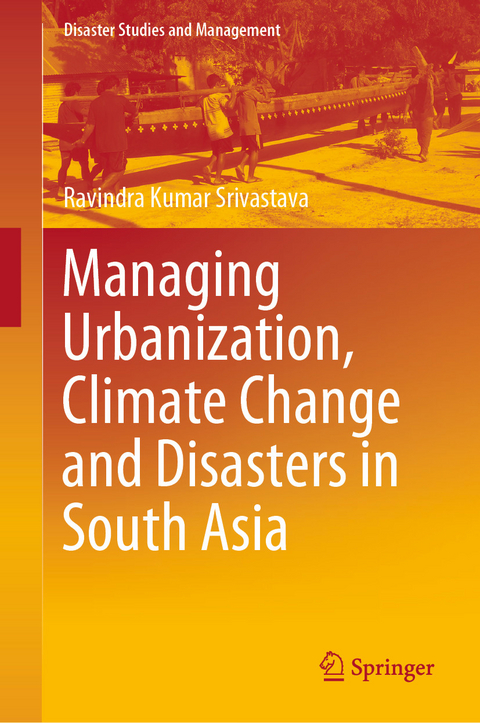
This book offers essential insights into potential catastrophic events that might befall upon the emerging urban landscape in South Asia, and which are due to hazards, risks and vulnerabilities inherent in the region's geophysical location, as well as due to climate change and unplanned urbanization. It highlights major physio-graphic, demographic, geological and geophysical indicators that are responsible for changing the pattern and trend of urbanization in South Asia - a crucial issue in view of emerging threats of climate change, and changes in the demographic profile. The book addresses the disaster management scenario in South Asia, manifestations of climate change in the region and various urban setups under climate-change-induced risks. Further, it elaborates on the challenges of urbanization-based neo-risks and vulnerabilities, which manifest in the form of slum area growth, piling and littering of waste and filth, new health risks, groundwater contamination, air pollution, highly energy-dependent lifestyles, poverty, socio-economic tensions, etc. It also critically examines the institutional mechanisms for disaster risk reduction (DRR), climate change adaptation (CCA) and urban governance, and suggests appropriate changes in the governing structure to mitigate these risks.
The book draws the attention of urban planners and policymakers to current shortcomings in the administrative and financial structures of local urban bodies. While outlining climate-associated risks and adaptation strategies in South Asia, it also suggests measures for integrating climate change and urban adaption with state's planning processes, and puts forward a risk alleviation platform to bring the risk managers working in different fields together, so that they make concerted efforts to achieve sustainable development. It offers valuable takeaways for researchers, urban planners, those working in industry, consultants, and policymakers.Dr. R. K. Srivastava is a former Indian Administrative Service (IAS) officer with extensive field experience in complex areas of governance such as general administration, management, finance, regulatory and judicial. While serving the Government of India (GoI), he had a long stint in the area of disaster management, environmental and forest management. Dr. Srivastava, while serving the DM sector at the federal level, chaired the South Asia Disaster Management Centre in Delhi. He also held the position of Director, National Institute of Disaster Management, Delhi. While serving in the state of Jharkhand as secretary to the state government, he planned and executed major infrastructure and urban development projects. As leader of a disaster management team, he authored the book 'Disaster Management of India', published by UNDP. He has numerous publications on the subjects of flood management, smart cities, urban setups under climate-change-induced risks and several others in national and international journals to his credit. Dr. Srivastava was actively engaged with Jamia Millia Islamia, a central university in Delhi, and contributed his expertise to structure the courses on disaster management and climate sustainability.
This book offers essential insights into potential catastrophic events that might befall upon the emerging urban landscape in South Asia, and which are due to hazards, risks and vulnerabilities inherent in the region's geophysical location, as well as due to climate change and unplanned urbanization. It highlights major physio-graphic, demographic, geological and geophysical indicators that are responsible for changing the pattern and trend of urbanization in South Asia - a crucial issue in view of emerging threats of climate change, and changes in the demographic profile. The book addresses the disaster management scenario in South Asia, manifestations of climate change in the region and various urban setups under climate-change-induced risks. Further, it elaborates on the challenges of urbanization-based neo-risks and vulnerabilities, which manifest in the form of slum area growth, piling and littering of waste and filth, new health risks, groundwater contamination, air pollution,highly energy-dependent lifestyles, poverty, socio-economic tensions, etc. It also critically examines the institutional mechanisms for disaster risk reduction (DRR), climate change adaptation (CCA) and urban governance, and suggests appropriate changes in the governing structure to mitigate these risks. The book draws the attention of urban planners and policymakers to current shortcomings in the administrative and financial structures of local urban bodies. While outlining climate-associated risks and adaptation strategies in South Asia, it also suggests measures for integrating climate change and urban adaption with state's planning processes, and puts forward a risk alleviation platform to bring the risk managers working in different fields together, so that they make concerted efforts to achieve sustainable development. It offers valuable takeaways for researchers, urban planners, those working in industry, consultants, and policymakers.
| Erscheint lt. Verlag | 20.7.2020 |
|---|---|
| Reihe/Serie | Disaster Studies and Management | Disaster Studies and Management |
| Zusatzinfo | XXXVII, 469 p. 135 illus., 132 illus. in color. |
| Sprache | englisch |
| Themenwelt | Naturwissenschaften ► Biologie ► Ökologie / Naturschutz |
| Sozialwissenschaften ► Soziologie | |
| Technik | |
| Wirtschaft ► Volkswirtschaftslehre | |
| Schlagworte | Climate Change Induced Risks • Climate Change Management • smart cities • Sustainable Urbanization • Urban Disaster Risks • Urban governance • Urban growth • urban planning |
| ISBN-10 | 981-15-2410-6 / 9811524106 |
| ISBN-13 | 978-981-15-2410-3 / 9789811524103 |
| Informationen gemäß Produktsicherheitsverordnung (GPSR) | |
| Haben Sie eine Frage zum Produkt? |
 PDF (Wasserzeichen)
DRM: Digitales Wasserzeichen
Dieses eBook enthält ein digitales Wasserzeichen und ist damit für Sie personalisiert. Bei einer missbräuchlichen Weitergabe des eBooks an Dritte ist eine Rückverfolgung an die Quelle möglich.
Dateiformat: PDF (Portable Document Format)
Mit einem festen Seitenlayout eignet sich die PDF besonders für Fachbücher mit Spalten, Tabellen und Abbildungen. Eine PDF kann auf fast allen Geräten angezeigt werden, ist aber für kleine Displays (Smartphone, eReader) nur eingeschränkt geeignet.
Systemvoraussetzungen:
PC/Mac: Mit einem PC oder Mac können Sie dieses eBook lesen. Sie benötigen dafür einen PDF-Viewer - z.B. den Adobe Reader oder Adobe Digital Editions.
eReader: Dieses eBook kann mit (fast) allen eBook-Readern gelesen werden. Mit dem amazon-Kindle ist es aber nicht kompatibel.
Smartphone/Tablet: Egal ob Apple oder Android, dieses eBook können Sie lesen. Sie benötigen dafür einen PDF-Viewer - z.B. die kostenlose Adobe Digital Editions-App.
Buying eBooks from abroad
For tax law reasons we can sell eBooks just within Germany and Switzerland. Regrettably we cannot fulfill eBook-orders from other countries.
aus dem Bereich