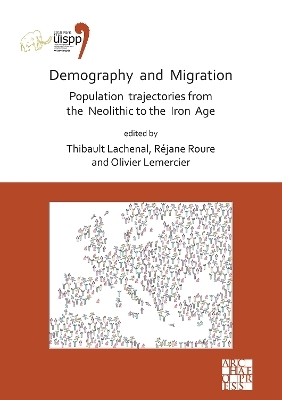
Demography and Migration Population trajectories from the Neolithic to the Iron Age
Access Archaeology (Verlag)
978-1-78969-665-3 (ISBN)
This volume presents the combined proceedings of two complementary sessions of the XVIII UISPP World Congress (4–9 June 2018, Paris, France): Sessions XXXII-2 and XXXIV-8. These sessions aimed to identify demographic variations during the Neolithic and Bronze Age and to question their causes while avoiding the potential taphonomic and chronological biases affecting the documentation. It appears that certain periods feature a large number of domestic and/or funeral sites in a given region and much fewer in the following periods. These phenomena have most often been interpreted in terms of demographics, habitat organization or land use. They are sometimes linked to climatic and environmental crises or historical events, such as population displacements. In the past few years, the increase in large-scale palaeogenetic analyses concerning late prehistory and protohistory has led to the interpretation of genomic modifications as the result of population movements leading to demographic transformations. Nevertheless, historiography demonstrates how ideas come and go and come again. Migration is one of these ideas: developed in the first part of the XX century, then abandoned for more social and economic analysis, it recently again assumed importance for the field of ancient people with the increase of isotopic and ancient DNA analysis. But these new analyses have to be discussed, as the old theories have been; their results offer new data, but not definitive answers. During the sessions, the full range of archaeological data and isotopic and genetic analysis were covered, however for this publication, mainly archaeological perspectives are presented.
Thibault Lachenal is a CNRS Research Fellow and manager of the ‘Society of Prehistory and Protohistory’ team of the ‘Archaeology of Mediterranean Societies’ laboratory (UMR5140-ASM) in Montpellier. Réjane Roure is Senior Lecturer in Protohistoric Archaeology at Paul Valéry Montpellier 3 University; she works in the Joint Research Unit ‘Archaeology of Mediterranean Societies’ (JRU5140-ASM). Olivier Lemercier is Professor of Prehistory at the University Paul Valéry - Montpellier 3 (France), and director of studies for the Master of Archaeology and Doctor of Archaeology degrees sp. Prehistory, Protohistory, Paleoenvironments, Mediterranean and African.
Demography and migration: an introduction – Réjane Roure, Thibault Lachenal and Olivier Lemercier ;
Is it possible to observe the Demographic Evolution from the Middle Neolithic to the Early Bronze Age – Olivier Lemercier ;
Essai sur la dynamique de peuplement à l’échelle du canton de Fribourg (Suisse) – Léonard Kramer et Michel Mauvilly ;
Demographic dynamics, paleoenvironmental changes and social complexity in the late prehistory of central Sicily – Enrico Giannitrapani and Filippo Iannì ;
Dynamiques de peuplement de la fin du Néolithique à la fin de l’âge du Bronze en France – Cyril Marcigny,Vincent Riquier, Frédéric Audouit, Eric Frénée, Eric Néré, Rebecca Peake et Marc Talon ;
Entre Champagne et Bourgogne, quelle trajectoire du peuplement protohistorique dans la plaine de Troyes ? – Vincent Riquier et Grégory Dandurand ;
Demographic Transitions – Cycles and Mobility in the Neolithic of Western Germany – Andreas Zimmermann, Silviane Scharl and Isabell Schmidt ;
Comment s’est produit le premier peuplement des petites îles ? Étude de cas de l’archipel – Tomaso Di Fraia ;
The Bell Beaker Question: from Historical-Cultural Approaches to aDNA Analyses – Olivier Lemercier ;
Migrations, mobilities and integrations in Campania (8th-7th centuries BC): trajectories and perspectives – Anna Maria Desiderio and Arianna Esposito ;
Réflexions pluridisciplinaires sur l’installation des Helvètes Tigurins dans l’ouest du Plateau suisse – Thierry Luginbühl, Julia Genechesi, Pascal Brand et Matthieu Demierre ;
Auteurs / Authors
| Erscheinungsdatum | 07.09.2020 |
|---|---|
| Reihe/Serie | Proceedings of the UISPP World Congress |
| Zusatzinfo | 89 figures, 2 tables |
| Verlagsort | Oxford |
| Sprache | englisch; französisch |
| Maße | 205 x 290 mm |
| Gewicht | 1150 g |
| Themenwelt | Geisteswissenschaften ► Archäologie |
| Geschichte ► Allgemeine Geschichte ► Vor- und Frühgeschichte | |
| Naturwissenschaften ► Biologie ► Evolution | |
| ISBN-10 | 1-78969-665-8 / 1789696658 |
| ISBN-13 | 978-1-78969-665-3 / 9781789696653 |
| Zustand | Neuware |
| Informationen gemäß Produktsicherheitsverordnung (GPSR) | |
| Haben Sie eine Frage zum Produkt? |
aus dem Bereich