


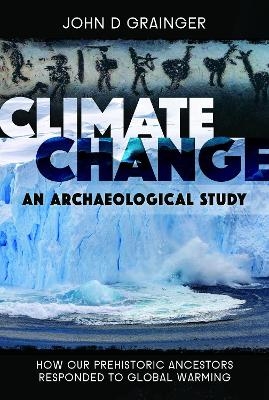
Climate Change: An Archaeological Study
How Our Prehistoric Ancestors Responded to Global Warming
Seiten
2020
Pen & Sword History (Verlag)
978-1-5267-8654-8 (ISBN)
Pen & Sword History (Verlag)
978-1-5267-8654-8 (ISBN)
Uses archaeological evidence to determine how our Stone Age ancestors faced Climate Change.
Global warming is among the most urgent problems facing the world today. Yet many commentators, and even some scientists, discuss it with reference only to the changing climate of the last century or so. John Grainger takes a longer view and draws on the archaeological evidence to show how our ancestors faced up to the ending of the last Ice Age, arguably a more dramatic climate change crisis than the present one. Ranging from the Paleolithic down to the development of agriculture in the Neolithic, the author shows how human ingenuity and resourcefulness allowed them to adapt to the changing conditions in a variety of ways as the ice sheets retreated and water levels rose. Different strategies, from big game hunting on the ice, nomadic hunter gathering, sedentary foraging and finally farming, were developed in various regions in response to local conditions as early man colonized the changing world. The human response to climate change was not to try to stop it, but to embrace technology and innovation to cope with it.
Global warming is among the most urgent problems facing the world today. Yet many commentators, and even some scientists, discuss it with reference only to the changing climate of the last century or so. John Grainger takes a longer view and draws on the archaeological evidence to show how our ancestors faced up to the ending of the last Ice Age, arguably a more dramatic climate change crisis than the present one. Ranging from the Paleolithic down to the development of agriculture in the Neolithic, the author shows how human ingenuity and resourcefulness allowed them to adapt to the changing conditions in a variety of ways as the ice sheets retreated and water levels rose. Different strategies, from big game hunting on the ice, nomadic hunter gathering, sedentary foraging and finally farming, were developed in various regions in response to local conditions as early man colonized the changing world. The human response to climate change was not to try to stop it, but to embrace technology and innovation to cope with it.
John D Grainger is a former teacher and historian of great experience with a particular interest in Classical and Hellenistic Greek history. His many previous works include the following for Pen & Sword: _Hellenistic and Roman Naval Wars_ (2011); _The Wars of the Maccabees_ (2012); _Roman Conquests: Egypt and Judaea_ (2013); a three-part history of the Seleukid Empire (2014-16), _King's and Kingship in the Hellenistic World 350-30 BC_ (2017), _Antipater's Dynasty_ (2018), _Ancient Dynasties_ (2019), _The Roman Imperial Succession_ (March 2020) and _The Galatians_ (August 2020). He lives in Evesham, Worcestershire.
| Erscheinungsdatum | 15.01.2021 |
|---|---|
| Zusatzinfo | 100 colour & black and white illustrations |
| Verlagsort | Barnsley |
| Sprache | englisch |
| Maße | 156 x 234 mm |
| Themenwelt | Sachbuch/Ratgeber ► Natur / Technik ► Natur / Ökologie |
| Naturwissenschaften ► Biologie ► Ökologie / Naturschutz | |
| ISBN-10 | 1-5267-8654-0 / 1526786540 |
| ISBN-13 | 978-1-5267-8654-8 / 9781526786548 |
| Zustand | Neuware |
| Informationen gemäß Produktsicherheitsverordnung (GPSR) | |
| Haben Sie eine Frage zum Produkt? |
Mehr entdecken
aus dem Bereich



aus dem Bereich
eine Geschichte der letzten 500 Jahre
Buch | Hardcover (2025)
C.H.Beck (Verlag)
CHF 47,60
das bewährte 8-Wochen-Training für kleine Fellnasen. PLUS: …
Buch | Softcover (2025)
Gräfe und Unzer Verlag
CHF 34,90


