


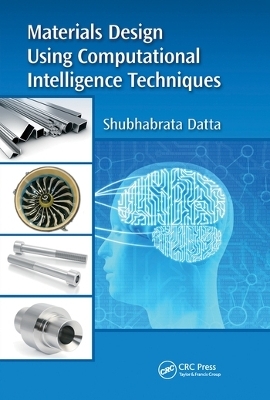
Materials Design Using Computational Intelligence Techniques
Seiten
2020
CRC Press (Verlag)
978-0-367-57433-8 (ISBN)
CRC Press (Verlag)
978-0-367-57433-8 (ISBN)
This book illustrates the alternative but effective methods of designing materials, where models are developed through capturing the inherent correlations among the variables on the basis of available imprecise knowledge in the form of rules or database.
Several statistical techniques are used for the design of materials through extraction of knowledge from existing data banks. These approaches are getting more attention with the application of computational intelligence techniques. This book illustrates the alternative but effective methods of designing materials, where models are developed through capturing the inherent correlations among the variables on the basis of available imprecise knowledge in the form of rules or database, as well as through the extraction of knowledge from experimental or industrial database, and using optimization tools.
Several statistical techniques are used for the design of materials through extraction of knowledge from existing data banks. These approaches are getting more attention with the application of computational intelligence techniques. This book illustrates the alternative but effective methods of designing materials, where models are developed through capturing the inherent correlations among the variables on the basis of available imprecise knowledge in the form of rules or database, as well as through the extraction of knowledge from experimental or industrial database, and using optimization tools.
Shubhabrata Datta
Introduction. A brief overview of traditional approaches to materials design. Statistics and data mining concepts. Principles of neural network and other soft modeling techniques. Knowledge extraction using rough and fuzzy set theories. Handling imprecise knowledge through fuzzy inference system. Evolutionary algorithm for designing materials. Technique blends to suit a materials system. Hybridizing with traditional approaches. Designing microstructure. Concluding remarks.
| Erscheinungsdatum | 01.07.2020 |
|---|---|
| Verlagsort | London |
| Sprache | englisch |
| Maße | 156 x 234 mm |
| Gewicht | 294 g |
| Themenwelt | Mathematik / Informatik ► Informatik ► Theorie / Studium |
| Naturwissenschaften ► Biologie | |
| Technik ► Maschinenbau | |
| Technik ► Umwelttechnik / Biotechnologie | |
| ISBN-10 | 0-367-57433-0 / 0367574330 |
| ISBN-13 | 978-0-367-57433-8 / 9780367574338 |
| Zustand | Neuware |
| Informationen gemäß Produktsicherheitsverordnung (GPSR) | |
| Haben Sie eine Frage zum Produkt? |
Mehr entdecken
aus dem Bereich



aus dem Bereich
Grundlagen – Anwendungen – Perspektiven
Buch | Softcover (2022)
Springer Vieweg (Verlag)
CHF 53,15
was jeder über Informatik wissen sollte
Buch | Softcover (2024)
Springer Vieweg (Verlag)
CHF 53,15
Teil 2 der gestreckten Abschlussprüfung Fachinformatiker/-in …
Buch | Softcover (2025)
Europa-Lehrmittel (Verlag)
CHF 37,90


