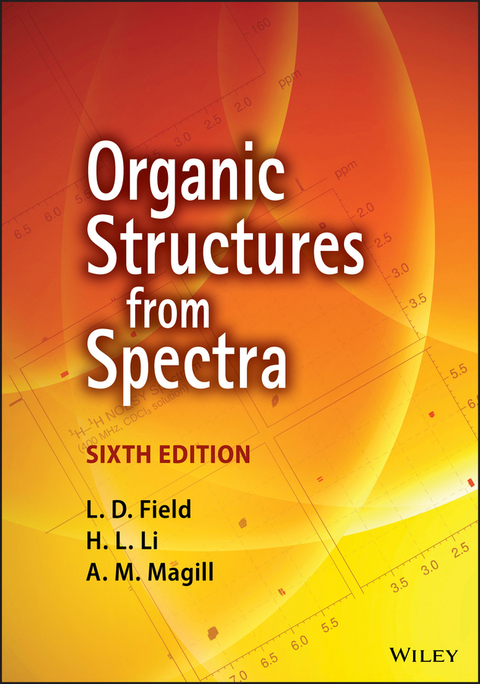
Organic Structures from Spectra (eBook)
John Wiley & Sons (Verlag)
978-1-119-52484-7 (ISBN)
The derivation of structural information from spectroscopic data is now an integral part of organic chemistry courses at all Universities. A critical part of any such course is a suitable set of problems to develop the students’ understanding of how organic structures are determined from spectra. The book builds on the very successful teaching philosophy of learning by hands-on problem solving; carefully graded examples build confidence and develop and consolidate a student’s understanding of organic spectroscopy.
Organic Structures from Spectra, 6th Edition is a carefully chosen set of about 250 structural problems employing the major modern spectroscopic techniques, including Mass Spectrometry, 1D and 2D 13C and 1H NMR Spectroscopy and Infrared Spectroscopy. There are 25 problems specifically dealing with the interpretation of spin–spin coupling in proton NMR spectra and 10 problems based on the quantitative analysis of mixtures using proton and carbon NMR spectroscopy. The accompanying text is descriptive and only explains the underlying theory at a level that is sufficient to tackle the problems. The text includes condensed tables of characteristic spectral properties covering the frequently encountered functional groups.
The examples themselves have been selected to include all important structural features and to emphasise connectivity arguments and stereochemistry. Many of the compounds were synthesised specifically for this book. In this collection, there are many additional easy problems designed to build confidence and to demonstrate basic principles.
The Sixth Edition of this popular textbook:
- now incorporates many new problems using 2D NMR spectra (C–H Correlation spectroscopy, HMBC, COSY, NOESY and TOCSY);
- has been expanded and updated to reflect the new developments in NMR spectroscopy;
- has an additional 40 carefully selected basic problems;
- provides a set of problems dealing specifically with the quantitative analysis of mixtures using NMR spectroscopy;
- features proton NMR spectra obtained at 200, 400 and 600 MHz and 13C NMR spectra including routine 2D C–H correlation, HMBC spectra and DEPT spectra;
- contains a selection of problems in the style of the experimental section of a research paper;
- includes examples of fully worked solutions in the appendix;
- has a complete set of solutions available to instructors and teachers from the authors.
Organic Structures from Spectra, Sixth Edition will prove invaluable for students of Chemistry, Pharmacy and Biochemistry taking a first course in Organic Chemistry.
L. D. Field, Professor of Chemistry, School of Chemistry, University of New South Wales, Australia
H. L. Li, Senior Research Associate, School of Chemistry, University of New South Wales, Australia
A. M. Magill, Honorary Associate, School of Chemistry, University of New South Wales, Australia
L. D. Field, Professor of Chemistry, School of Chemistry, University of New South Wales, Australia H. L. Li, Senior Research Associate, School of Chemistry, University of New South Wales, Australia A. M. Magill, Honorary Associate, School of Chemistry, University of New South Wales, Australia
1
INTRODUCTION
1.1 GENERAL PRINCIPLES OF ABSORPTION SPECTROSCOPY
Spectroscopy involves resolving electromagnetic radiation into its component wavelengths (or frequencies) and absorption spectroscopy is the absorption of electromagnetic radiation by matter as a function of wavelength.
In Organic Chemistry, we typically deal with molecular spectroscopy, i.e. the spectroscopy of atoms that are bound together in molecules rather than absorption by individual atoms or ions.
An absorption spectrum is a plot or graph of the absorption of energy (radiation) as a function of its wavelength (λ) or frequency (ν). A schematic absorption spectrum is given in Figure 1.1.
Figure 1.1 Schematic Absorption Spectrum
It follows that the x-axis in Figure 1.1 is an energy scale, since the frequency, wavelength and energy (E) of electromagnetic radiation are interrelated by the Planck–Einstein relation:
where ν is the frequency of the electromagnetic radiation, λ is the wavelength of the electromagnetic radiation, and c is the velocity of light.
An absorption band can be characterised primarily by two parameters:
- the wavelength (or frequency) at which maximum absorption occurs
- the intensity of absorption at this wavelength compared to base-line (or background) absorption
A spectroscopic transition takes a molecule from one energy state to a state of higher energy. For any spectroscopic transition between energy states (e.g. E1 and E2 in Figure 1.2), the change in energy (ΔE) is given by:
where h is Planck's constant and ν is the frequency of the electromagnetic energy absorbed.
Figure 1.2 Definition of a Spectroscopic Transition
It follows that ΔE ∝ ν and that ΔE ∝ 1/λ; i.e. the larger ΔE, the higher the frequency of radiation required for absorption to take place or the shorter the wavelength of radiation required for absorption to take place.
The y-axis in Figure 1.1 measures the intensity of the absorption band and this depends on the number of molecules observed (the Beer–Lambert Law) and the probability of the transition between the energy levels.
A spectrum consists of distinct bands or transitions because the absorption (or emission) of energy is quantised. The energy gap for a transition (and hence the absorption frequency) is a molecular property and it is characteristic of molecular structure. The absorption intensity is also a molecular property and both the frequency and the intensity of a transition can provide structural information.
1.2 CHROMOPHORES
In general, any spectral feature, i.e. a band or group of bands, is due not to the whole molecule, but to an identifiable part of the molecule, which we loosely call a chromophore.
A chromophore may correspond to a functional group (e.g. a hydroxyl group or the double bond in a carbonyl group). However, it may equally well correspond to a single atom within a molecule or to a group of atoms (e.g. a methyl group) that is not normally associated with chemical functionality.
The detection of a chromophore permits us to deduce the presence of a structural fragment or a structural element in the molecule. The fact that it is the chromophores and not the molecule as a whole that give rise to spectral features is fortunate because it permits complete molecular structures to be built up piece-by-piece from the molecular fragments.
1.3 DEGREE OF UNSATURATION
Traditionally, the molecular formula of a compound was derived from elemental analysis and its molecular weight, and these were determined independently. The concept of the degree of unsaturation of an organic compound derives simply from the tetravalency of carbon. For a non-cyclic hydrocarbon (i.e. an alkane) the number of hydrogen atoms must be twice the number of carbon atoms plus two, any “deficiency” in the number of hydrogens must be due to the presence of unsaturation, i.e. double bonds, triple bonds or rings in the structure.
The degree of unsaturation can be calculated from the molecular formula for all compounds containing C, H, N, O, S or the halogens. There are three basic steps in calculating the degree of unsaturation:
- Step 1 – take the molecular formula and replace all halogens by hydrogens
- Step 2 – omit all of the sulfur or oxygen atoms
- Step 3 – for each nitrogen, omit the nitrogen and omit one hydrogen
After these three steps, the molecular formula is reduced to CnHm and the degree of unsaturation is given by:
The degree of unsaturation indicates the number of π bonds or rings that the compound contains. For example, a compound whose molecular formula is C4H9NO2 is reduced to C4H8, which gives a degree of unsaturation of 1. This indicates that the molecule must have one π bond or one ring. Note that a triple bond (e.g. the –C≡C– bond in an alkyne or the –C≡N bond in a nitrile) contributes two units of unsaturation (two π bonds). Note also that any compound that contains an aromatic ring always has a degree of unsaturation greater than or equal to 4, since the aromatic ring contains a ring plus three π bonds. Similarly, if a compound has a degree of unsaturation greater than or equal to 4, one should suspect the possibility that the structure contains an aromatic ring.
1.4 CONNECTIVITY
Even if it were possible to identify sufficient structural elements in a molecule to account for the molecular formula, it may not be possible to deduce the structural formula from a knowledge of the structural elements alone. For example, it could be demonstrated that a substance of molecular formula C3H5OCl contains the structural elements:
and this leaves two possible structures:
Not only the presence of various structural elements, but also their juxtaposition, must be determined to establish the structure of a molecule. Fortunately, spectroscopy often gives valuable information concerning the connectivity of structural elements and in the above example it would be very easy to determine whether there is a ketonic carbonyl group (as in 1) or an acid chloride (as in 2). In addition, it is possible to determine independently whether the methyl (–CH3) and methylene (–CH2–) groups are separated (as in 1) or adjacent (as in 2).
1.5 SENSITIVITY
Sensitivity is generally taken to signify the limits of detectability of a chromophore. Some methods (e.g. 1H NMR spectroscopy) detect all chromophores accessible to them with equal sensitivity while in other techniques (e.g. UV spectroscopy) the range of sensitivity towards different chromophores spans many orders of magnitude. Mass spectroscopy is the most sensitive of the common spectroscopic techniques and requires only very small amounts of sample (< 10−10 g) whereas 13C NMR typically requires tens of milligrams of sample. In terms of overall sensitivity:
but the relative sensitivity of different spectroscopic techniques often depends on the specific chromophores present in a molecule.
1.6 PRACTICAL CONSIDERATIONS
The five major spectroscopic methods (MS, UV, IR, 1H NMR and 13C NMR) have become established as the principal tools for the determination of the structures of organic compounds because, between them, they detect a wide variety of structural elements.
The instrumentation and skills involved in the use of all five major spectroscopic methods are now widely spread, but the ease of obtaining and interpreting the data from each method under real laboratory conditions varies.
In very general terms:
- While the cost of each type of instrumentation differs greatly (NMR instruments cost between $50,000 and several million dollars), as an overall guide, MS and NMR instruments are much more costly than UV and IR spectrometers. With increasing cost comes increasing difficulty in maintenance and the required operator expertise, thus compounding the total outlay.
- In terms of ease of usage for routine operation, most UV and IR instruments are comparatively straightforward bench-top laboratory instruments. NMR spectrometers are also common as “hands-on” instruments in most chemistry laboratories and the users require routine training and a degree of basic computer literacy. Similarly some mass spectrometers are now designed to be used by researchers as “hands-on” routine instruments. However, the more advanced NMR spectrometers and most mass spectrometers are still sophisticated instruments that are usually operated and maintained by specialists.
- The scope of each spectroscopic method can be defined as the amount of useful information it provides. This is a function of the total amount of information obtainable and also how difficult the data are to interpret. The scope of each method varies from problem to problem, and each method has its aficionados and specialists, but the overall utility undoubtedly decreases in the order:
with the combination of 1H and 13C NMR spectroscopy providing the most useful information.
- The...
| Erscheint lt. Verlag | 27.4.2020 |
|---|---|
| Sprache | englisch |
| Themenwelt | Naturwissenschaften ► Chemie ► Analytische Chemie |
| Schlagworte | 2D NMR Spectroscopy • Analytische Chemie • Chemie • Chemistry • infrared spectroscopy introduction • infrared Spectroscopy text • mass spectroscopy introduction • mass Spectroscopy text • NMR Spectroscopy introduction • NMR spectroscopy text • Organic Chemistry • Organische Chemie • Pharmaceutical & Medicinal Chemistry • Pharmazeutische u. Medizinische Chemie • spectroscopy • Spektroskopie • ultraviolet Spectroscopy introduction • ultraviolet Spectroscopy text |
| ISBN-10 | 1-119-52484-9 / 1119524849 |
| ISBN-13 | 978-1-119-52484-7 / 9781119524847 |
| Informationen gemäß Produktsicherheitsverordnung (GPSR) | |
| Haben Sie eine Frage zum Produkt? |
 EPUB (Adobe DRM)
Kopierschutz: Adobe-DRM
Adobe-DRM ist ein Kopierschutz, der das eBook vor Mißbrauch schützen soll. Dabei wird das eBook bereits beim Download auf Ihre persönliche Adobe-ID autorisiert. Lesen können Sie das eBook dann nur auf den Geräten, welche ebenfalls auf Ihre Adobe-ID registriert sind.
Details zum Adobe-DRM
Dateiformat: EPUB (Electronic Publication)
EPUB ist ein offener Standard für eBooks und eignet sich besonders zur Darstellung von Belletristik und Sachbüchern. Der Fließtext wird dynamisch an die Display- und Schriftgröße angepasst. Auch für mobile Lesegeräte ist EPUB daher gut geeignet.
Systemvoraussetzungen:
PC/Mac: Mit einem PC oder Mac können Sie dieses eBook lesen. Sie benötigen eine
eReader: Dieses eBook kann mit (fast) allen eBook-Readern gelesen werden. Mit dem amazon-Kindle ist es aber nicht kompatibel.
Smartphone/Tablet: Egal ob Apple oder Android, dieses eBook können Sie lesen. Sie benötigen eine
Geräteliste und zusätzliche Hinweise
Buying eBooks from abroad
For tax law reasons we can sell eBooks just within Germany and Switzerland. Regrettably we cannot fulfill eBook-orders from other countries.
aus dem Bereich