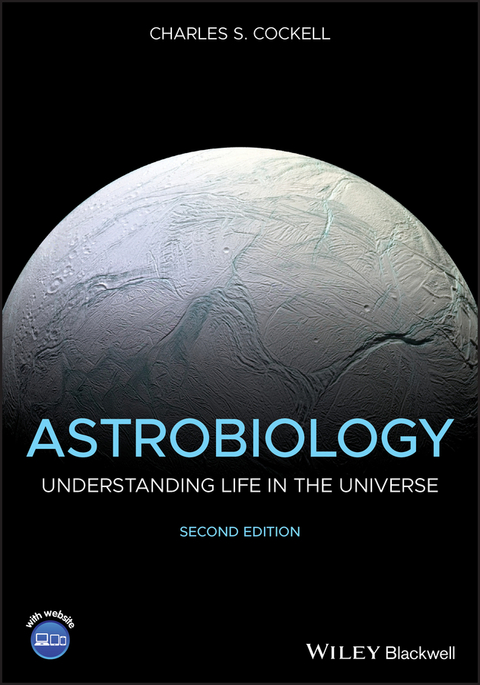
Astrobiology (eBook)
John Wiley & Sons (Verlag)
9781119550396 (ISBN)
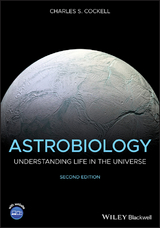
A guide to understanding the formation of life in the Universe
The revised and updated second edition of Astrobiology offers an introductory text that explores the structure of living things, the formation of the elements required for life in the Universe, the biological and geological history of the Earth, and the habitability of other planets. Written by a noted expert on the topic, the book examines many of the major conceptual foundations in astrobiology, which cover a diversity of traditional fields including chemistry, biology, geosciences, physics, and astronomy.
The book explores many profound questions such as: How did life originate on Earth? How has life persisted on Earth for over three billion years? Is there life elsewhere in the Universe? What is the future of life on Earth? Astrobiology is centered on investigating the past and future of life on Earth by looking beyond Earth to get the answers. Astrobiology links the diverse scientific fields needed to understand life on our own planet and, potentially, life beyond. This new second edition:
- Expands on information about the nature of astrobiology and why it is useful
- Contains a new chapter 'What is Life?' that explores the history of attempts to understand life
- Contains 20% more material on the astrobiology of Mars, icy moons, the structure of life, and the habitability of planets
- New 'Discussion Boxes' to stimulate debate and thought about key questions in astrobiology
- New review and reflection questions for each chapter to aid learning
- New boxes describing the careers of astrobiologists and how they got into the subject
- Offers revised and updated information throughout to reflect the latest advances in the field
Written for students of life sciences, physics, astronomy and related disciplines, the updated edition of Astrobiology is an essential introductory text that includes recent advances to this dynamic field.
CHARLES S. COCKELL is Professor of Astrobiology at the University of Edinburgh, United Kingdom.
CHARLES S. COCKELL is Professor of Astrobiology at the University of Edinburgh, United Kingdom.
1. Astrobiology
2. What is Life?
3. Matter and Life
4. The Molecular Structure of Life
5. The Cellular Structure of Life
6. Energy for Life
7. The Limits of Life
8. The Tree of Life
9. The Universe, the Solar System, and the Elements of Life
10. Astrochemistry: Carbon in Space
11. Early Earth: The First Billion Years
12. The Origin of Life
13. Early Life on Earth
14. The Geology of a Habitable World
15. The Co-Evolution of Life and a Planet: The Rise of Oxygen
16. Mass Extinctions
17. The Habitability of Planetary Bodies
18. The Astrobiology of Mars
19. Ocean Worlds and Icy Moons
20. Exoplanets and the Search for Life
21. The Search for Extraterrestrial Intelligence
22. Our Civilization
Appendix
Glossary
1
Astrobiology
Learning Outcomes
- Understand that astrobiology is concerned with the origin, evolution, and distribution of life in the Universe. It investigates life in its cosmic context.
- Understand some of the detailed scientific questions that underpin astrobiology's main lines of enquiry.
- Know about some aspects of the history of astrobiology and how it emerged as a field.
1.1 Introductory Remarks
If you've ever wondered about some of the most fascinating questions in science, such as how life originated, whether it could exist elsewhere, and how life has managed to evolve and persist on our planet for over three and a half billion years, then you've opened the right book.
Astrobiology is a remarkably diverse subject whose main objective is to investigate and understand the phenomenon of life in its cosmic context (Figure 1.1). Astrobiology might be said to address at least four large-scale questions:
- How did life originate and diversify on Earth?
- How does life co-evolve with a planet?
- Does life exist beyond Earth?
- What is the future of life on Earth and its capacity to move beyond the home planet?
Figure 1.1 Astrobiology seeks to understand the phenomenon of life in its cosmic context. This “ultra-deep field” view imaged by the Hubble Space Telescope includes nearly 10 000 galaxies across the observable Universe in both visible and near infrared light. The smallest, reddest galaxies are among the youngest, in existence when the Universe was just 800 million years old. How does life fit into this grand cosmic perspective?
Source: Reproduced with permission of NASA, ESA, H. Teplitz and M. Rafelski (IPAC/Caltech), A. Koekemoer (STScI), R. Windhorst (Arizona State University), and Z. Levay (STScI).
Astrobiology covers and integrates a wide diversity of subjects including astronomy, biology, chemistry, geosciences, planetary sciences, physics, and social sciences. In that sense, to the newcomer it may even look intimidating in its scope. However, as I hope you'll discover in this book, it is an enormously rewarding area of study and whether you come at this subject as an astronomer, biologist, or chemist, or from another discipline, the subject will encourage you to cross seamlessly into other areas of science.
Who is this booked aimed at? Its core audience is students taking astrobiology courses or lectures, but it can be read by anyone with an interest in the subject. The book might be useful for scientists in specific disciplines keen to see where their subject area intersects with other fields of science. For policy makers or others with a social sciences or humanities background, the book will provide a scientific backdrop to astrobiology and its links to space exploration. I would hope, given its structure and layout, that interested laypersons might find this a useful reference source to learn about astrobiology and get to grips with some of its key concepts.
You might ask: But why would we want to study biology from a cosmic perspective in the first place? And in answer: Even the most limited view of life on Earth forces us to consider the cosmic view. Our planet seems like a tranquil place. However, it is subjected to the vagaries of its astronomical environment. For example, a key hypothesis for the mechanism of the extinction of the dinosaurs is an asteroid impact 66 million years ago (Figure 1.2). This hypothesis underscores the fact that to understand past life on Earth, we need to understand how the astronomical environment may have influenced life. To know how the dinosaurs and about 75% of all animal life went extinct at the end of the Cretaceous geological period, you have to know how frequently asteroid impacts occur. That means knowing something about how many asteroids are in space, where they come from, and why they exist in the first place, a question itself linked to the formation of the Solar System. The death of the dinosaurs takes you into astronomy, and that means into the purview of astrobiology.
Figure 1.2 Astrobiology requires an understanding of astronomy. At the end of the Cretaceous, these flying reptiles (pterosaurs) and many other forms of life, including the dinosaurs, are thought to have been driven to extinction by the effects of a large asteroid impact. Therefore, to understand the history of life on Earth, we need to investigate our planet's astronomical environment, a key objective of astrobiology.
Source: Reproduced with permission of NASA.
Instead of looking back in time, we could look into the future. Eventually, when the Sun's luminosity increases to a sufficiently high value, the Earth's oceans will boil away, and the planet will suffer a runaway greenhouse effect, eventually turning into a Venus-like world (Figure 1.3). This will probably occur in approximately 1.5 billion years. Thus, to understand the future of life on Earth, we must also understand our astronomical environment. We need to know how stars are born and die and what the fate of planets is during this stellar evolution.
Figure 1.3 The future of the Earth is a topic in astrobiology. When the Sun turns into a Red Giant star in several billion years from now, the Earth will be a dead planet. However, the increasing luminosity of the Sun over the next one to two billion years will ensure that life on Earth will already have long since been extinguished and the oceans boiled away when the planet enters a greenhouse state. Therefore, to understand the future of life on our planet, we need to know about the evolution of stars. Biology and astronomy are inextricably linked in astrobiology.
Source: Reproduced with permission of Fsgregs, https://upload.wikimedia.org/wikipedia/commons/6/60/Red_Giant_Earth.jpg.
In summary, investigating the past and future of life on Earth means that we need to look beyond Earth to get answers. Astrobiology is about taking that journey and linking the diverse scientific fields needed to understand life on our own planet and, potentially, life beyond.
Let me address an interesting question that I often get asked: What's the use of astrobiology and how is it different from biology? Can it really claim to be a field in its own right? I hope that you've already got some understanding of why it is a useful area of science. Without a long digression into the philosophy of science, it is worth remembering that scientific fields are human constructions. It is true to say that the existing field of “biology” covers investigations into all the living things that we know, which might make you wonder why we need astrobiology at all. However, astrobiology is merely a way to think about living things in their astronomical or cosmic context, to address questions such as the origin of life or the existence of life elsewhere that requires linking biology with other fields such as planetary sciences or astronomy. Does that make astrobiology a subfield of biology or something wider? You decide! I don't think it really matters. What is important is that it is a useful term to encompass a set of scientific questions. It brings together a wide range of scientists, in textbooks like this or at scientific conferences, and of course in scientific papers. If a scientific word achieves nothing more than the advance of collaboration between thinking human beings, then it is an outstanding thing.
1.2 The Major Questions of Astrobiology and the Content of the Textbook
Astrobiology is a very broad field, and it can be difficult to grasp all the topics and fascinating questions that it addresses. This textbook is focused on providing a comprehensive overview of some of the major strands of science that underpin the study of life in its cosmic context, while hopefully achieving an appropriate depth of understanding in key subjects such as physics, biology, chemistry, and geosciences. The textbook is based on six years of teaching an astrobiology course at undergraduate level at the University of Edinburgh. During that time, I have been able to observe what undergraduates find interesting and the things for which they have less enthusiasm. The content of the chapters is based around these experiences. In particular, concepts that are important and sometimes more tricky to grasp have more pages devoted on them. The textbook should by no means be regarded as exhaustive, and there are many other texts that can provide ancillary information and deeper discussion on particular subjects.
There is a point I would like to make right away. If you bought this textbook to read all about aliens, you are going to be disappointed. The matter of whether life exists elsewhere in the Universe is certainly one of astrobiology's major questions. “Does life exist beyond Earth?” sometimes expressed as “Are we alone in the Universe?” or similar formulations of the question of whether we are the only type of life in the Universe grips the public as well as the scientific imagination. It justifiably finds itself center stage whenever the word “astrobiology” comes into view. In fact, one of the challenges of being an astrobiologist is to explain to people that the subject is not just about searching for alien life! Perhaps one reason why the question of whether alien life exists is so pervasive is that it is a statistically reasonable question to ask. Earth is one planet in...
| Erscheint lt. Verlag | 1.4.2020 |
|---|---|
| Sprache | englisch |
| Themenwelt | Naturwissenschaften ► Biologie |
| Naturwissenschaften ► Physik / Astronomie ► Astronomie / Astrophysik | |
| Schlagworte | applications of astrobiology</p> • Astronomie u. Astrophysik • Astronomy & Astrophysics • biological history of earth • earth sciences • formation of life in the universe • Geowissenschaften • habitability of planets • introduction to astrobiology • life in the universe • <p>Guide to Astrobiology • Paläontologie, Paläobiologie u. Geobiologie • Paleontology, Paleobiology & Geobiology • Physics • Physik • Understanding astrobiology |
| ISBN-13 | 9781119550396 / 9781119550396 |
| Informationen gemäß Produktsicherheitsverordnung (GPSR) | |
| Haben Sie eine Frage zum Produkt? |
 EPUB (Adobe DRM)
Kopierschutz: Adobe-DRM
Adobe-DRM ist ein Kopierschutz, der das eBook vor Mißbrauch schützen soll. Dabei wird das eBook bereits beim Download auf Ihre persönliche Adobe-ID autorisiert. Lesen können Sie das eBook dann nur auf den Geräten, welche ebenfalls auf Ihre Adobe-ID registriert sind.
Details zum Adobe-DRM
Dateiformat: EPUB (Electronic Publication)
EPUB ist ein offener Standard für eBooks und eignet sich besonders zur Darstellung von Belletristik und Sachbüchern. Der Fließtext wird dynamisch an die Display- und Schriftgröße angepasst. Auch für mobile Lesegeräte ist EPUB daher gut geeignet.
Systemvoraussetzungen:
PC/Mac: Mit einem PC oder Mac können Sie dieses eBook lesen. Sie benötigen eine
eReader: Dieses eBook kann mit (fast) allen eBook-Readern gelesen werden. Mit dem amazon-Kindle ist es aber nicht kompatibel.
Smartphone/Tablet: Egal ob Apple oder Android, dieses eBook können Sie lesen. Sie benötigen eine
Geräteliste und zusätzliche Hinweise
Buying eBooks from abroad
For tax law reasons we can sell eBooks just within Germany and Switzerland. Regrettably we cannot fulfill eBook-orders from other countries.
aus dem Bereich