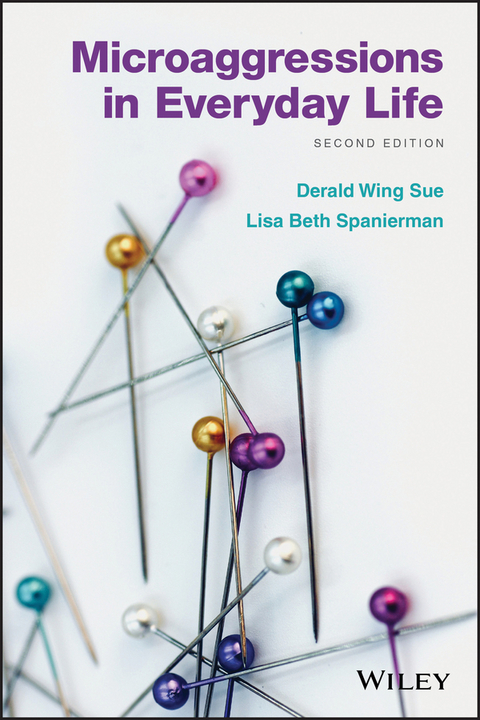
Microaggressions in Everyday Life (eBook)
John Wiley & Sons (Verlag)
978-1-119-51381-0 (ISBN)
The essential, authoritative guide to microaggressions, revised and updated
The revised and updated second edition of Microaggressions in Everyday Life presents an introduction to the concept of microaggressions, classifies the various types of microaggressions, and offers solutions for ending microaggressions at the individual, group, and community levels. The authors-noted experts on the topic-explore the psychological effects of microaggressions on both perpetrators and targets.
Subtle racism, sexism, and heterosexism remain relatively invisible and potentially harmful to the wellbeing, self-esteem, and standard of living of many marginalized groups in society. The book examines the manifestations of various forms of microaggressions and explores their impact. The text covers: researching microaggressions, exploring microaggressions in education, identifying best practices teaching about microaggressions, understanding microaggressions in the counseling setting, as well as guidelines for combating microaggressions. Each chapter concludes with a section called 'The Way Forward' that provides guidelines, strategies, and interventions designed to help make our society free of microaggressions. This important book:
- Offers an updated edition of the seminal work on microaggressions
- Distinguishes between microaggressions and macroaggressions
- Includes new information on social media as a key site where microaggressions occur
- Presents updated qualitative and quantitative findings
- Introduces the concept of microinterventions
- Contains new coverage throughout the text with fresh examples and new research findings from a wide range of studies
Written for students, faculty, and practitioners of psychology, education, social work, and related disciplines, the revised edition of Microaggressions in Everyday Life illustrates the impact microaggressions have on both targets and perpetrators and offers suggestions to eradicate microaggressions.
Derald Wing Sue, Ph.D., is Professor of Psychology and Education in the Department of Counseling and Clinical Psychology at Teachers College, Columbia University in New York.
Lisa Beth Spanierman, Ph.D., is Professor and Head of the Faculty of Counseling and Counseling Psychology at Arizona State University in Tempe.
Derald Wing Sue, Ph.D., is Professor of Psychology and Education in the Department of Counseling and Clinical Psychology at Teachers College, Columbia University in New York. Lisa Beth Spanierman, Ph.D., is Professor and Head of the Faculty of Counseling and Counseling Psychology at Arizona State University in Tempe.
Preface
Microaggressions in Everyday Life, Second Edition is about the damaging consequences of everyday prejudice, bias, and discrimination on the lives of marginalized groups in our society. Building on the highly successful first edition, this completely revised and updated version analyzes the most recent research findings and current scholarly thinking on the manifestation, dynamics, and impact of microaggressions across a broad range of marginalized groups and settings. Microaggressions theory has become integrated into many professional fields including psychology, education, law, medicine, and public policy and has become part of mainstream discourse (e.g., print, television, and talk radio) and social media (e.g., internet blogs and Facebook). The concept of microaggressions, which initially focused on race and communities of color, has been applied to many marginalized groups in society (women, LGBTQ populations, people with disabilities, religious minorities, and persons living in poverty), and in a multitude of settings (classrooms, public spaces, and places of employment). In 2017 the word “microaggression” was formally added to the Merriam‐Webster Dictionary, thereby making the term a part of the American lexicon.
Those of you familiar with the first edition will note that major changes have occurred in coverage and emphasis due to my collaboration with Dr. Lisa B. Spanierman, an expert scholar and researcher on the psychosocial costs of racism to White Americans, the detrimental impact of microaggressions to targets, and the roles and responsibilities of White racial justice allies. Her expertise in this revised edition offers a fresh contemporary look, incorporates new and important topical areas, and applies microaggression research to everyday life. Although there are a number of major organizational and topical changes, we have maintained three key features that our readers consistently declare as extremely helpful: (a) using real‐life examples or case vignettes at the opening of most chapters to illustrate the upcoming content; (b) employing contemporary interpersonal, social, and political events that anchor the concepts of explicit and implicit bias; and (c) concluding each chapter with a section titled “The Way Forward” that provides concrete future actions/directions to combat microaggressions.
Organizationally, we have eliminated three chapters from the first edition that deal separately with racial microaggressions, gender microaggressions, and sexual‐orientation microaggressions. Instead, we have incorporated these group‐based microaggressions throughout the chapters and discussed microaggressions in an integrated fashion, pointing out similarities and differences between the targeted groups.
What Is New to the Second Edition?
According to many psychologists and educators, the taxonomy of microaggressions has revolutionized the way we think about prejudice and discrimination. Since the publication of “Racial Microaggressions in Everyday Life: Implications for Clinical Practice” (Sue, Capodilupo, et al., 2007) and of Microaggressions in Everyday Life: Race, Gender and Sexual Orientation (Sue, 2010), there have been over 20,000 publications on the topic (Google Scholar, October 2018). The journal article and book have generated a multitude of research studies, conceptual/analytical models, case studies, anecdotal reports, and editorial/opinion pieces. This current edition was guided by the most up‐to‐date research findings on microaggressions, resulting in what we hope will become an equally important and groundbreaking standard for the field. The new features/topics of Microaggressions in Everyday Life, Second Edition are discussed next.
The majority of work on microaggressions has focused on how they detrimentally harm target populations. In this new edition, we devote Chapter 6 to how macrolevel systems of dominance and oppression affect the microlevel psyche and behavior of perpetrators or offenders. Interestingly, very little research has focused on understanding those who commit microaggressions. Thus, we address several important questions: Who are microaggressive perpetrators? How and why do individuals perpetrate microaggressions? What makes it so difficult for perpetrators to recognize their role in the transmission of microaggressions? What are the costs of microaggressions to those who perpetrate them? This last question is unique and important because most discussions of perpetrators emphasize power, privilege, and the advantages that accrue to dominant‐group members who engage in oppressive acts. We show, however, that research reveals microaggressors experience a multitude of psychosocial costs (emotional, behavioral, spiritual, and moral) that deplete their humanity.
Second, we also introduce a completely new concept in this edition that we label microinterventions. In our work with microaggressions, we have repeatedly asked how people can effectively fight against expressions of bias. In Chapter 10 we review the literature and findings on antibias actions and develop a conceptual framework of strategies (microinterventions)—a repertoire of responses used to directly disarm or counteract the effects of micro‐ and macroaggressions by challenging perpetrators who deliver interpersonal slights and persons in authority who operate under biased policies or practices. In this chapter we describe the potential antiracist actions of three major groups—targets, allies, and bystanders—in their struggle against racism. We believe these constituents must take a proactive stance against the discriminatory actions of perpetrators. Drawing from research studies, we extract guiding principles and provide suggestions, strategies, and interventions that disrupt, diminish, or terminate prejudice and discrimination at the individual level. We also address the need for scholars and practitioners to develop antiracist microintervention strategies directed at biased institutional programs and practices and toward biased societal social policies as well.
Third, another major addition to the book is Chapter 7, “Researching Microaggressions: Show Me the Evidence,” and our stance that there are multiple ways to ask and answer questions about the human condition, especially in the study of microaggressions. Unlike some scholars who minimize the importance of experiential reality and targets’ perspectives, we believe that methodological diversity is necessary and must involve to some degree people's lived experiences. We provide a historical look at how the study of microaggressions has evolved over the years; the advantages and disadvantages of specific research strategies; and a description of both qualitative and quantitative methodologies used to portray a more comprehensive picture of the nature, manifestation, expression, and impact of microaggressions and how these aspects vary for different groups in different contexts. Of special relevance to future researchers, we provide an overview of more than a dozen microaggression scales commonly used to research these forms of bias.
Fourth, throughout the book we distinguish between the usage of the terms “microaggressions” and “macroaggressions.” In our earlier formulation of microaggression theory, we concentrated primarily on microassaults, microinsults, and microinvalidations. This led to confusion when some in the public began to use the term “macroaggressions” to indicate the immense harm that often resulted from a microaggression. Unlike microaggressions, which are situated in microlevel interpersonal contexts, macroaggressions affect whole groups or classes of people because they are systemic in nature. Further, microaggressions reside in the beliefs and attitudes of individuals, while macroaggressions reside in the programs, policies, and practices of institutions and society. Disarming or counteracting microaggressions refers to neutralizing bigotry among individuals, whereas combating macroaggressions refers to changing the policies and practices of organizations and institutions that deny equal access and opportunity for all.
Fifth, being both educators and mental health practitioners, we introduce two completely revised chapters: Chapter 8, “Teaching About Microaggressions,” which has implications for educators, and Chapter 9, “Microaggressions in Counseling and Psychotherapy.” As it is nearly impossible to separate the practice of teaching about microaggressions from the dynamics of encountering microaggressions in the classroom, in Chapter 8 we focus on teaching about microaggressions as well as using teachable moments effectively when microaggressions occur in our classrooms. In Chapter 9 we underscore how clients’ presenting concerns may be related to microaggressive harm in their everyday lives. We also emphasize how well‐intentioned helping professionals unknowingly commit harmful microaggressions toward their clients in the therapeutic context, which is especially concerning because clients seek therapy to resolve problems. Culturally insensitive therapeutic practice can lead to secondary trauma, especially among clients who experience multiple microaggressions in their everyday lives. If microaggressions are not addressed in therapy or, worse yet, if a therapist commits microaggressions during a session, clients may never receive the help they need. In this chapter we describe briefly mental health disparities in terms of...
| Erscheint lt. Verlag | 31.3.2020 |
|---|---|
| Sprache | englisch |
| Themenwelt | Geisteswissenschaften ► Psychologie ► Sozialpsychologie |
| Naturwissenschaften ► Chemie | |
| Schlagworte | Diversity, Culture & Ethnicity • environmental microagressions</p> • gender microagressions • impact of microagressions • Kulturelle u. ethnische Vielfalt • <p>Guide to Microaggressions • Mikroaggression • Psychologie • Psychology • Psychotherapie • Psychotherapie u. Beratung • Psychotherapy & Counseling • racial microagressions • sexual mircoragressions • Social Policy & Welfare • Social Problems • Soziale Probleme • Sozialpolitik u. Wohlfahrt • text on microaggressions • toxic microagressions • understanding mircoagressions |
| ISBN-10 | 1-119-51381-2 / 1119513812 |
| ISBN-13 | 978-1-119-51381-0 / 9781119513810 |
| Informationen gemäß Produktsicherheitsverordnung (GPSR) | |
| Haben Sie eine Frage zum Produkt? |
 EPUB (Adobe DRM)
Kopierschutz: Adobe-DRM
Adobe-DRM ist ein Kopierschutz, der das eBook vor Mißbrauch schützen soll. Dabei wird das eBook bereits beim Download auf Ihre persönliche Adobe-ID autorisiert. Lesen können Sie das eBook dann nur auf den Geräten, welche ebenfalls auf Ihre Adobe-ID registriert sind.
Details zum Adobe-DRM
Dateiformat: EPUB (Electronic Publication)
EPUB ist ein offener Standard für eBooks und eignet sich besonders zur Darstellung von Belletristik und Sachbüchern. Der Fließtext wird dynamisch an die Display- und Schriftgröße angepasst. Auch für mobile Lesegeräte ist EPUB daher gut geeignet.
Systemvoraussetzungen:
PC/Mac: Mit einem PC oder Mac können Sie dieses eBook lesen. Sie benötigen eine
eReader: Dieses eBook kann mit (fast) allen eBook-Readern gelesen werden. Mit dem amazon-Kindle ist es aber nicht kompatibel.
Smartphone/Tablet: Egal ob Apple oder Android, dieses eBook können Sie lesen. Sie benötigen eine
Geräteliste und zusätzliche Hinweise
Buying eBooks from abroad
For tax law reasons we can sell eBooks just within Germany and Switzerland. Regrettably we cannot fulfill eBook-orders from other countries.
aus dem Bereich