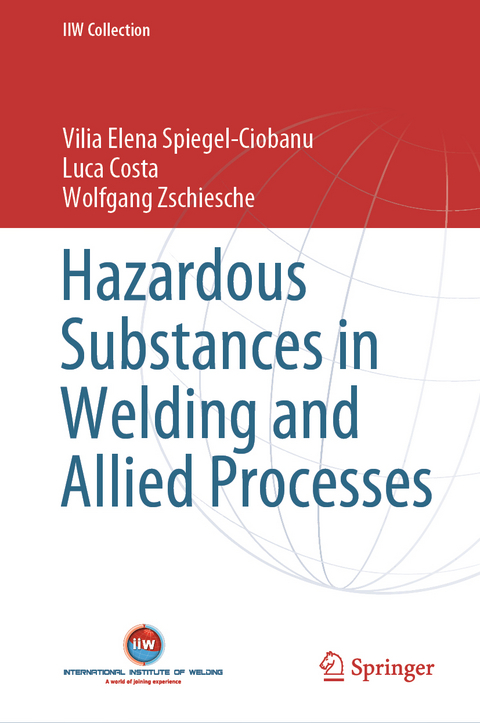
Hazardous Substances in Welding and Allied Processes (eBook)
XVII, 99 Seiten
Springer International Publishing (Verlag)
978-3-030-36926-2 (ISBN)
In addition, the book explains tests in order to understand the concentration and intensity of key hazardous substances. Last but not least, the book suggests several possibilities of avoiding the risk to worker's health as a result of exposing them to these substances.
Preface I 8
Preface II 10
Acknowledgements 12
Contents 13
1 General Information on Hazardous Substances in Welding and Allied Processes 16
1.1 Definition 16
1.2 Classification 16
1.2.1 Occurrence 16
1.2.2 Health Effects 19
1.3 Generation 21
1.3.1 Gaseous Hazardous Substances 22
1.3.2 Particulate Hazardous Substances 23
1.3.3 Hazardous Substances from Organic Based Coating Materials 26
1.4 Influencing Factors 27
1.5 Occupational Exposure Limit Values 28
1.6 Biological Limit Values 29
1.7 Test Methods 29
References 30
2 Health Effects of Specific Hazardous Substances 32
2.1 Toxic Gaseous Hazardous Substances 32
2.1.1 Carbon Monoxide (CO) 32
2.1.2 Nitrogen Oxides (NOx = NO, NO2) 32
2.1.3 Ozone (O3) 33
2.1.4 Phosgene (COCI2) 34
2.1.5 Gases from Coating Materials and Fluxes 34
2.2 Particulate Hazardous Substances 34
2.2.1 Lung-Stressing Substances 34
2.2.2 Toxic Substances 36
2.2.3 Carcinogenic Substances 36
2.2.4 Radioactive Substances 37
References 37
3 Assignment of Hazardous Substances to Welding Processes and Materials 39
3.1 Welding 39
3.1.1 Gas Welding 40
3.1.2 Manual Metal Arc Welding with Covered Electrodes 41
3.1.3 Gas-Shielded Arc Welding, in General 43
3.1.4 Gas-Shielded Metal Arc Welding (GMAW) 43
3.1.5 Tungsten Inert Gas Welding (TIG) 45
3.1.6 Submerged Arc Welding (SAW) 46
3.1.7 Resistance Welding 46
3.1.8 Laser Welding Without Filler Metal 46
3.1.9 Laser Cladding 47
3.1.10 Laser Welding with Nd:YAG-Laser 48
3.1.11 Assignment of Key Components to Welding Processes (Example) 48
3.1.12 Hybrid Welding 50
3.2 Thermal Cutting 51
3.2.1 Flame Cutting (Unalloyed and Low-Alloy Steel) 51
3.2.2 Plasma Cutting 51
3.2.3 Laser Beam Cutting, in General 52
3.2.4 Laser Cutting with CO2-Laser 53
3.2.5 Laser Cutting with Nd:YAG-Laser 54
3.3 Thermal Spraying 55
3.3.1 Flame Spraying 56
3.3.2 Arc Spraying 56
3.3.3 Plasma Spraying 57
3.4 Soldering and Brazing 58
3.4.1 Soldering (T < 450 °C)
3.4.2 Brazing (T > 450 °C)
3.4.3 MIG Brazing, Laser Brazing, Plasma Brazing (T > 900 °C)
References 62
4 Ultrafine Particles (UFP) 64
4.1 Findings from Studies on Toxicity of UFP in General 64
4.2 Findings from Research on the Characteristics of UFP 64
4.3 Results from Studies on Welding Processes 65
4.4 Findings from Research on Identification of Particle Characteristics in Welding of Galvanized Sheet 73
4.5 Other Findings 74
References 74
5 Hazard Evaluation During Welding 75
5.1 ISO 15011-4 Approach 75
5.2 Risk Assessment 76
5.3 Assessment of Airborne Particles During Welding and Allied Processes 77
5.4 Additional Tools for Hazard Evaluation 78
References 78
6 Measurement Methods 79
6.1 Measurement Methods for Gaseous Substances 80
6.2 Measurement Methods for Particulate Substances in the Breathing Zone 81
6.3 Stationary Sampling for Particulate Substances 84
References 87
7 Technical Protective Measures 88
7.1 Selection of Low Fume Emission Processes 88
7.2 Selection of Low Emission Consumables 90
7.3 Improvement of the Working Conditions 90
7.4 Technical Safety Devices 91
7.4.1 Oxyacetylene Welding and Cutting 91
7.4.2 Plasma Cutting 92
7.4.3 Operations in Enclosed Booths 92
7.4.4 Ventilation 92
7.4.5 Free Ventilation (Natural Ventilation) 92
7.4.6 Forced (Mechanical) Ventilation 93
7.4.7 Extraction 93
7.4.8 Downdraft Cutting Tables 96
7.4.9 Supply Air Systems/Room Ventilation 97
References 98
8 Personal Protective Equipment (PPE) for Hazardous Substances 99
8.1 Welder’s Hand-Held Shields and Welding Helmets 99
8.2 Respiratory Protective Equipment 99
9 Preventive Occupational Medical Care 101
References 103
Appendix Hazard evaluation during welding, German approach 104
References 107
| Erscheint lt. Verlag | 31.3.2020 |
|---|---|
| Reihe/Serie | IIW Collection | IIW Collection |
| Zusatzinfo | XVII, 99 p. 57 illus., 41 illus. in color. |
| Sprache | englisch |
| Themenwelt | Naturwissenschaften ► Chemie |
| Technik ► Maschinenbau | |
| Wirtschaft ► Betriebswirtschaft / Management ► Personalwesen | |
| Schlagworte | Carcinogenic Substances • Inhalable Substances • ISO 15011-4 Approach • laser cutting • Lung-stressing Substances • Metal Arc Welding • Thermal Spraying • Toxic Substances Control Act TSCA • ultrafine particles (UFP) • Welding Fume |
| ISBN-10 | 3-030-36926-9 / 3030369269 |
| ISBN-13 | 978-3-030-36926-2 / 9783030369262 |
| Informationen gemäß Produktsicherheitsverordnung (GPSR) | |
| Haben Sie eine Frage zum Produkt? |
 PDF (Wasserzeichen)
DRM: Digitales Wasserzeichen
Dieses eBook enthält ein digitales Wasserzeichen und ist damit für Sie personalisiert. Bei einer missbräuchlichen Weitergabe des eBooks an Dritte ist eine Rückverfolgung an die Quelle möglich.
Dateiformat: PDF (Portable Document Format)
Mit einem festen Seitenlayout eignet sich die PDF besonders für Fachbücher mit Spalten, Tabellen und Abbildungen. Eine PDF kann auf fast allen Geräten angezeigt werden, ist aber für kleine Displays (Smartphone, eReader) nur eingeschränkt geeignet.
Systemvoraussetzungen:
PC/Mac: Mit einem PC oder Mac können Sie dieses eBook lesen. Sie benötigen dafür einen PDF-Viewer - z.B. den Adobe Reader oder Adobe Digital Editions.
eReader: Dieses eBook kann mit (fast) allen eBook-Readern gelesen werden. Mit dem amazon-Kindle ist es aber nicht kompatibel.
Smartphone/Tablet: Egal ob Apple oder Android, dieses eBook können Sie lesen. Sie benötigen dafür einen PDF-Viewer - z.B. die kostenlose Adobe Digital Editions-App.
Buying eBooks from abroad
For tax law reasons we can sell eBooks just within Germany and Switzerland. Regrettably we cannot fulfill eBook-orders from other countries.
aus dem Bereich