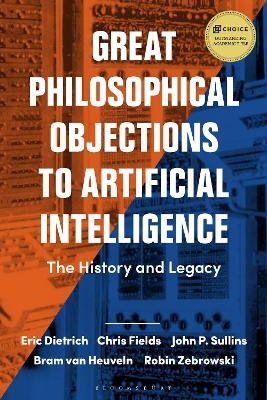
Great Philosophical Objections to Artificial Intelligence
Bloomsbury Academic (Verlag)
978-1-4742-5710-7 (ISBN)
A 2022 Choice Outstanding Academic Title
This book surveys and examines the most famous philosophical arguments against building a machine with human-level intelligence.
From claims and counter-claims about the ability to implement consciousness, rationality, and meaning, to arguments about cognitive architecture, the book presents a vivid history of the clash between the philosophy and AI. Tellingly, the AI Wars are mostly quiet now. Explaining this crucial fact opens new paths to understanding the current resurgence AI (especially, deep learning AI and robotics), what happens when philosophy meets science, and the role of philosophy in the culture in which it is embedded.
Organising the arguments into four core topics - 'Is AI possible', 'Architectures of the Mind', 'Mental Semantics and Mental Symbols' and 'Rationality and Creativity' - this book shows the debate that played out between the philosophers on both sides of the question, and, as well, the debate between philosophers and AI scientists and engineers building AI systems. Up-to-date and forward-looking, the book is packed with fresh insights and supporting material, including:
- Accessible introductions to each war, explaining the background behind the main arguments against AI
- Each chapter details what happened in the AI wars, the legacy of the attacks, and what new controversies are on the horizon.
- Extensive bibliography of key readings
Eric Dietrich is Professor of Philosophy of Binghamton University, USA. Chris Fields is an independent scholar based in France. John P. Sullins is Professor of Philosophy at Sonoma State University, USA. Bram Van Heuveln is Lecturer in the Cognitive Science Department at Rensselaer Polytechnic Institute, USA. Robin Zebrowski is Associate Professor of Cognitive Science, Chair of the Program in Cognitive Science, Beloit College, USA.
Contents
List of Figures
Prologue to the Second Edition
Prologue: The AI Wars and Beyond
Part I The AI Wars, 1950 to 2000
Introduction
The First War: Is AI Even Possible?
1 Gödel and a Foundational Objection to AI
2 How (not) to think about the Turing Test
The Second War: Architectures for Intelligence
3 How Computer Science Saved the Mind
4 Implementing an Intelligence
The Third War: Mental Semantics and Mental Symbols
5 The Strange Case of the Missing Meaning: Can Computers Think About Things?
The Fourth War: Rationality, Relevance, and Creativity
6 What is Relevant to What? The Frame Problem
Part II Beyond the AI Wars: New Issues Arise
Introduction
7 What about Consciousness?
8 Ethical Issues Surrounding AI Applications
9 Could Embodied AIs be Ethical Agents?
Part III The “New AI”: Generative Models Reignite Old Controversies
Introduction: Why is the “new AI” surprising?
10 Representation and semantics in Large Language Models
11 Have LLMs changed the debate about consciousness?
12 Sustainability: the new ethical issue raised by generative AI
Conclusion: Whither the AI Wars?
Notes
Bibliography
Index
| Erscheinungsdatum | 15.01.2021 |
|---|---|
| Verlagsort | London |
| Sprache | englisch |
| Maße | 150 x 229 mm |
| Gewicht | 480 g |
| Themenwelt | Geisteswissenschaften ► Philosophie |
| Naturwissenschaften | |
| ISBN-10 | 1-4742-5710-0 / 1474257100 |
| ISBN-13 | 978-1-4742-5710-7 / 9781474257107 |
| Zustand | Neuware |
| Informationen gemäß Produktsicherheitsverordnung (GPSR) | |
| Haben Sie eine Frage zum Produkt? |
aus dem Bereich