


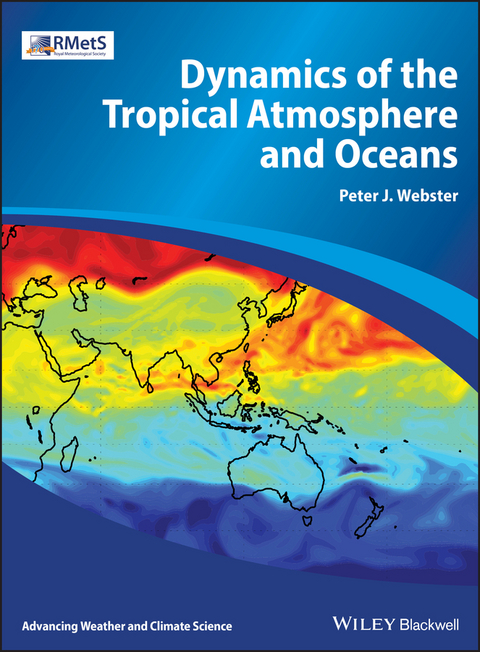
Dynamics of the Tropical Atmosphere and Oceans (eBook)
John Wiley & Sons (Verlag)
978-1-118-64845-2 (ISBN)
This book presents a unique and comprehensive view of the fundamental dynamical and thermodynamic principles underlying the large circulations of the coupled ocean-atmosphere system
Dynamics of The Tropical Atmosphere and Oceans provides a detailed description of macroscale tropical circulation systems such as the monsoon, the Hadley and Walker Circulations, El Niño, and the tropical ocean warm pool. These macroscale circulations interact with a myriad of higher frequency systems, ranging from convective cloud systems to migrating equatorial waves that attend the low-frequency background flow. Towards understanding and predicting these circulation systems.
A comprehensive overview of the dynamics and thermodynamics of large-scale tropical atmosphere and oceans is presented using both a 'reductionist' and 'holistic' perspectives of the coupled tropical system. The reductionist perspective provides a detailed description of the individual elements of the ocean and atmospheric circulations. The physical nature of each component of the tropical circulation such as the Hadley and Walker circulations, the monsoon, the incursion of extratropical phenomena into the tropics, precipitation distributions, equatorial waves and disturbances described in detail. The holistic perspective provides a physical description of how the collection of the individual components produces the observed tropical weather and climate. How the collective tropical processes determine the tropical circulation and their role in global weather and climate is provided in a series of overlapping theoretical and modelling constructs.
The structure of the book follows a graduated framework. Following a detailed description of tropical phenomenology, the reader is introduced to dynamical and thermodynamical constraints that guide the planetary climate and establish a critical role for the tropics. Equatorial wave theory is developed for simple and complex background flows, including the critical role played by moist processes. The manner in which the tropics and the extratropics interact is then described, followed by a discussion of the physics behind the subtropical and near-equatorial precipitation including arid regions. The El Niño phenomena and the monsoon circulations are discussed, including their covariance and predictability. Finally, the changing structure of the tropics is discussed in terms of the extent of the tropical ocean warm pool and its relationship to the intensity of global convection and climate change.
Dynamics of the Tropical Atmosphere and Oceans is aimed at advanced undergraduate and early career graduate students. It also serves as an excellent general reference book for scientists interested in tropical circulations and their relationship with the broader climate system.
Peter J. Webster, PhD, is Professor Emeritus in the School of Earth and Atmospheric Sciences at the Georgia Institute of Technology.
This book presents a unique and comprehensive view of the fundamental dynamical and thermodynamic principles underlying the large circulations of the coupled ocean-atmosphere system Dynamics of The Tropical Atmosphere and Oceans provides a detailed description of macroscale tropical circulation systems such as the monsoon, the Hadley and Walker Circulations, El Ni o, and the tropical ocean warm pool. These macroscale circulations interact with a myriad of higher frequency systems, ranging from convective cloud systems to migrating equatorial waves that attend the low-frequency background flow. Towards understanding and predicting these circulation systems. A comprehensive overview of the dynamics and thermodynamics of large-scale tropical atmosphere and oceans is presented using both a reductionist and holistic perspectives of the coupled tropical system. The reductionist perspective provides a detailed description of the individual elements of the ocean and atmospheric circulations. The physical nature of each component of the tropical circulation such as the Hadley and Walker circulations, the monsoon, the incursion of extratropical phenomena into the tropics, precipitation distributions, equatorial waves and disturbances described in detail. The holistic perspective provides a physical description of how the collection of the individual components produces the observed tropical weather and climate. How the collective tropical processes determine the tropical circulation and their role in global weather and climate is provided in a series of overlapping theoretical and modelling constructs. The structure of the book follows a graduated framework. Following a detailed description of tropical phenomenology, the reader is introduced to dynamical and thermodynamical constraints that guide the planetary climate and establish a critical role for the tropics. Equatorial wave theory is developed for simple and complex background flows, including the critical role played by moist processes. The manner in which the tropics and the extratropics interact is then described, followed by a discussion of the physics behind the subtropical and near-equatorial precipitation including arid regions. The El Ni o phenomena and the monsoon circulations are discussed, including their covariance and predictability. Finally, the changing structure of the tropics is discussed in terms of the extent of the tropical ocean warm pool and its relationship to the intensity of global convection and climate change. Dynamics of the Tropical Atmosphere and Oceans is aimed at advanced undergraduate and early career graduate students. It also serves as an excellent general reference book for scientists interested in tropical circulations and their relationship with the broader climate system.
Peter J. Webster, PhD, is Professor Emeritus in the School of Earth and Atmospheric Sciences at the Georgia Institute of Technology.
Acknowledgments
Throughout my career, I have had the privilege to work with many gifted students and colleagues. In fact, there are 31 young scientists whom I mentored on their way to their doctorates, in addition to many postdoctoral fellows who were part of our research group through the years. They constituted a diverse and international cadre, hailing from Romania, China, Australia, the United Kingdom, Brazil, Colombia, the United States, Japan, Russia, India, Taiwan, and Korea. Many have risen to positions of prominence, making significant contributions in their chosen careers in academia, research laboratories, and the private sector.
Most of all I have to thank my students and post-docs. I think one of the great privileges of being a professor is to be associated with bright young minds, watching them develop through hard work to become shining skeptical scientists. I know that the faculty–student interaction is often thought to be “top-down” but I feel that it is at least an equal interaction or perhaps even weighted “bottom-up.” Over the years, I think all of us have enjoyed the to and fro of what were often exciting group meetings.
I would like to acknowledge two members of my research group in particular, Drs. Hai-Ru Chang and Violeta Toma, both of whom contributed substantially to earlier versions of the manuscript. Hai-Ru has been an integral component of my research group since the mid-1980s. His rigor and theoretical knowledge of fluid dynamics have been a great benefit to our collective efforts. Violeta is a gifted diagnostician and was instrumental in producing analyses of near-equatorial phenomena, designing models and conducting many simulations. She has also made fundamental contributions to the concept of global synchronicity described in Chapter 11. I would also like to thank both Hai-Ru and Violeta for their critical assessment of various parts of the text. Thanks are also due to Dr. Ferdinand Hirata who carefully produced many of the figures.
The work of our research group is embodied in much of the text. I would like to mention some contributions that are particularly relevant to its major themes: Hye-Mi Kim for her diagnostics of intraseasonal variability and its relationship to tropical cyclone development; Song Yang who pointed out the non-stationarity of the interaction of the El Niño–Southern Oscillation (ENSO) and the Asian monsoon; Chidong Zhang who did initial work on the interaction of equatorially trapped modes and complex basic states and his more recent work on intraseasonal variability; Bill Lau for his insightful coupled ocean–atmosphere modeling over 40 years ago; Hai-Ru Chang who developed the concept of “wave energy” accumulation and emanation; Robert Tomas for determining the role that ocean heat transport played in the evolution and stability of the Asian monsoon and also, with Violeta Toma, on deciphering structure of near-equatorial convection; Carolyn Reynolds who introduced the group into uncertainties brought into forecasts and the regional growth of errors; Johannes Loschnigg and Chris Torrence who have made great strides towards understanding linkages between ENSO and monsoon variability, adding clarity to Normand's (1951) surmise regarding the lag and or lead of variability between ENSO and the Asian monsoon; Victor Magana and Sanjay Dixit who contributed to our understanding of monsoon and ENSO prediction; John Fasullo for perceptions relating westerly wind bursts and the heat balance of the tropical warm pool; Gill Compo for determining the fundamental structures of Asian cold surges and, with John Fasullo, how they alter the meteorology of the equatorial Pacific; Initial work on the Indian Ocean Zonal mode and its utility in prediction was undertaken by Christie Oefke Clarke and Daria Halkidies; Carlos Hoyos for his work on the evolution of the tropical warm pool and the development of a Bayesian prediction scheme for monsoon rainfall; Paula Agudelo for deciphering the physics of the transition of the suppressed phase of intraseasonal variability to its convective phase; Kam Sahami and Galina Chirokova for insightful modeling of Indian Ocean variability; Fernando Hirata and Dave Lawrence for deducing the intricacies of intraseasonal behavior in both the summer and winter monsoon; Matt Widlansky and Fernando Hirata for making great strides towards solving the mystery of the Great Cloud Bands; Manuel Zuluaga who advanced understanding of the role of aerosols in tropical climates; and Sebastian Ortega for developing fundamental insights into how the tropics and the extratropics interact. Matt Wheeler, of course, made fundamental contributions to the manner in which equatorial modes and convection intertwine. I appreciate the hard and inspirational work Tom Hopson, jun Jian and Kris Shrestha who developed long-horizon prediction schemes for Bangladesh and Pakistan. Also, thanks to Tom, Jun, jun, Bob Grossman, Subbiah-Ji of RIMES and Tom Brennan (of USAID), with whom I shared adventures in South Asia, Bangladesh and Pakistan attempting to implement these forecasting schemes. We may even have actually done something useful!
Over the years, I have had many colleagues to whom I have moaned and groaned about writing a book. They have remained cheerful, more so than me I must admit, and convinced me that it is a worthwhile endeavor. They have made both substantive and philosophical contributions that I have welcomed very much. George Kiladis and Matt Wheeler persisted (patiently) in convincing me in how convection and equatorial modes interact. George has been very generous with his time in discussing large sections of pertinent text. Robert Houze of the University of Washington has reminded me on many occasions how convective elements comprise an integral part of the dynamics of the tropics. Thanks are due to my Australian colleagues, Greg Holland, John McBride, and also “fellow (field expedition) traveller” Bob Grossman, who all nudged me on many occasions towards the realization that there is reality beyond theory or model results. I have come to realize that the empiricism embodied in their work and that offered by scientists such as Richard Johnson and Bob Houze is a vital component of the tropical puzzle. With respect to empiricism, I appreciate the inspiration of Prof. Michael Garstang, with whose research group I was briefly associated when I first arrived in the US. He was rather forceful in reminding many of us that the tropics was a complicated system and that not everything can be encapsulated in a neat set of equations. I also appreciate my colleague Professor Tim Palmer at Oxford for introducing me to the wonderful concept of uncertainty, chaos, and probabilistic forecasting during a sabbatical at ECMWF that has had a profound influence on subsequent work. Professor Sharon Nicholson of Florida State University provided data and ideas about the meteorology of near-equatorial Africa and how meteorology and climate differs markedly from one tropical region to another. I appreciate Graeme Stephens of NASA, who at an early stage of my career explained painstakingly the role of clouds in radiative forcing of the tropical atmosphere. We started our discussions in our cramped shared office in Australia. His work has gone onwards to influence climate research globally. He surely has influenced my way of thinking about the role of clouds in global climate. Professor Bin Wang's support, scientific collaboration, generosity and friendship through the years have remained very important to me. Much of our joint research appears throughout the text. Roger Lukas, my hard-working and dedicated “partner in TOGA COARE crime,” insisted I realize that the tropics must be thought of as a closely coupled ocean–atmosphere system across all time scales. I think his influence permeates much of the text.
A large part of my career has been involved in field expeditions. I have come to believe that these times in the field account for much of the progress we have made in tropical meteorology. The data collected is invaluable but they are catalysts for thought. Although expeditions arise from curiosity, implementation is often beyond the capabilities of just the curious. The transformation of ideas to results requires expert logistical support. Such support has come from the University Corporation of Atmospheric Research's (UCAR) Joint Office for Science Support led for many years by Karyn Sawyer. I first met Karyn in 1978 in Kolkata, India, during the Summer Monsoon Experiment and in the many subsequent field adventures that have followed. On numerous occasions her office has made it possible to transform a myriad of ideas to an organized reality, with the result of providing essential data to the larger scientific community.
It is a pleasure to acknowledge two colleagues who, early in my career, changed the way I think about science. The first was A. J. “Sandy” Troup of Australia, who showed that you could do quiet, personal research with dignity and without the expectation acknowledgement and be successful and influential. He explained the coupled nature of the Southern Oscillation 5–10 years before it became an accepted theory, but received little credit for his publications, externally or internally. Just doing the science was sufficient for him. I met Shri Dev Sikka-ji during my first visit to India in 1976. He remained an influential colleague for the next 40 years. He was a monsoon polymath with extraordinary physical insight and his contributions were rooted in his profound urge to understand the monsoon system fully and make this knowledge useful to society. His enthusiasm and dedication were infectious!
I wish to thank my...
| Erscheint lt. Verlag | 19.3.2020 |
|---|---|
| Reihe/Serie | Advancing Weather and Climate Science |
| Advancing Weather and Climate Science | Advancing Weather and Climate Science |
| Sprache | englisch |
| Themenwelt | Naturwissenschaften ► Geowissenschaften ► Meteorologie / Klimatologie |
| Technik | |
| Schlagworte | Atmosphere • atmospheric science • atmospheric sciences • Climate • climatology • Climatology & Palaeoclimatology • earth science • earth sciences • Geowissenschaften • Klimatologie u. Meteorologie • Klimatologie u. Paläoklimatologie • <p>weather • Meteorologie • meteorology • meteorology</p> • Tropical • tropical climate • tropical fluid dynamics • tropics • weather prediction |
| ISBN-10 | 1-118-64845-5 / 1118648455 |
| ISBN-13 | 978-1-118-64845-2 / 9781118648452 |
| Informationen gemäß Produktsicherheitsverordnung (GPSR) | |
| Haben Sie eine Frage zum Produkt? |
 EPUB (Adobe DRM)
Kopierschutz: Adobe-DRM
Adobe-DRM ist ein Kopierschutz, der das eBook vor Mißbrauch schützen soll. Dabei wird das eBook bereits beim Download auf Ihre persönliche Adobe-ID autorisiert. Lesen können Sie das eBook dann nur auf den Geräten, welche ebenfalls auf Ihre Adobe-ID registriert sind.
Details zum Adobe-DRM
Dateiformat: EPUB (Electronic Publication)
EPUB ist ein offener Standard für eBooks und eignet sich besonders zur Darstellung von Belletristik und Sachbüchern. Der Fließtext wird dynamisch an die Display- und Schriftgröße angepasst. Auch für mobile Lesegeräte ist EPUB daher gut geeignet.
Systemvoraussetzungen:
PC/Mac: Mit einem PC oder Mac können Sie dieses eBook lesen. Sie benötigen eine
eReader: Dieses eBook kann mit (fast) allen eBook-Readern gelesen werden. Mit dem amazon-Kindle ist es aber nicht kompatibel.
Smartphone/Tablet: Egal ob Apple oder Android, dieses eBook können Sie lesen. Sie benötigen eine
Geräteliste und zusätzliche Hinweise
Buying eBooks from abroad
For tax law reasons we can sell eBooks just within Germany and Switzerland. Regrettably we cannot fulfill eBook-orders from other countries.
aus dem Bereich


