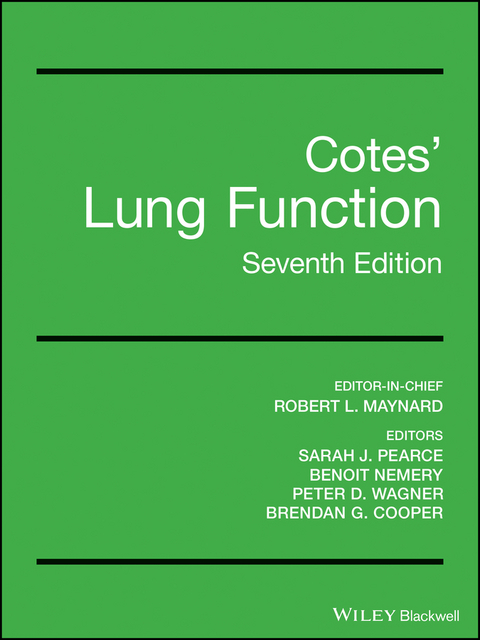
Lung Function (eBook)
John Wiley & Sons (Verlag)
978-1-118-59732-3 (ISBN)
The seventh edition of the most authoritative and comprehensive book published on lung function, now completely revised and restructured
Lung function assessment is the central pillar of respiratory diagnosis. Most hospitals have lung function laboratories where patients are tested with a variety of physiological methods. The tests and techniques used are specialized and utilize the expertise of respiratory physicians, physiologists, and technicians. This new edition of the classic text on lung function is a theoretical textbook and practical manual in one that gives a comprehensive account of lung function and its assessment in healthy persons and those with all types of respiratory disorder, against a background of respiratory, exercise, and environmental physiology. It incorporates the technical and methodological recommendations for lung function testing of the American Thoracic Society and European Respiratory Society.
Cotes' Lung Function, 7th Edition is filled with chapters covering respiratory surveys, respiratory muscles, neonatal assessment, exercise, sleep, high altitude, hyperbaria, the effects of cold and heat, respirable dusts, fumes and vapors, anesthesia, surgery, and respiratory rehabilitation. It also offers a compendium of lung function in selected individual diseases and is filled with more diagrams and illustrative cases than previous editions.
- The only text to cover lung function assessment from first principles including methodology, reference values, and interpretation
- Completely re-written in a contemporary style-includes user-friendly equations and more diagrams
- Covers the latest advances in the treatment of lung function, including a stronger clinical and practical bias and more on new techniques and equipment
- Keeps mathematical treatments to a minimum
Cotes' Lung Function is an ideal guide for respiratory physicians and surgeons, staff of lung function laboratories, and others who have a professional interest in the function of the lungs at rest or on exercise and how it may be assessed. Physiologists, anthropologists, pediatricians, anesthetists, occupational physicians, explorers, epidemiologists, and respiratory nurses should also find the book useful.
John Cotes, PhD, (deceased), was a respiratory physiologist who played a key role in the conquest of Everest in 1953. He also played prominent roles in the European Respiratory Society, the Thoracic Society, and the Association of Respiratory Technicians and Physiologists, and was an honorary fellow of the Faculty of Occupational Medicine.
Robert L. Maynard, CBE, FRCP, FRCPath, is an Honorary Professor of Environmental Medicine at the University of Birmingham, Birmingham, UK.
Sarah J. Pearce, FRCP, is Formerly Consultant Physician at County Durham and Darlington NHS Foundation Trust, Darlington, UK.
Benoit B. Nemery, MD, PhD, is Professor of Toxicology & Occupational Medicine for the Faculty of Medicine at the Department of Public Health and Primary Care, KU Leuven, Belgium.
Peter D. Wagner, MD, is Distinguished Professor of Medicine & Bioengineering at the University of California, San Diego, CA, USA.
Brendan G. Cooper, PhD, FERS, FRSB, is Consultant Clinical Scientist in Respiratory and Sleep Physiology at University Hospital Birmingham and holds an Honorary Professorship in Respiratory & Sleep Physiology at the University of Birmingham, Birmingham, UK.
The seventh edition of the most authoritative and comprehensive book published on lung function, now completely revised and restructured Lung function assessment is the central pillar of respiratory diagnosis. Most hospitals have lung function laboratories where patients are tested with a variety of physiological methods. The tests and techniques used are specialized and utilize the expertise of respiratory physicians, physiologists, and technicians. This new edition of the classic text on lung function is a theoretical textbook and practical manual in one that gives a comprehensive account of lung function and its assessment in healthy persons and those with all types of respiratory disorder, against a background of respiratory, exercise, and environmental physiology. It incorporates the technical and methodological recommendations for lung function testing of the American Thoracic Society and European Respiratory Society. Cotes' Lung Function, 7th Edition is filled with chapters covering respiratory surveys, respiratory muscles, neonatal assessment, exercise, sleep, high altitude, hyperbaria, the effects of cold and heat, respirable dusts, fumes and vapors, anesthesia, surgery, and respiratory rehabilitation. It also offers a compendium of lung function in selected individual diseases and is filled with more diagrams and illustrative cases than previous editions. The only text to cover lung function assessment from first principles including methodology, reference values, and interpretation Completely re-written in a contemporary style includes user-friendly equations and more diagrams Covers the latest advances in the treatment of lung function, including a stronger clinical and practical bias and more on new techniques and equipment Keeps mathematical treatments to a minimum Cotes' Lung Function is an ideal guide for respiratory physicians and surgeons, staff of lung function laboratories, and others who have a professional interest in the function of the lungs at rest or on exercise and how it may be assessed. Physiologists, anthropologists, pediatricians, anesthetists, occupational physicians, explorers, epidemiologists, and respiratory nurses should also find the book useful.
John Cotes, PhD, (deceased), was a respiratory physiologist who played a key role in the conquest of Everest in 1953. He also played prominent roles in the European Respiratory Society, the Thoracic Society, and the Association of Respiratory Technicians and Physiologists, and was an honorary fellow of the Faculty of Occupational Medicine. Robert L. Maynard, CBE, FRCP, FRCPath, is an Honorary Professor of Environmental Medicine at the University of Birmingham, Birmingham, UK. Sarah J. Pearce, FRCP, is Formerly Consultant Physician at County Durham and Darlington NHS Foundation Trust, Darlington, UK. Benoit B. Nemery, MD, PhD, is Professor of Toxicology & Occupational Medicine for the Faculty of Medicine at the Department of Public Health and Primary Care, KU Leuven, Belgium. Peter D. Wagner, MD, is Distinguished Professor of Medicine & Bioengineering at the University of California, San Diego, CA, USA. Brendan G. Cooper, PhD, FERS, FRSB, is Consultant Clinical Scientist in Respiratory and Sleep Physiology at University Hospital Birmingham and holds an Honorary Professorship in Respiratory & Sleep Physiology at the University of Birmingham, Birmingham, UK.
Preface xxvii
Contributors xxix
Part I Introduction 1
1 How We Came to Have Lungs and How Our Understanding of Lung Function has Developed 3
Part II Foundations 21
2 Getting Started 23
3 Development and Functional Anatomy of the Respiratory System 33
Sungmi Jung and Richard Fraser
4 Body Size and Anthropometric Measurements 45
5 Numerical Interpretation of Physiological Variables 57
J. Martin Bland
6 Basic Terminology and Gas Laws 75
Adrian Kendrick
7 Basic Equipment and Measurement Techniques 91
Brendan G. Cooper
8 Respiratory Surveys 117
Peter G.J. Burney
9 The Application of Analytical Technique Applied to Expired Air as a Means of Monitoring Airway and Lung Function 129
Paolo Paredi and Peter Barnes
Part III Physiology and Measurement of Lung Function 149
10 Chest Wall and Respiratory Muscles 151
Andre De Troyer and John Moxham
11 Lung Volumes 177
12 Lung and Chest Wall Elasticity 187
G. John Gibson
13 Forced Ventilatory Volumes and Flows 203
Riccardo Pellegrino
14 Theory and Measurement of Respiratory Resistance 217
Jason H.T. Bates
15 The Control of Airway Function and the Assessment of Airway Calibre 231
Eric Derom
16 Ventilation, Blood Flow, and Their Inter-Relationships 259
G. Kim Prisk
17 Transfer of Gases into the Blood of Alveolar Capillaries 301
Eric Derom and Guy F. Joos
18 Transfer Factor (Tl) for carbon monoxide (CO) and nitric oxide (NO) 313
Colin D.R. Borland and Mike Hughes
19 Oxygen 353
Dan S. Karbing and Stephen E. Rees
20 Carbon Dioxide 377
Erik R. Swenson
21 Control of Respiration 389
Bertien M.-A. Buyse
22 The Sensation of Breathing 407
Mathias Schroijen, Paul W. Davenport, Omer Van den Bergh, and Ilse Van Diest
23 Breathing Function in Newborn Babies 423
Urs P. Frey and Philipp Latzin
Part IV Normal Variation in Lung Function 435
24 Normal Lung Function from Childhood to Old Age 437
Andrew Bush and Michael D.L. Morgan
25 Reference Values for Lung Function in White Children and Adults 463
26 Reference Values for Lung Function in Non-White Adults and Children 499
Part V Exercise 517
27 Physiology of Exercise and Effects of Lung Disease on Performance 519
28 Exercise Testing and Interpretation, Including Reference Values 553
29 Assessment of Exercise Limitation, Disability, and Residual Ability 577
30 Exercise in Children 587
Andrew Bush
Part VI Breathing During Sleep 595
31 Breathing During Sleep and its Investigation 597
Joerg Steier
Part VII Potentially Adverse Environments 615
32 Hypobaria 617
James Milledge
33 Immersion in Water, Hyperbaria, and Hyperoxia Including Oxygen Therapy 639
Einar Thorsen
34 Effects of Cold and Heat on the Lung 653
Malcolm Sue-Chu
Part VIII Lung Function in Clinical Practice 661
35 Strategies for Assessment of Lung Function 663
James Hull
36 Patterns of Abnormal Lung Function in Lung Disease 673
William Kinnear
37 Lung Function in Asthma, Chronic Obstructive Pulmonary Disease, and Lung Fibrosis 681
Wim Janssens and Pascal Van Bleyenbergh
38 Lung Function in Specific Respiratory and Systemic Diseases 697
Stephen J. Bourke
39 Pulmonary Rehabilitation 729
Sally Singh
40 Lung Function in Relation to Surgery, Anaesthesia, and Intensive Care 737
Goran Hedenstierna
Index 751
1
How We Came to Have Lungs and How Our Understanding of Lung Function has Developed
This chapter describes how the theory and practice of lung function testing have reached their present state of development and gives pointers to the future.
CHAPTER MENU
- 1.1 The Gaseous Environment
- 1.2 Functional Evolution of the Lung
- 1.3 Early Studies of Lung Function
- 1.4 The Past 350 Years
- 1.5 Practical Assessment of Lung Function
- 1.6 The Position Today
- 1.7 Future Prospects
- References
1.1 The Gaseous Environment
The basis of respiratory physiology is Claude Bernard’s concept of a ‘milieu interieur’ that remains constant and stable despite changes in the environment. However, the two are not independent since life on Earth has evolved symbiotically with changes in Earth’s atmosphere and this process is continuing. At first, the composition of the atmosphere was determined by physical processes, and then by biological ones. Now changes in the composition of air are being driven by man’s own actions. It remains to be seen how and to what extent the system will adapt.
Initially the atmosphere was mainly nitrogen. Then as the Earth cooled, carbon dioxide (CO2) was formed by chemical reactions beneath the Earth’s crust and released by volcanic activity. Some of the gas was taken up by combination with minerals and deposited as sediment at the bottom of the oceans. Oxygen was released, but immediately combined with iron and other elements, and so the atmospheric concentration was very low [1, 2]. Subsequently, the concentration of oxygen increased as a result of biological activity [3]. A hypothesis as to how this happened was proposed by Lovelock [4], whose concept of the living Earth (Gaia) is on a par with evolution as one of the formative influences of our time.
Free oxygen first appeared some 3.5 × 10⁹ years ago, coincidentally with the development of organisms capable of photosynthesis. The organisms multiplied and their growth reduced significantly the atmospheric concentration of CO2. Some organisms (methanogens) developed an ability to form free methane gas. The methane was liberated into the atmosphere, where it shielded the Earth’s surface from ultraviolet light. The shielding allowed ammonia gas to accumulate and this provided a substrate for the growth of photosynthesising organisms; as a result, at the beginning of the Proterozoic era some 2.3 × 10⁹ years ago, the atmospheric concentration of oxygen began to rise. By geological standards the increase was rapid, from 0.1% to 1% over about 1 million years (Figure 1.1).
When the ambient oxygen concentration reached 0.2%, aerobic organisms became abundant in the surface layers of lakes and oceans; at 2%, life began to move onto the land. A concentration of 3% may have been attained some 1.99 × 10⁹ years ago. At 10% photosynthesis was at its peak; this further raised the concentration of oxygen and lowered that of CO2. The changes reduced the available substrate (CO2) and increased the formation of hydrogen peroxide, superoxide ions, and atomic oxygen that were potentially lethal to cells. Photosynthesis was reduced in consequence. With other factors, the balance between promotion and inhibition of photosynthesis formed a feedback loop that stabilised the atmospheric concentration of oxygen at its present level (21.93%, FIO2 = 0.2193; Chapter 6).
Figure 1.1 Approximate timescale for the evolution of the gaseous environment.
Source: After [4].
The concentration of oxygen stabilised at the start of the Phanerozoic era some 6 × 10⁸ years ago. It led to the evolution of animals with skeletons. Thereafter, the concentration of CO2, and to some extent that of oxygen, appears to have oscillated in response to secondary factors. These included fluctuations in the balance between the relative dominance of plants and animals. Some 5 × 10⁸ years ago the species that were net consumers of oxygen (e.g. bacteria, fungi, and insects) were in the ascendancy and CO2 levels were relatively high. Then, plants that fix CO2 as lignin appeared and the levels fell. The plants led to the evolution of dinosaurs and other animals that could feed off and digest the cellulose. The species flourished and the cycle was reversed. From time to time the sequence was unsettled by dust clouds from meteors and volcanic eruptions. The dust interfered with photosynthesis by obscuring the sun, but up to the present the equilibrium has always been restored.
Currently, the atmosphere is under threat from human activity. Clearance of forests and the replacement of grassland by buildings and roads are reducing the Earth’s capacity for photosynthesis. Hence, the amount of CO2 removed from air is falling. Concurrently, the quantity released is increasing because of massive combustion of fossil fuels. As a result, the Earth’s temperature is rising and this is increasing the formation of methane gas that could raise the temperature further. However it also has other effects, and so the long‐term outcome is unpredictable. In the short term any change in gaseous equilibrium is likely to occur slowly.
In summary, living organisms first appeared in an anaerobic environment that they helped to convert to an aerobic one. Hence they were adapting to the new conditions as they were creating them. On this account, the capacity to tolerate conditions of hypoxia and hypercapnia are part of man’s heritage. How this is achieved is described in subsequent chapters. The evolutionary history also indicates the importance of natural protection against oxygen radicals. However, there is only limited evidence for Berken and Marshall’s suggestion [1] that the relevant mechanisms emerged during periods of what we would now regard as hyperoxia.
1.2 Functional Evolution of the Lung
Aerobic organisms developed in an aqueous medium where the amount of oxygen is determined by its partial pressure and by the solubility; this is such that the concentration in water is only about one‐fortieth of that in air (Table 1.1). By contrast CO2 is highly soluble, so at physiological partial pressures the concentration in water is nearly as great as in air. The differences in solubility have consequences for gas exchange [5].
For fish the problem of obtaining sufficient oxygen was solved by the evolution of the gill system. This organ is ventilated by a large volume of water from which almost all the oxygen is extracted; the blood leaving the bronchial clefts contains oxygen in a concentration equal to that in blood leaving the lung in man. However, the large volume of water flowing over the gill takes with it much of the CO2 in solution and this lowers the CO2 tension in the blood leaving the gill to less than 0.7 kPa (5 mmHg). Mainly on this account the blood pH is relatively high (approximately 8.0 pH units at a temperature of 20 °C). At higher water temperatures the pH falls to approach that in the blood of man. Concurrently, the solubility of oxygen in water delivered to the gill clefts is reduced.
Table 1.1 Atmospheric concentrations and solubility in water of oxygen and carbon dioxide.
| Units | Oxygen | Carbon dioxide |
| Atmospheric concentration Solubility in water at 1 atm: | vol./vol. | 0.2093 | 0.003 |
| Temperature 20 °Ca | 0.031 | 0.88 |
| Temperature 37 °Ca | 0.024 | 0.55 |
a Solubility in blood plasma is approximately 10% less.
atm., atmosphere; TPD, standard temperature and pressure dry.
In hot climates a high ambient temperature might cause streams to dry up, leaving any fish stranded. To meet this hazard some fish developed lung‐like pouches in the back of the pharynx; they also developed primitive limbs with which to crawl along streambeds in search of water. For this type of existence a gill for the exchange of CO2 and a primitive lung for exchanging oxygen formed a life‐saving combination. The lung was further developed in reptiles. In birds the pouches were adapted as reservoirs from which air was pumped in a cross‐current manner through parabronchi; these supplied air to the gas exchange zones where the whole of the surface was lined with capillaries. This arrangement resulted in a very compact lung with a high capacity to transfer gas. The amphibians developed in a different way by shedding their scales to leave a soft vascular skin; this replaced the gill as a means of exchanging CO2 with the surrounding water. Somewhere between these diverging species emerged the primitive mammals and eventually man.
1.3 Early Studies of Lung Function
Erasistratus (c. 280 BCE) and Galen (129–201) (see Footnote 1.1) demonstrated the role of the diaphragm as a muscle of respiration, the origin and function of the phrenic nerve, and the function of the intercostal...
| Erscheint lt. Verlag | 13.3.2020 |
|---|---|
| Sprache | englisch |
| Themenwelt | Medizin / Pharmazie ► Gesundheitsfachberufe |
| Medizinische Fachgebiete ► Innere Medizin ► Pneumologie | |
| Naturwissenschaften ► Biologie | |
| Schlagworte | Altitude • Anatomie u. Physiologie • Anatomy & Physiology • Biowissenschaften • Breathing • Bronchial • Bronchoscopy • Life Sciences • <p>lungs • Lung • Lunge • lung function • Medical Science • Medizin • Medizin des Atmungssystems • Pulmonary • Pulmonary function • Pulmonary Medicine • pulmonology</p> • respiration • respiratory diagnosis • Respiratory Medicine • Respiratory physiology • Sportmedizin • sports medicine • Thoracic Medicine • Thorax |
| ISBN-10 | 1-118-59732-X / 111859732X |
| ISBN-13 | 978-1-118-59732-3 / 9781118597323 |
| Informationen gemäß Produktsicherheitsverordnung (GPSR) | |
| Haben Sie eine Frage zum Produkt? |
 EPUB (Adobe DRM)
Kopierschutz: Adobe-DRM
Adobe-DRM ist ein Kopierschutz, der das eBook vor Mißbrauch schützen soll. Dabei wird das eBook bereits beim Download auf Ihre persönliche Adobe-ID autorisiert. Lesen können Sie das eBook dann nur auf den Geräten, welche ebenfalls auf Ihre Adobe-ID registriert sind.
Details zum Adobe-DRM
Dateiformat: EPUB (Electronic Publication)
EPUB ist ein offener Standard für eBooks und eignet sich besonders zur Darstellung von Belletristik und Sachbüchern. Der Fließtext wird dynamisch an die Display- und Schriftgröße angepasst. Auch für mobile Lesegeräte ist EPUB daher gut geeignet.
Systemvoraussetzungen:
PC/Mac: Mit einem PC oder Mac können Sie dieses eBook lesen. Sie benötigen eine
eReader: Dieses eBook kann mit (fast) allen eBook-Readern gelesen werden. Mit dem amazon-Kindle ist es aber nicht kompatibel.
Smartphone/Tablet: Egal ob Apple oder Android, dieses eBook können Sie lesen. Sie benötigen eine
Geräteliste und zusätzliche Hinweise
Buying eBooks from abroad
For tax law reasons we can sell eBooks just within Germany and Switzerland. Regrettably we cannot fulfill eBook-orders from other countries.
aus dem Bereich