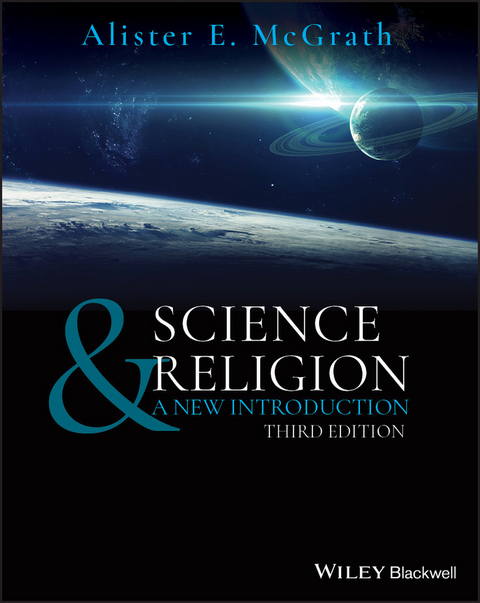
Science & Religion (eBook)
272 Seiten
Wiley-Blackwell (Verlag)
978-1-119-59986-9 (ISBN)
The leading introductory textbook on the study of religion and the natural sciences, including new coverage of the latest topics in the field
Science and Religion provides students with a thorough introduction to the major themes and landmark debates in the interaction of science and religion. Incorporating history, philosophy, the natural sciences, and theology, this popular textbook examines how science and religion approach central questions and discusses the relationship between the two areas through the centuries. The authoritative and accessible chapters are designed for readers with minimal knowledge of science or theology.
Written by one of the world's leading authorities on the study of religion and science, this fully revised and updated third edition addresses contemporary topics and reflects the latest conceptual developments in the field. New and expanded chapters and case studies discuss Scientism, evolutionary theodicy, the Theory of Relativity, warranted belief in science and religion, the influence of science and religion on human values, and more. The most up-to-date introduction to this exciting and rapidly growing field, this textbook:
- Offers an engaging, thematically-based approach to the subject
- Provides historical context for major events in science and religion
- Explores scientific and religious perspectives on Creation and the existence of God
- Discusses models, analogies, and issues at the intersection of science and religion
- Is supported by a series of videos that complement each chapter
One of the most respected and widely adopted textbooks in the field, Science and Religion: A New Introduction, 3rd Edition is an ideal resource for college, seminary, and university students in courses in science and religion; church or community courses in the relation of science and faith; and general readers looking for an inclusive overview of the field.
Alister E. McGrath is Andreas Idreos Professor of Science and Religion and Director of the Ian Ramsey Centre for Science and Religion at the University of Oxford, UK. He is the editor of the Ian Ramsey Centre Studies in Science and Religion and the author of many influential works, including Dawkins' God: From the 'Selftsh Gene' to the 'God Delusion.'
Alister E. McGrath is Andreas Idreos Professor of Science and Religion and Director of the Ian Ramsey Centre for Science and Religion at the University of Oxford, UK. He is the editor of the Ian Ramsey Centre Studies in Science and Religion and the author of many influential works, including Dawkins' God: From the "Selftsh Gene" to the "God Delusion."
"Science and Religion: A New Introduction is now into its third edition and is an excellent introduction to the whole field of science and religion." - Perspectives on Science and Christian Faith, Volume 73, Number 1, March 2021
Chapter 2
Getting Started: Some Historical Landmarks
Many people are attracted to study the relation of science and religion because it engages many of today's ‘big questions’ – such as how to live a good life, and how we can inhabit this puzzling universe in a meaningful way. Part of the sheer excitement of this field is the fact that it engages live debates, issues that are of immediate relevance. Yet many who are exploring the field of science and religion for the first time find themselves puzzled by the emphasis that many works in this field place on past discussions and debates.
Why study past debates, when these seem irrelevant to contemporary concerns? Why look at the past, when there are so many important discussions taking place in the present? Many natural scientists point out that their disciplines are developing so rapidly that older ideas become outdated with alarming speed, with research articles becoming outdated within two decades. To study history seems to be about disengaging from the real world and entering a very different world that bears little relation to ours. ‘The past is a foreign country: they do things differently there’ (L. P. Hartley).
Nevertheless, anyone wishing to understand the interaction of science and religion needs to become familiar with at least four major historical landmarks – the astronomical debates of the sixteenth and early seventeenth centuries; the rise of the Newtonian worldview in the late seventeenth and eighteenth century; the Darwinian controversy of the nineteenth century; and the cosmological developments of the twentieth century relating to the origins of the universe. The issues raised by these developments are found again and again in contemporary debates. They loom over contemporary discussions of the relation of science and faith in general, while raising specific questions that continue to be debated today, often relating to biblical interpretation. Memories of past debates constantly hover around today's discussions.
This chapter aims to introduce these historical landmarks, indicating the major points they raise for discussion and their significance for our time. As these four discussions are constantly referred to in the literature concerning the theme of ‘science and religion’ – as they are also in the present text – readers need to be familiar with the basic ideas and developments. They are therefore discussed in this early section, along with the emergence of the ‘medieval synthesis’, which many scholars now consider to have provided the essential intellectual context for the emergence of the natural sciences.
Yet many readers of this work, while recognizing the practical force of this point, will still want to ask why they should bother studying history at all. Before looking at these four specific debates, we shall pause and give some thought to the place of history in the interaction between science and religion.
Why Study History?
What is the point of looking back to the past when we are meant to be talking about themes concerning science and religion in the twenty‐first century? Why study debates from centuries ago, when there is so much that is intellectually important and interesting in the present? These are fair questions, which deserve careful answers.
Any discussion of the relationship between science and religion today has been made problematic by the lingering influence of past controversies, often in the form of popular misreadings or misrepresentations of multifaceted historical episodes. For example, the tensions between Galileo and the church were complicated by institutional apologetics and the political power of Aristotelian approaches to science, especially at the University of Padua. Modern scholarship has successfully deconstructed popular historical accounts of many of these controversies, exposing the power dynamics and cultural agendas of many of those who seek to portray science and Christianity as locked in mortal combat.
In a series of important and influential historical studies of science and religion, published in the 1990s and beyond and focusing especially on the nineteenth century, the Oxford scholar John Hedley Brooke has argued that serious scholarship in the history of science has revealed ‘so extraordinarily rich and complex a relationship between science and religion in the past that general theses are difficult to sustain. The real lesson turns out to be the complexity.’ Brooke's analysis has found widespread support within the scholarly community, even if it has been slow to filter down to popular discussions. Peter Harrison has more recently pointed out that ‘study of the historical relations between science and religion does not reveal any simple pattern at all’, such as the monomyth of the ‘conflict’ narrative, which we shall consider below. It does, however, disclose a general trend – that for most of the time, according to Harrison, religion has facilitated scientific inquiry.
Historical research over the last three decades has made it clear that there is no ‘right’ or privileged way of understanding the relationship of science and religion. Instead, we find a rich range of possibilities, some of which are declared to be normative by those with special interests in the matter. The tendency to essentialize both ‘science’ and ‘religion’ has led many to neglect the importance of historical and cultural context in shaping perceptions about how Christianity and the natural sciences should – or might – relate to each other.
In what follows, we shall look at how studying the past history of the interaction of science and religion helps us understand their present relationship. To explore the importance of this point, we shall begin by considering the origins of the widespread popular belief that science and religion are permanently at loggerheads – the so‐called ‘warfare’ model of the interaction of science and religion. This is still deeply embedded in popular thinking.
Inventing the ‘Warfare’ of Science and Religion
The relationship between science and religion has always been complex. There is no ‘master narrative’ which describes their relationship – such as the notoriously inaccurate ‘warfare’ narrative, noted above, which posits that science and religion have always been engaged in a fight to the death. It is well known that the scientific revolution witnessed both tension and collaboration between traditional religious viewpoints and innovative scientific theories.
To illustrate this complex picture, let us consider the Christian doctrine of creation, which shaped the intellectual world of early modern Europe, and encouraged people to think of a regular, ordered universe that reflected the wisdom of its creator. Intense study of the created order was seen by many as a means of gaining an increased appreciation of the ‘mind of God’. There was thus a positive religious motivation for undertaking scientific research. Yet this same traditional doctrine of creation generated tensions, especially as Charles Darwin's narrative of human origins began to gain the ascendency in the late nineteenth century. Darwin's theory seemed to call into question the validity of a literal reading of the opening chapters of the book of Genesis. Tensions emerged, which remain to this day.
It is also important to appreciate that science is, almost by definition, a subversive activity, challenging all kinds of vested interests and power groups. The physicist Freeman Dyson penned an important essay entitled ‘The Scientist as Rebel’, in which he pointed out that many scientists have found themselves engaged in a ‘rebellion against the restrictions imposed by the local prevailing culture’.
This can easily be illustrated from the history of the interaction of science and culture. For the Arab mathematician and astronomer Omar Khayyam (1048–1122), science was a rebellion against the intellectual constraints of Islam; for nineteenth‐century Japanese scientists, science was a rebellion against the lingering feudalism of their culture; for the great Indian physicists of the twentieth century, their discipline was a powerful intellectual force directed against the fatalistic ethic of Hinduism (not to mention British imperialism, which was then dominant in the region). In western Europe, scientific advance inevitably involved confrontation with the culture of the day – including its political, social, and religious elements. In that the West has been dominated by Christianity, it is thus unsurprising that the tension between science and Western culture has often been viewed as a confrontation between science and Christianity. In fact, the real tension is between scientific innovation and cultural traditionalism.
Yet despite this clear absence of any normative metanarrative of the relation of religion and science, one ‘story’ has gained the ascendancy and, despite its obvious evidential underdetermination, it continues to shape media narratives and cultural attitudes – I refer to the ‘warfare’ model. According to the historian of science Thomas Dixon, the myth of the ‘warfare’ of science and religion was a self‐serving myth that was invented by Enlightenment rationalists in the late 1700s, propagated by Victorian free‐thinkers in the late 1800s, and is defended today by...
| Erscheint lt. Verlag | 25.2.2020 |
|---|---|
| Sprache | englisch |
| Themenwelt | Geisteswissenschaften ► Philosophie ► Erkenntnistheorie / Wissenschaftstheorie |
| Religion / Theologie ► Christentum ► Kirchengeschichte | |
| Naturwissenschaften | |
| Schlagworte | <p>science and religion • Natural Theology • Religion & Culture • Religion & Science • Religion & Theology • Religion, Issues & Current Affairs • Religionsfragen u. aktuelle Probleme • Religion u. Kultur • Religion u. Naturwissenschaften • Religion u. Theologie • science and creation • science and faith • science and God</p> • science and religion fundamentals • science and religion interaction • science and religion intro • science and religion textbook • Science and theology |
| ISBN-10 | 1-119-59986-5 / 1119599865 |
| ISBN-13 | 978-1-119-59986-9 / 9781119599869 |
| Informationen gemäß Produktsicherheitsverordnung (GPSR) | |
| Haben Sie eine Frage zum Produkt? |
 EPUB (Adobe DRM)
Kopierschutz: Adobe-DRM
Adobe-DRM ist ein Kopierschutz, der das eBook vor Mißbrauch schützen soll. Dabei wird das eBook bereits beim Download auf Ihre persönliche Adobe-ID autorisiert. Lesen können Sie das eBook dann nur auf den Geräten, welche ebenfalls auf Ihre Adobe-ID registriert sind.
Details zum Adobe-DRM
Dateiformat: EPUB (Electronic Publication)
EPUB ist ein offener Standard für eBooks und eignet sich besonders zur Darstellung von Belletristik und Sachbüchern. Der Fließtext wird dynamisch an die Display- und Schriftgröße angepasst. Auch für mobile Lesegeräte ist EPUB daher gut geeignet.
Systemvoraussetzungen:
PC/Mac: Mit einem PC oder Mac können Sie dieses eBook lesen. Sie benötigen eine
eReader: Dieses eBook kann mit (fast) allen eBook-Readern gelesen werden. Mit dem amazon-Kindle ist es aber nicht kompatibel.
Smartphone/Tablet: Egal ob Apple oder Android, dieses eBook können Sie lesen. Sie benötigen eine
Geräteliste und zusätzliche Hinweise
Buying eBooks from abroad
For tax law reasons we can sell eBooks just within Germany and Switzerland. Regrettably we cannot fulfill eBook-orders from other countries.
aus dem Bereich