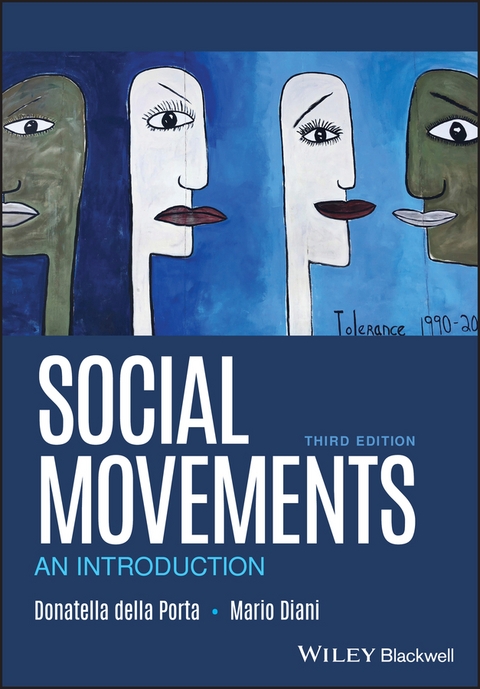
Social Movements (eBook)
John Wiley & Sons (Verlag)
9781119167679 (ISBN)
A new, fully-revised and updated edition of the leading introduction to social movements and collective action - covers a broad range of approaches in the social sciences.
Now in its third edition, Social Movements is the market-leading introductory text on collective action in contemporary society. The text draws from theory-driven, systematic empirical research from across the social sciences to address central questions and concepts in the field. Sophisticated yet reader-friendly chapters offer critical analyses of relevant literature whilst exploring important issues and debates.
The global political landscape has undergone significant changes in the years since this book's initial publication, such as the spread of online protests, the resurgence of nationalist and right-wing activity, global revolts, and increased social and economic polarization. This thoroughly updated edition offers fresh discussions of recent social movements against austerity from around the world, new empirical examples, references to recent episodes of contention, an expanded comparative approach to social movement theory in the scientific literature, and more. Positioned at the intersection of sociology and political science, this book:
- Presents an empirical and engaging exploration of contemporary social movements
- Discusses topics such as organizing within social movements, eventful protests, political opportunities, symbolism and identity in collective action, and social change
- Highlights how core mechanisms of collective action operate in different movements, past and present
- Provides a conceptual methodology useful for social science students and researchers alike
- Highlights how core mechanisms of collective action operate in different movements in the past and present
Written by two internationally recognized experts in sociology and political science, the third edition of Social Movements: An Introduction is an essential course text and a must-read for students and scholars of sociology, political sociology, political science, and social movement studies.
Donatella della Porta is Professor of Political Science and Dean of the Faculty of Political and Social Sciences at the Scuola Normale Superiore, Florence, Italy. She is also Director of the PhD program in Political Science and Sociology, and she leads the Center on Social Movement Studies (Cosmos). She has authored and edited many books, journal articles and contributions in edited volumes. Recent publications include Where did the Revolution go? (2017) and Legacies and Memories in Movements (2018).
Mario Diani is Professor and Chair of the Department of Sociology and Social Research, University of Trento, Italy. He was formerly ICREA Research Professor in the Department of Political and Social Sciences of Universitat Pompeu Fabra, Barcelona from 2010-2012, and Professor of Sociology at Strathclyde University in Glasgow from 1996-2001. His publications include The Cement of Civil Society: Studying Networks in Localities (2015) and articles in leading journals such as American Sociological Review and American Journal of Sociology.
Donatella della Porta is Professor of Political Science and Dean of the Faculty of Political and Social Sciences at the Scuola Normale Superiore, Florence, Italy. She is also Director of the PhD program in Political Science and Sociology, and she leads the Center on Social Movement Studies (Cosmos). She has authored and edited many books, journal articles and contributions in edited volumes. Recent publications include Where did the Revolution go? (2017) and Legacies and Memories in Movements (2018). Mario Diani is Professor and Chair of the Department of Sociology and Social Research, University of Trento, Italy. He was formerly ICREA Research Professor in the Department of Political and Social Sciences of Universitat Pompeu Fabra, Barcelona from 2010-2012, and Professor of Sociology at Strathclyde University in Glasgow from 1996-2001. His publications include The Cement of Civil Society: Studying Networks in Localities (2015) and articles in leading journals such as American Sociological Review and American Journal of Sociology.
Foreword to the Third Edition vi
Chapter 1 The Study of Social Movements: Recurring Questions, (Partially) Changing Answers 1
Chapter 2 Social Changes and Social Movements 31
Chapter 3 The Symbolic Dimension of Collective Action 66
Chapter 4 Collective Action and Identity 90
Chapter 5 Individuals, Networks, and Participation 113
Chapter 6 Organizations and Organizing within Social Movements 134
Chapter 7 Eventful Protests 161
Chapter 8 Political Opportunities for Social Movements 197
Chapter 9 The Effects of Social Movements 232
References 260
Index 321
CHAPTER 2
Social Changes and Social Movements
The austerity policies implemented during the financial crisis, which from the United States spread to Europe around 2008, have triggered an intense wave of protest, against cuts in public expenditures that added up to privatization of public services and the deregulation of financial and labor markets. Intensifying especially in 2011 in the so called ‘Occupy movement’, contention has diffused globally in the following years, involving also countries which, as Brazil or Turkey, had been considered on the winning side of neoliberal developments (della Porta 2015a, 2017a).
Beginning with Iceland in 2008, and then spreading to Egypt, Tunisia, Spain, Greece, and the United States, among others, protests targeted the corruption of the political class, seen in both bribes in a concrete sense, and in the privileges granted to lobbies and collusion of interests between public institutions and economic (often financial) powers. In the years to follow, most recently in Perù, Brazil, Russia, Bulgaria, Turkey, France, citizens took the street against what they perceived as a corruption of democracy, defined as source of inequality and people’s suffering.
Data collected on the social background of those who protested do not unequivocally confirm either the thesis of the mobilization of a new precariat, or that of a middle‐class movement. In all protests, a broad range of social backgrounds is represented, from students, to precarious workers, manual and non‐manual dependent workers, petty bourgeoisie and professionals. Over‐proportionally young in terms of generation, the protests also see the participation of other age cohorts whose high educational levels do not correspond to winning positions in the labor market. As Goran Therborn (2014, p. 16) noted, in different combinations, the critique to neoliberalism came from pre‐capitalist populations (as indigenous people), extra‐capitalist “wretched of the earth” (as casual laborers, landless peasants and street vendors), but also workers and emerging middle‐class layers. In sum, an alliance needed to develop between pre‐capitalist populations, fighting to retain their territory and means of subsistence; surplus masses, excluded from formal employment in the circuits of capitalist production; exploited manufacturing workers across rustbelt and sunbelt zones; new and old middle classes, increasingly encumbered with debt payments to the financial corporations – these constitute the potential social bases for contemporary critiques of the ruling capitalist order.
Anti‐austerity protests developed indeed during the Great Recession. Beginning in the 1980s, the core capitalist states experienced a turn toward more free market in so‐called neoliberal capitalism and then its crisis. First, the United States and Great Britain, led respectively by Ronald Reagan and Margaret Thatcher, moved toward cuts in the welfare state as justified by an ideology of the free market. As increasing inequalities and reduction of public intervention risked depressing the demand for goods, low interest rates were used, in a sort of private Keynesianism, to support demand – ultimately fueling the 2008 financial crisis. In fact, in that year, the failure of Lehman Brothers produced such a shock that governments decided to come to the rescue, with increasing government debt. Given economic decline in the United States and United Kingdom, coordinated market economies like the EU and Japan – where firms rely more on non‐market relations to manage their activities – seemed to demonstrate equal or even superior competitiveness as compared to the liberal market economy, which relies for coordination on competitive market arrangements (Hall and Soskice 2001; Streeck 2010). However, that form of capitalism also moved toward more free market and was hit by the financial crisis. This could be seen especially in the EU, where the trend toward welfare retrenchment was aggravated, especially in the weaker economies, by the monetary union that (together with the fiscal crisis) increased inequalities both among and within member states. With the abandonment of Keynesian types of intervention, which assigned leading functions to fiscal policies, the monetarist orientation of the EU policies – with the renunciation of full employment as a goal and the priority given to price stability – was responsible for the type of crisis that developed in the union (Scharpf, 2011; Stiglitz, 2012, p. 237). The European Monetary Union (EMU) created in fact particular problems for countries with below‐average growth, as interest rates proved too high for their economies.
In 2008, the evidence of the crisis at the core of capitalism became dramatic as the attempt to develop public demands through low interest rates showed its fragility. Some countries (with traditionally weak economies) were indeed much harder hit than others. In rich states as well, however, neoliberalism had the effect of exponentially increasing social inequalities, with a very small percentage of winners and a pauperization of the working class, together with a proletarization of the middle class. While the welfare state under Fordism had brought about a decommodification of some goods, subtracted to free market and defined as public services, neoliberalism brought about the privatization and (re)commodification of once‐public goods together with a deregulation of the labor market that weakened workers’ power. The evolution of the last 30 years or so has deeply transformed the social structures. Fordism is said to have created a two‐thirds society, with new social movements emerging from the pacification of class conflict, and even the embourgeoisement of the working class, with the crisis of the 1970s producing a short but radical wave of protest by the excluded one third. The mobilizations of 2011 seem instead to reflect the pauperization of the lower classes as well as the proletarianization of the middle classes, with the growth of the excluded in some countries to about two thirds of the population (della Porta 2015a). As protest spread worldwide, its target was especially social inequality that neoliberalism had produced.
Different from the previous wave of protests against neoliberalism at the turn of the millennium, especially the Global Justice Movement, the anti‐austerity protests developed mainly at domestic level, following the different timing, intensity and dynamics of the financial crisis. In fact, anti‐austerity protests had very different strength and forms in the different countries with varying capacity to mobilize the heterogeneous social groups that had been hit from neoliberalism and its crisis. In particular, while protest was initially limited in the countries in which the financial crisis – and consequent Great Recession – had hit relatively less, it later spread also to countries that had looked more protected from the worst consequences of the Great Recession. Also in the latter countries, discontent emerged in different forms, in some cases through electoral earthquakes, with the breakdown of center‐left and center‐right parties and the growth of right‐wing populism, in others taking the streets and even ending up in the development of strong electoral challenges on the Left. The constellation of protests varied in particular, between more traditional mobilization through trade unions and new forms of Occupy‐type protests (della Porta 2017a). These protests have been seen as part of anti‐austerity movements, mobilizing in a context of the crisis of neoliberalism. Protestors react not only to economic crisis (with high unemployment and precarious work) but also to a political situation in which institutions are (and are perceived to be) particularly closed toward citizens’ demands, at the same time unwilling and incapable of addressing them in an inclusive way.
As it is often the case, this new wave of protest has revitalized social movement studies, giving new relevance to contentious politics, but also brought about some challenges for interpreting protests that did not neatly fit within existing theoretical models. In particular, it focused attention on the impact of social transformation on social movements. Strangely, in social movement studies concerns for the social bases of protest had declined, as socioeconomic claims raised through protest remained stable or even increased, with scholars talking of a strange disappearance of capitalism from the analysis (Hetland and Goodwin 2013). Similarly, in political sociology the focus on the process of mobilization has, since the 1980s, diverted attention from the relations between social structures and political participation, as well as collective identities (Walder 2009). Recently, some scholars have looked at Marxist approaches to social movements (Barker, Cox, Krinsky, and Nilsen 2013), or called to bring political economy back into the analysis of recent mobilizations against austerity (Tejerina et al. 2013). Research on the 2011 protests pointed at the grievances neoliberalism and its crisis had spread in the Arab countries as well as in Southern Europe (della Porta 2014), given cuts in public spending, deterioration of public services and related growth in inequality and poverty as sources for grievances, and therefore protests. In all of these mobilizations, a new class – the precariat: young, unemployed or only part‐time employed, with...
| Erscheint lt. Verlag | 3.2.2020 |
|---|---|
| Sprache | englisch |
| Themenwelt | Naturwissenschaften ► Geowissenschaften ► Geografie / Kartografie |
| Sozialwissenschaften ► Politik / Verwaltung ► Politische Theorie | |
| Sozialwissenschaften ► Soziologie ► Spezielle Soziologien | |
| Schlagworte | collective action introduction • collective action research • collective action study • Environmental Geography • Geographie • Geography • Gesellschaftliche Bewegungen u. Veränderungen • Political Science • Politikwissenschaft • social change • social movement research • Social Movements • social movements introduction • Social Movements / Social Change • social movements textbook • Social Movement Studies • social movement theory • Sociology • Soziale Bewegung • Soziologie • Umweltgeographie |
| ISBN-13 | 9781119167679 / 9781119167679 |
| Informationen gemäß Produktsicherheitsverordnung (GPSR) | |
| Haben Sie eine Frage zum Produkt? |
 EPUB (Adobe DRM)
Kopierschutz: Adobe-DRM
Adobe-DRM ist ein Kopierschutz, der das eBook vor Mißbrauch schützen soll. Dabei wird das eBook bereits beim Download auf Ihre persönliche Adobe-ID autorisiert. Lesen können Sie das eBook dann nur auf den Geräten, welche ebenfalls auf Ihre Adobe-ID registriert sind.
Details zum Adobe-DRM
Dateiformat: EPUB (Electronic Publication)
EPUB ist ein offener Standard für eBooks und eignet sich besonders zur Darstellung von Belletristik und Sachbüchern. Der Fließtext wird dynamisch an die Display- und Schriftgröße angepasst. Auch für mobile Lesegeräte ist EPUB daher gut geeignet.
Systemvoraussetzungen:
PC/Mac: Mit einem PC oder Mac können Sie dieses eBook lesen. Sie benötigen eine
eReader: Dieses eBook kann mit (fast) allen eBook-Readern gelesen werden. Mit dem amazon-Kindle ist es aber nicht kompatibel.
Smartphone/Tablet: Egal ob Apple oder Android, dieses eBook können Sie lesen. Sie benötigen eine
Geräteliste und zusätzliche Hinweise
Buying eBooks from abroad
For tax law reasons we can sell eBooks just within Germany and Switzerland. Regrettably we cannot fulfill eBook-orders from other countries.
aus dem Bereich