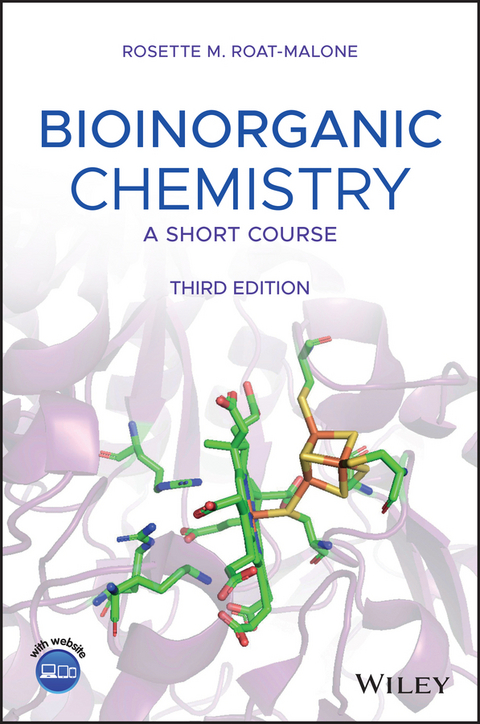
Bioinorganic Chemistry (eBook)
John Wiley & Sons (Verlag)
978-1-119-53526-3 (ISBN)
Introduces students to the basics of bioinorganic chemistry
This book provides the fundamentals for inorganic chemistry and biochemistry relevant to understanding bioinorganic topics. It provides essential background material, followed by detailed information on selected topics, to give readers the background, tools, and skills they need to research and study bioinorganic topics of interest to them. To reflect current practices and needs, instrumental methods and techniques are referred to and mixed in throughout the book.
Bioinorganic Chemistry: A Short Course, Third Edition begins with a chapter on Inorganic Chemistry and Biochemistry Essentials. It then continues with chapters on: Computer Hardware, Software, and Computational Chemistry Methods; Important Metal Centers in Proteins; Myoglobins, Hemoglobins, Superoxide Dismutases, Nitrogenases, Hydrogenases, Carbonic Anhydrases, and Nitrogen Cycle Enzymes. The book concludes with chapters on Nanobioinorganic Chemistry and Metals in Medicine. Readers are also offered end-of-section summaries, conclusions, and thought problems.
- Reduces size of the text from previous edition to match the first, keeping it appropriate for a one-semester course
- Offers primers and background materials to help students feel comfortable with research-level bioinorganic chemistry
- Emphasizes select and diverse topics using extensive references from current scientific literature, with more emphasis on molecular biology in the biochemistry section, leading to a discussion of CRISPR technology
- Adds new chapters on hydrogenases, carbonic anhydrases, and nitrogen cycle enzymes, along with a separate chapter on nanobioinorganic chemistry
- Features expanded coverage of computer hardware and software, metalloenzymes, and metals in medicines
- Supplemented with a companion website for students and instructors featuring Powerpoint and JPEG figures and tables, arranged by chapter
Appropriate for one-semester bioinorganic chemistry courses, Bioinorganic Chemistry: A Short Course, Third Edition is ideal for upper-level undergraduate and beginning graduate students. It is also a valuable reference for practitioners and researchers in need of a general introduction to the subject, as well as chemists requiring an accessible reference.
ROSETTE M. ROAT-MALONE, PhD is Clarence C. White Professor of Chemistry Emerita at Washington College in Chestertown, Maryland. She developed the advanced bioinorganic chemistry course that formed the basis for this book's two preceding editions. Her research in the chemistry of platinum(IV) compounds as anti-cancer agents led to research appointments at several universities and support from various funding agencies.
Introduces students to the basics of bioinorganic chemistry This book provides the fundamentals for inorganic chemistry and biochemistry relevant to understanding bioinorganic topics. It provides essential background material, followed by detailed information on selected topics, to give readers the background, tools, and skills they need to research and study bioinorganic topics of interest to them. To reflect current practices and needs, instrumental methods and techniques are referred to and mixed in throughout the book. Bioinorganic Chemistry: A Short Course, Third Edition begins with a chapter on Inorganic Chemistry and Biochemistry Essentials. It then continues with chapters on: Computer Hardware, Software, and Computational Chemistry Methods; Important Metal Centers in Proteins; Myoglobins, Hemoglobins, Superoxide Dismutases, Nitrogenases, Hydrogenases, Carbonic Anhydrases, and Nitrogen Cycle Enzymes. The book concludes with chapters on Nanobioinorganic Chemistry and Metals in Medicine. Readers are also offered end-of-section summaries, conclusions, and thought problems. Reduces size of the text from previous edition to match the first, keeping it appropriate for a one-semester course Offers primers and background materials to help students feel comfortable with research-level bioinorganic chemistry Emphasizes select and diverse topics using extensive references from current scientific literature, with more emphasis on molecular biology in the biochemistry section, leading to a discussion of CRISPR technology Adds new chapters on hydrogenases, carbonic anhydrases, and nitrogen cycle enzymes, along with a separate chapter on nanobioinorganic chemistry Features expanded coverage of computer hardware and software, metalloenzymes, and metals in medicines Supplemented with a companion website for students and instructors featuring Powerpoint and JPEG figures and tables, arranged by chapter Appropriate for one-semester bioinorganic chemistry courses, Bioinorganic Chemistry: A Short Course, Third Edition is ideal for upper-level undergraduate and beginning graduate students. It is also a valuable reference for practitioners and researchers in need of a general introduction to the subject, as well as chemists requiring an accessible reference.
ROSETTE M. ROAT-MALONE, PhD is Clarence C. White Professor of Chemistry Emerita at Washington College in Chestertown, Maryland. She developed the advanced bioinorganic chemistry course that formed the basis for this book's two preceding editions. Her research in the chemistry of platinum(IV) compounds as anti-cancer agents led to research appointments at several universities and support from various funding agencies.
1
INORGANIC CHEMISTRY AND BIOCHEMISTRY ESSENTIALS
1.1 INTRODUCTION
Bioinorganic chemistry involves the study of metal species in biological systems. As an introduction to the basic inorganic chemistry is needed for understanding bioinorganic topics, this chapter will discuss the essential chemical elements, the occurrences and purposes of metal centers in biological species, the geometries of ligand fields surrounding these metal centers and ionic states preferred by the metals. The occurrence of organometallic complexes and clusters in metalloproteins will be discussed briefly and an introduction to electron transfer in coordination complexes will be presented. Since the metal centers under consideration are found in a biochemical milieu, basic biochemical concepts, including a discussion of proteins and nucleic acids, are presented later in this chapter.
1.2 ESSENTIAL CHEMICAL ELEMENTS
Chemical elements essential to life forms can be broken down into four major categories: (i) bulk elements (H/H+, C, N, O2−/O2−·/O22−, P, and S/S2−); (ii) macrominerals and ions (Na/Na+, K/K+, Mg/Mg2+, Ca/Ca2+, Cl−, PO43−, and SO42−); (iii) trace elements (Fe/FeII/FeIII/FeIV, Zn/ZnII, and Cu/CuI/CuIICuIII); and (iv) ultratrace elements, that comprise nonmetals (F/F−, I/I−, Se/Se2−, Si/SiIV, As, and B) and metals (Mn/MnII/MnIII/MnIV, Mo/MoIV/MoV/MoVI, Co/CoII/ CoIII, Cr/CrIII/CrVI, V/VIII/ VIV/ VV/, NiI/ NiII/ NiIII/, Cd/Cd2+, Sn/SnII/SnIV, Pb/Pb2+, and Li/Li+). In the preceding classification, only the common biologically active ion oxidation states are indicated (see references [1, 2d] for more information). If no charge is shown, the element predominately bonds covalently with its partners in biological compounds, although elements such as carbon (C), sulfur (S), phosphorus (P), arsenic (As), boron (B), and selenium (Se) have positive formal oxidation states in ions containing oxygen atoms; i.e. S = +6 in the SO42− ion or P = +5 in the PO43− ion. The identities of essential elements are based on historical work done by Klaus Schwarz in the 1970s [3]. Other essential elements may be present in various biological species. Essentiality has been defined by certain criteria: (i) a physiological deficiency appears when the element is removed from the diet; (ii) the deficiency is relieved by the addition of that element to the diet; and (iii) a specific biological function is associated with the element [4]. Table 1.1 indicates the approximate percentages by weight of selected essential elements for an adult human.
Every essential element follows a dose‐response curve, shown in Figure 1.1, as adapted from reference [4]. At lowest dosages, the organism does not survive whereas in deficiency regions the organism exists with less than optimal function. After the concentration plateau of the optimal dosage region, higher dosages cause toxic effects in the organism eventually leading to lethality. Specific daily requirements of essential elements may range from microgram to gram quantities.
Considering the content of earth's contemporary waters and atmospheres, many questions arise as to the choice of essential elements at the time of life's origins 3.5 billion or more years ago. Certainly sufficient quantities of the bulk elements were available in primordial oceans and at shorelines. However, the concentrations of essential trace metals in modern oceans may differ considerably from those found in prebiotic times. Iron's current approximate 10−4 mM concentration in seawater, for instance, may not reflect accurately its prelife‐forms availability. If one assumes a mostly reducing atmosphere contemporary with the beginnings of biological life, the availability of the more soluble iron(II) ion in primordial oceans must have been much higher. Thus, the essentiality of iron(II) at a concentration of 0.02 mM in the blood plasma heme (hemoglobin) and muscle tissue heme (myoglobin) may be explained. Beside the availability factor, many chemical and physical properties of elements and their ions are responsible for their inclusion in biological systems. These include ionic charge, ionic radius, ligand preferences, preferred coordination geometries, spin pairings, systemic kinetic control, and the chemical reactivity of the ions in solution. These factors are discussed in detail by daSilva and Williams [1].
TABLE 1.1 Percentage Composition of Selected Elements in the Human Body
| Element | Percentage (By Weight) | Element | Percentage (By Weight) |
| Oxygen | 53.6 | Silicon and Mg | 0.04 |
| Carbon | 16.0 | Iron and fluorine | 0.005 |
| Hydrogen | 13.4 | Zinc | 0.003 |
| Nitrogen | 2.4 | Copper and bromine | 2 × 10⁻⁴ |
| Sodium, potassium, and sulfur | 0.10 | Selenium, manganese, arsenic, and nickel | 2 × 10⁻⁵ |
| Chlorine | 0.09 | Lead and cobalt | 9 × 10⁻⁶ |
Figure 1.1 Dose‐response curve for elements.
Source: adapted from Kaim et al. [4].
1.3 INORGANIC CHEMISTRY BASICS
Ligand preference and possible coordination geometries of the metal center are important bioinorganic principles. Metal ligand preference is closely related to the hard–soft acid–base nature of metals and their preferred ligands. These are listed in Table 1.2.
In general, hard metal cations form their most stable compounds with hard ligands and soft metal cations with soft ligands. Hard cations can be thought of as small dense cores of positive charge whereas hard ligands are usually the small highly electronegative elements or ligand atoms within a hard polyatomic ion, i.e. oxygen ligands in (RO)2PO2− or CH3CO2−.
It is possible to modify a hard nitrogen ligand towards an intermediate softness by increasing the polarizability of its substituents or the π electron cloud about it. The imidazole nitrogen of the amino acid histidine, a ubiquitous ligand in biological proteins, is an example. Increasing the softness of phosphate ion substituents can transform the hard oxygen ligand of (RO)2PO2− to a soft state in (RS)2PO2−. Soft cations and anions are those with highly polarizable, large electron clouds – Hg2+, sulfur ligands as sulfides or thiolates, and iodide ions. Also, note that metal ions can overlap into different categories. Lead as Pb2+, for instance, appears in both the intermediate and soft categories. The Fe3+ ion, classified as a hard cation, coordinates to histidine (imidazole) ligands in biological systems and Fe2+, classified as intermediate, can coordinate to sulfur ligands and the carbon atom of CO (see Sections 3.1–3.3, 3.6, and 4.1).
TABLE 1.2 Hard–soft Acid–base Classification of Metal Ions and Ligands
| Metals, Ions, and Molecules | Ligands |
| Hard High charge density Small ionic radius | Hard Low polarizability High electronegativity Hard to oxidize |
| Hard | Hard |
| H+ | Mg2+ | Al3+ | SO3 | Oxygen ligands in H2O, CO32−, NO3−, and PO43−, |
| Na+ | Ca2+ | Co3+ | CO2 | ROPO32−, (RO)2PO2−, and CH3COO−, |
| K+ | Mn2+ | Cr3+ | OH−, RO−, R2O, and crown ethers |
| VO2+ | Ga3+ | Nitrogen ligands in NH3, N2H4, RNH2, or Cl− |
| Fe3+ | Nitrogen ligands in NH3, N2H4, RNH2, or Cl− |
| Intermediate | Intermediate |
| Fe2+, Ni2+, Zn2+, Co2+, Cu2+, Pb2+, Sn2+, Ru2+, Au3+, SO2, and NO+ | Br−, SO32−, nitrogen ligands in NO2−, N3−, N2, , and |
| Soft Low charge density Large ionic radius Easily exited outer shell electrons | Soft High polarizability Low electronegativity Low energy vacant orbitals Easily oxidized |
| Soft | Soft |
| Cu+ | Pt2+ | Pt4+ | Sulfur ligands in RSH, RS−, R2S, and R3P |
| Au+ | Pb2+ | RNC, CN−, CO, R−, H−, I−, and S2O32− |
| Tl+ | Hg2+ | (RS)2PO2− and (RO)2P(O)S− |
| Ag+ | Cd2+ |
| Hg22+ | Pd2+ |
In biological systems, many factors...
| Erscheint lt. Verlag | 31.1.2020 |
|---|---|
| Sprache | englisch |
| Themenwelt | Naturwissenschaften ► Biologie ► Biochemie |
| Naturwissenschaften ► Chemie ► Anorganische Chemie | |
| Schlagworte | Bioanorganische Chemie • Biochemie u. Chemische Biologie • biochemistry • Biochemistry (Chemical Biology) • bioinorganic chemistry • bioorganic chemistry • Chemie • Chemistry • CRISPR technology • Inorganic Chemistry • Life Science • <p>bioinorganic chemistry • Medicine • Metalloenzymes • metalloproteins</p> • metals in medicines • Molecular Biology • nanobioinorganic chemistry • nanomedicine • Nanomedizin • Nanotechnologie • nanotechnology • Organic Chemistry • Science Textbook |
| ISBN-10 | 1-119-53526-3 / 1119535263 |
| ISBN-13 | 978-1-119-53526-3 / 9781119535263 |
| Informationen gemäß Produktsicherheitsverordnung (GPSR) | |
| Haben Sie eine Frage zum Produkt? |
 EPUB (Adobe DRM)
Kopierschutz: Adobe-DRM
Adobe-DRM ist ein Kopierschutz, der das eBook vor Mißbrauch schützen soll. Dabei wird das eBook bereits beim Download auf Ihre persönliche Adobe-ID autorisiert. Lesen können Sie das eBook dann nur auf den Geräten, welche ebenfalls auf Ihre Adobe-ID registriert sind.
Details zum Adobe-DRM
Dateiformat: EPUB (Electronic Publication)
EPUB ist ein offener Standard für eBooks und eignet sich besonders zur Darstellung von Belletristik und Sachbüchern. Der Fließtext wird dynamisch an die Display- und Schriftgröße angepasst. Auch für mobile Lesegeräte ist EPUB daher gut geeignet.
Systemvoraussetzungen:
PC/Mac: Mit einem PC oder Mac können Sie dieses eBook lesen. Sie benötigen eine
eReader: Dieses eBook kann mit (fast) allen eBook-Readern gelesen werden. Mit dem amazon-Kindle ist es aber nicht kompatibel.
Smartphone/Tablet: Egal ob Apple oder Android, dieses eBook können Sie lesen. Sie benötigen eine
Geräteliste und zusätzliche Hinweise
Buying eBooks from abroad
For tax law reasons we can sell eBooks just within Germany and Switzerland. Regrettably we cannot fulfill eBook-orders from other countries.
aus dem Bereich