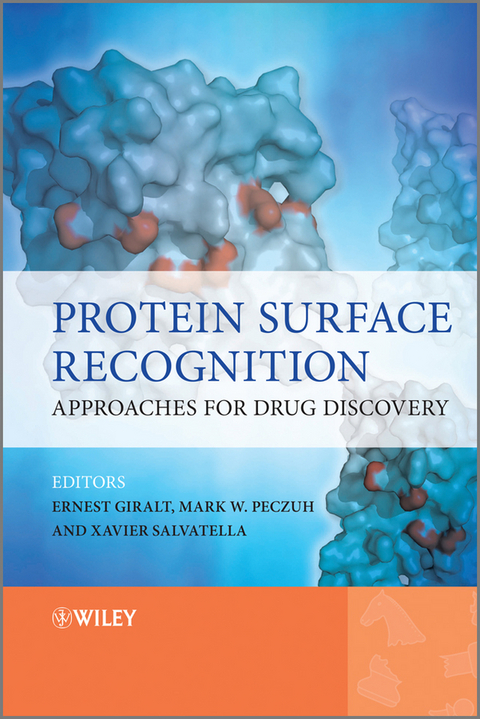
Protein Surface Recognition (eBook)
John Wiley & Sons (Verlag)
978-0-470-97212-0 (ISBN)
Protein Surface Recognition presents a detailed treatment of this strategy, with topics including:
- an extended survey of protein-protein interactions that are key players in human disease and biology and the potential for therapeutics derived from this new perspective
- the fundamental physical issues that surround protein-protein interactions that must be considered when designing ligands for protein surfaces
- examples of protein surface-small molecule interactions, including treatments of protein-natural product interactions, protein-interface peptides, and rational approaches to protein surface recognition from model to biological systems
- a survey of techniques that will be integral to the discovery of new small molecule protein surface binders, from high throughput synthesis and screening techniques to in silico and in vitro methods for the discovery of novel protein ligands.
Protein Surface Recognition provides an intellectual 'tool-kit' for investigators in medicinal and bioorganic chemistry looking to exploit this emerging paradigm in drug discovery.
ERNEST GIRALT, Department of Organic Chemistry, University of Barcelona and Institute for Research in Biomedicine, Barcelona, Spain
MARK PECZUH, Department of Chemistry, University of Connecticut, USA
XAVIER SALVATELLA, ICREA and Institute for Research in Biomedicine, Barcelona, Spain
A new perspective on the design of molecular therapeutics is emerging. This new strategy emphasizes the rational complementation of functionality along extended patches of a protein surface with the aim of inhibiting protein/protein interactions. The successful development of compounds able to inhibit these interactions offers a unique chance to selectively intervene in a large number of key cellular processes related to human disease. Protein Surface Recognition presents a detailed treatment of this strategy, with topics including: an extended survey of protein-protein interactions that are key players in human disease and biology and the potential for therapeutics derived from this new perspective the fundamental physical issues that surround protein-protein interactions that must be considered when designing ligands for protein surfaces examples of protein surface-small molecule interactions, including treatments of protein-natural product interactions, protein-interface peptides, and rational approaches to protein surface recognition from model to biological systems a survey of techniques that will be integral to the discovery of new small molecule protein surface binders, from high throughput synthesis and screening techniques to in silico and in vitro methods for the discovery of novel protein ligands. Protein Surface Recognition provides an intellectual tool-kit for investigators in medicinal and bioorganic chemistry looking to exploit this emerging paradigm in drug discovery.
ERNEST GIRALT, Department of Organic Chemistry, University of Barcelona and Institute for Research in Biomedicine, Barcelona, Spain MARK PECZUH, Department of Chemistry, University of Connecticut, USA XAVIER SALVATELLA, ICREA and Institute for Research in Biomedicine, Barcelona, Spain
Preface
List of Contributors
SECTION A. PRINCIPLES
1 The discovery and characterization of protein-protein interactions
C. Bertoncini, A. Higueruelo, and Xavi Salvatella
2 Biophysics of protein-protein interactions
Irene Luque
SECTION B. APPROACHES
3 On the logic of natural product binding in protein-protein interactivity
James J. La Clair
4 Interface peptide inhibitors of PPIs
Mark W. Peczuh, and Richard T. Desmond
5 Inhibition of protein-protein interactions by peptide mimics
Jorge Becerril, Johanna M. Rodriguez, Pauline N. Wyrembak, and Andrew D. Hamilton
6 Discovery of inhibitors of protein-protein interactions by screening chemical libraries
Carlos García-Echeverría
SECTION C. TECHNIQUES
7 High-throughput methods of chemical synthesis applied to the Preparation of inhibitors of protein-protein interactions
Annaliese K. Franz, Jared T. Shaw, and Yuchen Tang
8 In silico screening
F.J. Luque, and Xavier Barril
9.1 In vitro and in vivo screening: Screening by Nuclear Magnetic Resonance
Ernest Giralt
9.2 In vitro and in vivo screening: Methods of High Throughput Screening
Wenjiao Song and Qing Lin
SECTION D. CASE STUDIES
10 Case Study: Inhibitors of the MDM2-p53 protein-protein interaction
Sanjeev Shangary, Denzil Bernard, and Shaomeng Wang
11 Case Study: The Discovery of Potent LFA-1 Antagonists
Tom Gadek
Index
"This book picks up this trend and provides an excellent overview
of the current topics in the field of PPI modulation by small
molecules and peptides. . . Taken together, this excellent book is
very suitable both as an introduction to the field, as well as a
compendium for readers already familiar with the chemical approach
of modulating PPIs." (ChemMedChem, 2011)
| Erscheint lt. Verlag | 23.9.2010 |
|---|---|
| Sprache | englisch |
| Themenwelt | Naturwissenschaften ► Biologie ► Biochemie |
| Naturwissenschaften ► Chemie | |
| Schlagworte | Able • AIM • along • APPROACHES • Biochemie u. Chemische Biologie • Biochemistry (Chemical Biology) • Biowissenschaften • Cell & Molecular Biology • Chance • Chemie • Chemistry • Complementation • Design • Development • Drug • Extended • Functionality • Large • Life Sciences • molecular • Molekularbiologie • New • patches • Perspective • Pharmaceutical & Medicinal Chemistry • Pharmazeutische u. Medizinische Chemie • Protein • Proteine • Rational • Recognition • strategy emphasizes • Successful • Surface • therapeutics • Wirkstoffforschung • Zell- u. Molekularbiologie |
| ISBN-10 | 0-470-97212-2 / 0470972122 |
| ISBN-13 | 978-0-470-97212-0 / 9780470972120 |
| Informationen gemäß Produktsicherheitsverordnung (GPSR) | |
| Haben Sie eine Frage zum Produkt? |
 PDF (Adobe DRM)
Kopierschutz: Adobe-DRM
Adobe-DRM ist ein Kopierschutz, der das eBook vor Mißbrauch schützen soll. Dabei wird das eBook bereits beim Download auf Ihre persönliche Adobe-ID autorisiert. Lesen können Sie das eBook dann nur auf den Geräten, welche ebenfalls auf Ihre Adobe-ID registriert sind.
Details zum Adobe-DRM
Dateiformat: PDF (Portable Document Format)
Mit einem festen Seitenlayout eignet sich die PDF besonders für Fachbücher mit Spalten, Tabellen und Abbildungen. Eine PDF kann auf fast allen Geräten angezeigt werden, ist aber für kleine Displays (Smartphone, eReader) nur eingeschränkt geeignet.
Systemvoraussetzungen:
PC/Mac: Mit einem PC oder Mac können Sie dieses eBook lesen. Sie benötigen eine
eReader: Dieses eBook kann mit (fast) allen eBook-Readern gelesen werden. Mit dem amazon-Kindle ist es aber nicht kompatibel.
Smartphone/Tablet: Egal ob Apple oder Android, dieses eBook können Sie lesen. Sie benötigen eine
Geräteliste und zusätzliche Hinweise
Buying eBooks from abroad
For tax law reasons we can sell eBooks just within Germany and Switzerland. Regrettably we cannot fulfill eBook-orders from other countries.
aus dem Bereich