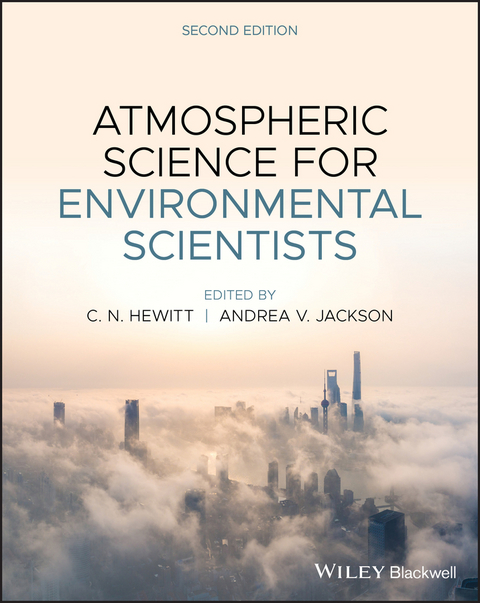
Atmospheric Science for Environmental Scientists (eBook)
John Wiley & Sons (Verlag)
978-1-119-51527-2 (ISBN)
Enlightens readers on the realities of global atmospheric change, including global warming and poor air quality
Climate change and air pollution are two of the most pressing issues facing Mankind. This book gives undergraduate and graduate students, researchers and professionals working in the science and policy of pollution, climate change and air quality a broad and up-to-date account of the processes that occur in the atmosphere, how these are changing as Man's relentless use of natural resources continues, and what effects these changes are having on the Earth's climate and the quality of the air we breathe.
Written by an international team of experts, Atmospheric Science for Environmental Scientists, 2nd Edition provides an excellent overview of our current understanding of the state of the Earth's atmosphere and how it is changing. The first half of the book covers: the climate of the Earth; chemical evolution of the atmosphere; atmospheric energy and the structure of the atmosphere; biogeochemical cycles; and tropospheric chemistry and air pollution. The second half looks at cloud formation and chemistry; particulate matter in the atmosphere; stratospheric chemistry and ozone depletion; boundary layer meteorology and atmospheric dispersion; urban air pollution; and global warming and climate change science.
- Provides succinct but detailed information on all the important aspects of atmospheric science for students
- Offers the most up-to-date treatment of key issues such as stratospheric chemistry, urban air pollution, and climate change
- Each chapter includes basic concepts, end-of-section questions, and more in-depth material
- Features contributions from the best experts and educators in the field of atmospheric science
Atmospheric Science for Environmental Scientists, 2nd Edition is an invaluable resource for students, teachers, and professionals involved in environmental science. It will also appeal to those interested in learning how the atmosphere works, how humankind is changing its composition, and what effects these changes are leading to.
NICK HEWITT, PHD, is Distinguished Professor of Atmospheric Chemistry at Lancaster University, UK. His main research interests are in understanding how the biosphere and the atmosphere interact, how emissions of trace gases from the surface affect the composition and chemistry of the atmosphere, and how the changing atmospheric environment affects the world we live in.
ANDREA V. JACKSON, PHD, recently retired as Professor of Student Education and Engagement at the University of Leeds, UK. As well as conducting research in atmospheric chemistry, she worked with the UK's National Centre for Atmospheric Science on the development of their education and training programmes.
NICK HEWITT, PHD, is Distinguished Professor of Atmospheric Chemistry at Lancaster University, UK. His main research interests are in understanding how the biosphere and the atmosphere interact, how emissions of trace gases from the surface affect the composition and chemistry of the atmosphere, and how the changing atmospheric environment affects the world we live in. ANDREA V. JACKSON, PHD, recently retired as Professor of Student Education and Engagement at the University of Leeds, UK. As well as conducting research in atmospheric chemistry, she worked with the UK's National Centre for Atmospheric Science on the development of their education and training programmes.
Abbreviations, Constants, and Nomenclature
- ADMS
- Atmospheric Dispersion Modelling System
- CEE
- Central and eastern Europe
- CCN
- cloud condensation nuclei
- CFC
- chlorofluorocarbons
- CO2
- carbon dioxide
- DMS
- dimethyl sulphide
- DNA
- deoxyribonucleic acid
- EC
- elemental carbon
- EM
- electromagnetic
- ENSO
- El Niño–Southern Oscillation
- EPA
- Environmental Protection Agency
- EU
- European Union
- GDP
- global domestic product
- GEMS/AIR
- Global Environmental Monitoring System/Air
- GHG
- greenhouse gas
- HAP
- hazardous air pollutant
- HCFC
- hydrochlorofluorocarbons
- HFC
- hydrofluorocarbons
- IAM
- integrated assessment models
- IBL
- internal boundary layer
- IPCC
- Intergovernmental Panel on Climate Change
- IR
- infrared
- ISAM
- integrated science assessment model
- ITCZ
- intertropical convergence zone
- LAI
- leaf‐area index
- LW
- longwave
- NMHC
- non‐methane hydrocarbons
- MAP
- major air pollutant
- MTBE
- methyl‐tert‐butyl ether
- NDVI
- normalized difference vegetation index
- OCS
- carbonyl sulphide
- OECD
- Organization for Economic Cooperation and Development
- PAH
- polycyclic aromatic hydrocarbons
- PAN
- peroxyacetyl nitrate
- PAR
- photosynthetically active radiation
- PCB
- polychlorinated biphenyls
- PFC
- perfluorogenated carbon
- PM
- particulate matter
- PM10
- particles with aerodynamic diameter less than 10 μm
- ppm
- parts per million
- ppmv
- part per million by volume (1 × 10⁻⁶)
- ppbv
- part per billion by volume (1 × 10⁻⁹)
- pptv
- part per trillion by volume (1 × 10⁻¹²)
- PSS
- photostationary state
- SAFARI
- South African Regional Science Initiative
- SW
- shortwave
- TSP
- total suspended particulates
- UNEP
- United Nations Environmental Programme
- UV
- ultraviolet
- VSLS
- very short‐lived substances
- VOC
- volatile organic compounds
- WHO
- World Health Organization
- WMO
- World Meteorological Organization
Constants
- c
- speed of light in vacuum 2.998 × 10⁸ m s−1
- g
- acceleration due to gravity 9.8 m s−2
- h
- Planck’s constant 6.626 × 1034 J s
- k
- Boltzmann constant 1.381 × 1034 J K−1
- R
- gas constant 8.314 J K−1 mol−1 (1.3 × 10⁵ l atm mol−1 K−1)
- Γd
- dry adiabatic lapse rate 9.81 K km−1
- π
- 3.14159
- σ
- Stefan–Boltzmann constant 5.67 × 10⁻⁸ W m−2 K−4
Nomenclature
- a
- radius of a particle
- A
- albedo
- A s
- surface albedo
- B
- radiative intensity of a blackbody
- c p
- specific heat capacity of dry air at constant pressure (1004 J kg−1 K−1)
- c v
- specific heat at constant volume
- C
- concentration (ppm or kg m−3)
- d
- preface to variable indicating incremental quantity
- d
- displacement height (m)
- dQ
- incremental change in heat
- du
- incremental change in internal energy
- dv
- incremental change in volume
- dw
- incremental change in work
- e
- turbulent kinetic energy per unit mass (J kg−1)
- F B
- the total flux from a black body radiator
- F s
- incoming solar radiation absorbed at the surface
- F
- net flux
- F↑
- upwelling radiative flux
- F↓
- downwelling radiative flux
- net flux leaving an element or layer
- F r
- total upward reflected shortwave flux
- F 0
- incident solar flux
- G
- ground heat flux (W m−2)
- h
- mean height of roughness elements (m)
- h b
- depth of internal boundary layer (m)
- H
- sensible heat flux (W m−2) or mean building height (m)
- H s
- scale height
- H/W
- aspect ratio (‐)
- I
- intensity of light
- I 0
- initial intensity of light
- k
- von Kármán’s constant ≈ 0.4 (‐)
- k a
- absorption coefficient
- k e
- extinction coefficient
- k s
- scattering coefficient
- l
- distance through a gas interacting with light
- L
- latent heat of vaporization
- L
- Obukhov length (m)
- L w
- Liquid water content
- L x
- integral (or decorrelation) lengthscale (m)
- m
- refractive index
- M
- molar mass (of air unless otherwise specified)
- n
- number concentration, typically of absorbers or scatterers
- p(u)
- probability of windspeed u (‐)
- P
- plant area index (‐)
- P, p
- pressure
- q
- specific humidity (kg kg−1, sometimes g kg−1) or source emission rate (kg s−1)
- q *
- scaling parameter for specific humidity profile (kg kg−1, sometimes g kg−1)
- r
- radial distance
- r v
- mass mixing ratio of water vapour
- r w
- saturation mixing ratio
- r r
- scattered fraction reflected upwards
- R
- radius of the Earth
- R(λ)
- action spectrum
- R n
- net radiation (W m−2)
- S
- Solar constant
- Sk u
- skewness statistic for downstream component of the wind (‐)
- Sk w
- skewness statistic for vertical component of the wind (‐)
- t
- time (s)
- t r
- scattered fraction transmitted downwards
- t t
- total fraction of radiation transmitted downwards
- T
- temperature
- T a
- transmittance of the atmosphere
- T e
- effective blackbody temperature of the Earth
- T L
- integral timescale (s)
- T *
- scaling parameter for temperature profile (°C)
- u
- downstream velocity component (m s−1)
- mean component (m s−1)
- u′
- fluctuation around mean component (m s−1)
- u *
- friction velocity (m s−1)
- U
- velocity vector (m s−1)
- (z)
- vertical mean wind profile (m s−1)
- mean windspeed at the top of a canopy (m s−1)
- v
- lateral velocity component (m s−1)
- w
- vertical velocity component (m s−1)
- W
- along wind building spacing (m)
- x
- horizontal distance in downstream direction (m)
- y
- horizontal distance in lateral direction (m)
- z
- distance, usually altitude (m)
- z h
- roughness length for heat transfer (m)
- z m
- height of maximum plant area index (m)
- z 0
- roughness length for momentum transfer (m)
- z 0r
- roughness length for rural surface (m)
- z 0u
- roughness length for urban surface (m)
- z q
- roughness length for moisture transfer (m)
- z*
- roughness sublayer depth (m)
- z/L
- Monin‐Obukhov stability parameter (‐)
- σ
- standard deviation (depends on quantity)
- σ x
- downstream plume spread (m)
- σ y
- lateral plume spread (m)
- σ z
- vertical plume spread (m)
- σ(λ)
- absorption cross section as a function of wavelength
- β
- upscatter or backscatter fraction
- γ s
- saturated adiabatic lapse rate
- ∆S
- storage term (W m−2)
- ∆T
- temperature difference between rural and...
| Erscheint lt. Verlag | 13.12.2019 |
|---|---|
| Sprache | englisch |
| Themenwelt | Naturwissenschaften ► Biologie ► Ökologie / Naturschutz |
| Naturwissenschaften ► Geowissenschaften ► Geologie | |
| Naturwissenschaften ► Geowissenschaften ► Meteorologie / Klimatologie | |
| Technik ► Umwelttechnik / Biotechnologie | |
| Schlagworte | air quality • Atmosphere • atmospheric chemistry • Atmospheric Physics & Chemistry • atmospheric science biogeochemical • atmospheric sciences • biosphere • boundary layer</p> • climate change • earth sciences • environmental • Environmental Science • Environmental Studies • Geowissenschaften • global atmospheric change • global warming • Klimatologie u. Meteorologie • <p>environment • meteorology • Ozone • Physik u. Chemie der Atmosphäre • pollution • Umweltforschung • Umweltwissenschaften |
| ISBN-10 | 1-119-51527-0 / 1119515270 |
| ISBN-13 | 978-1-119-51527-2 / 9781119515272 |
| Informationen gemäß Produktsicherheitsverordnung (GPSR) | |
| Haben Sie eine Frage zum Produkt? |
 EPUB (Adobe DRM)
Kopierschutz: Adobe-DRM
Adobe-DRM ist ein Kopierschutz, der das eBook vor Mißbrauch schützen soll. Dabei wird das eBook bereits beim Download auf Ihre persönliche Adobe-ID autorisiert. Lesen können Sie das eBook dann nur auf den Geräten, welche ebenfalls auf Ihre Adobe-ID registriert sind.
Details zum Adobe-DRM
Dateiformat: EPUB (Electronic Publication)
EPUB ist ein offener Standard für eBooks und eignet sich besonders zur Darstellung von Belletristik und Sachbüchern. Der Fließtext wird dynamisch an die Display- und Schriftgröße angepasst. Auch für mobile Lesegeräte ist EPUB daher gut geeignet.
Systemvoraussetzungen:
PC/Mac: Mit einem PC oder Mac können Sie dieses eBook lesen. Sie benötigen eine
eReader: Dieses eBook kann mit (fast) allen eBook-Readern gelesen werden. Mit dem amazon-Kindle ist es aber nicht kompatibel.
Smartphone/Tablet: Egal ob Apple oder Android, dieses eBook können Sie lesen. Sie benötigen eine
Geräteliste und zusätzliche Hinweise
Buying eBooks from abroad
For tax law reasons we can sell eBooks just within Germany and Switzerland. Regrettably we cannot fulfill eBook-orders from other countries.
aus dem Bereich