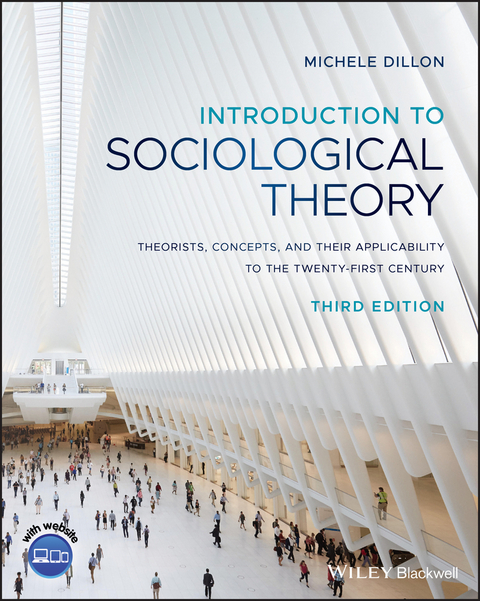
Introduction to Sociological Theory (eBook)
John Wiley & Sons (Verlag)
9781119410898 (ISBN)
The revised third edition of the text that combines classical and contemporary theories of sociological theory
Thoroughly revised and updated, the third edition of an Introduction to Sociological Theory offers an in-depth introduction to classical and contemporary theories, and demonstrates their relevance to offer a clear understanding of a broad range of contemporary issues and topics. As with the previous editions, the text continues to combine carefully selected primary quotations from a broad range of theorists with extensive discussion and illustrative examples from a diverse range of countries, helpful timelines of important and thematically relevant events, biographical notes, contemporary topic boxes, analytical photos, and chapter glossaries.
The text addresses topics such as the persistence of economic and social inequality, Brexit, post-truth society, same-sex marriage, digital surveillance and the on-demand gig economy. Written in an engaging style, Introduction to Sociological Theory offers a comprehensive introduction to the pluralistic breadth and wide-ranging applicability of sociological theory. This updated edition of the authoritative text:
- Contains both classical and contemporary theories in a single text
- Builds on excerpts from original theoretical writings with detailed discussion of the concepts and ideas under review
- Includes new examples of current empirical topics such as Brexit, Donald Trump's presidency, China's growing economic power, global warming, intersectionality, social media, and much more
- Offers additional resources including a website that contains multiple choice and essay questions, a thoroughly refreshed set of PowerPoint slides for each chapter with multimedia links to content illustrative of sociological processes, a list of complementary primary readings, a quotation bank, and other background materials
Written for undergraduate courses in contemporary and classical sociological theory, the third edition of an Introduction to Sociological Theory continues to provide a comprehensive, in-depth, and empirically engaging, introduction to sociological theory.
MICHELE DILLON, PhD, is Professor of Sociology at the University of New Hampshire, USA and has many years of experience teaching sociological theory to undergraduate and graduate students. She has authored five books on religion and social change, many articles and book chapters and is the editor of a handbook.
The revised third edition of the text that combines classical and contemporary theories of sociological theory Thoroughly revised and updated, the third edition of an Introduction to Sociological Theory offers an in-depth introduction to classical and contemporary theories, and demonstrates their relevance to offer a clear understanding of a broad range of contemporary issues and topics. As with the previous editions, the text continues to combine carefully selected primary quotations from a broad range of theorists with extensive discussion and illustrative examples from a diverse range of countries, helpful timelines of important and thematically relevant events, biographical notes, contemporary topic boxes, analytical photos, and chapter glossaries. The text addresses topics such as the persistence of economic and social inequality, Brexit, post-truth society, same-sex marriage, digital surveillance and the on-demand gig economy. Written in an engaging style, Introduction to Sociological Theory offers a comprehensive introduction to the pluralistic breadth and wide-ranging applicability of sociological theory. This updated edition of the authoritative text: Contains both classical and contemporary theories in a single text Builds on excerpts from original theoretical writings with detailed discussion of the concepts and ideas under review Includes new examples of current empirical topics such as Brexit, Donald Trump s presidency, China s growing economic power, global warming, intersectionality, social media, and much more Offers additional resources including a website that contains multiple choice and essay questions, a thoroughly refreshed set of PowerPoint slides for each chapter with multimedia links to content illustrative of sociological processes, a list of complementary primary readings, a quotation bank, and other background materials Written for undergraduate courses in contemporary and classical sociological theory, the third edition of an Introduction to Sociological Theory continues to provide a comprehensive, in-depth, and empirically engaging, introduction to sociological theory.
MICHELE DILLON, PhD, is Professor of Sociology at the University of New Hampshire, USA and has many years of experience teaching sociological theory to undergraduate and graduate students. She has authored five books on religion and social change, many articles and book chapters and is the editor of a handbook.
INTRODUCTION
SOCIOLOGICAL THEORY: A VIBRANT, LIVING TRADITION
KEY CONCEPTS
sociological theory
concepts
conceptual frameworks
pluralistic
macro
social structures
micro
culture
agency
classical theory
canon
contemporary theory
Enlightenment
democracy
reason
rationality
inalienable rights
utilitarianism
scientific reasoning
empiricism
positivist
objectivity
interpretive understanding
emancipatory knowledge
double‐consciousness
CHAPTER MENU
- Analyzing Everyday Social Life
- Societal Transformation and the Origins of Sociology
- The Establishment of Sociology as Science: Auguste Comte and Harriet Martineau
- Social Inequality and Contextual Standpoints: Du Bois, De Tocqueville, and Martineau
- Summary
- Points to Remember
- Glossary
- Questions for Review
- Note
- References
Timeline I.1 Major pre‐Enlightenment influences, and events from the Enlightenment to the establishment of sociology
| 500 BC–AD 999 The Classical World 1000–1490 The Feudal Age 1490–1664 The Age of Discovery |
| 1599 | Francis Bacon, Essays |
| 1620 | English Pilgrims arrive at Plymouth Rock, Massachusetts |
| 1633 | Galileo summoned by the Inquisition to defend his theory that the earth moves around the sun |
| 1636 | Harvard College founded |
| 1637 | René Descartes, “I think, therefore, I am” |
| 1665–1774 The Enlightenment |
| 1670 | Blaise Pascal, “Man is only a reed, the weakest thing in nature; but he is a thinking reed” |
| 1687 | Isaac Newton explains laws of motion and theories of gravitation |
| 1689 | John Locke, On Civil Government |
| 1702 | Cambridge University establishes faculty chairs in the sciences |
| 1733 | Voltaire praises British liberalism |
| 1752 | Benjamin Franklin invents a lightning conductor; demonstrates the identity of lightning and electricity |
| 1762 | Jean‐Jacques Rousseau, The Social Contract |
| 1771 | The right to report parliamentary debates established in Britain |
| 1775–1814 The Age of Revolution |
| 1775 | American War of Independence; battles of Lexington and Concord (Massachusetts) |
| 1776 | British troops evacuate Boston; Declaration of Independence |
| 1776 | Adam Smith, The Wealth of Nations |
| 1788 | Bread riots in France |
| 1789 | Fall of the Bastille; beginning of the French Revolution; new French Constituent Assembly abolishes feudal rights and privileges |
| 1791 | Bill of Rights in America; first 10 amendments to the US Constitution |
| 1792 | Mary Wollstonecraft, Vindication of the Rights of Woman |
| 1796 | Freedom of the press established in France |
| 1805 | First factory to be lit by gaslight (in Manchester, England) |
| 1807 | Air pump developed for use in mines |
| 1813 | Jane Austen, Pride and Prejudice |
| 1823 | Jeremy Bentham, utilitarianism |
| 1831 | John Stuart Mill, The Spirit of the Age |
| 1835–1840 | Alexis de Tocqueville, Democracy in America |
| 1837 | Harriet Martineau, Society in America |
| 1839 | Comte gives sociology its name |
| 1855 | Harriet Martineau translates Comte’s Positive Philosophy |
| 1859 | Charles Darwin, The Origin of Species (modern evolutionary theory) |
| 1861–1865 | American Civil War, the South (Confederates) versus the North (Union) |
| 1865 | US president Abraham Lincoln assassinated |
| 1865 | Thirteenth amendment to the US Constitution, abolishing slavery |
Welcome to sociological theory. Theory, by definition, is abstract. This book illustrates the richness of sociological theory by emphasizing how its breadth of concepts or analytical ideas have practical application and explanatory relevance to daily life. It will introduce you to the major theorists whose writings and conceptual frameworks inform sociological thinking. It will equip you with the theoretical vocabulary necessary to appreciate the range of perspectives found in sociological theory. It will give you confidence to apply these ideas to the many sociological topics you study (e.g., inequality, crime, medical sociology, race, political sociology, family, gender, sexuality, culture, religion, community, globalization, etc.) and help you to think analytically about the many occurrences in daily life far beyond the classroom.
Topic I.1 Hotel rooms get plusher, adding to maids’ injuries
“Some call it the ‘amenities arms race,’ some ‘the battle of the beds.’ It is a competition in which the nation’s premier hotels are trying to have their accommodations resemble royal bedrooms. Superthick mattresses, plush duvets and decorative bed skirts have been added, and five pillows rather than the pedestrian three now rest on a king‐size bed. Hilton markets these rooms as Suite Dreams, while Westin boasts of its heavenly beds. The beds may mean sweet dreams to hotel guests, but they mean pain to many of the nation’s 350,000 hotel housekeepers. Several new studies [by unions and health scientists] have found that thousands of housekeepers are suffering arm, shoulder, and lower‐back injuries … it is so strenuous a job that [housekeepers have] a higher risk of back disorders than autoworkers who assemble car doors … The problem, housekeepers say, is not just a heavier mattress, but having to rush because they are assigned the same number of rooms as before while being required to deal with far more per room: more pillows, more sheets, more amenities like bathrobes to hang up and coffee pots to wash. Ms. Reyes [a hotel housekeeper] complained that some days she must make 25 double beds, a task that entails taking off, and putting on, 100 pillowcases … Housekeepers who earn $17,300 a year on average, invariably stoop over to lift mattresses, some of which are only 14 inches off the floor. They frequently twist their backs as they tuck in the sheets, often three of them rather than the two of yesteryear. Since it can take 10 to 12 minutes a bed, a housekeeper who makes 25 beds a day frequently spends four to five hours on the task, lifting mattresses 150 to 200 times … [A Hilton spokesman] said the company had increased training to try to minimize harm to housekeepers … [and to ease] workloads … [and said that the unions are] pushing the injury issue as a smoke screen, largely to pressure hotel companies to agree to procedures making it easier to unionize workers.”
Steven Greenhouse, “Hotel Rooms Get Plusher, Adding to Maids’ Injuries.” New York Times (April 21, 2006). © 2006 The New York Times. All rights reserved. Used by permission and protected by the Copyright Laws of the United States.
ANALYZING EVERYDAY SOCIAL LIFE
This short excerpt (Topic I.1) on housekeepers and hotel mattresses provides a single snapshot of contemporary society, but its elements can be used to highlight the different ways that sociological theorists approach the study of society. Karl Marx (1818–1883), a towering figure in the analysis of modern capitalism (see chapter...
| Erscheint lt. Verlag | 4.12.2019 |
|---|---|
| Sprache | englisch |
| Themenwelt | Naturwissenschaften ► Geowissenschaften ► Geografie / Kartografie |
| Sozialwissenschaften ► Politik / Verwaltung ► Politische Theorie | |
| Sozialwissenschaften ► Soziologie ► Allgemeine Soziologie | |
| Schlagworte | Alfred Schutz • Anthony Giddens • Anthropogeographie • Arlie Hochschild • Charlotte Perkins Gilman • Classic Sociological Theory • Conflict theory • Contemporary Sociological Theory • Cornell West • Cosmopolitanism • Critical theory • C. Wright Mills • Dependency Theory • Dorothy Smith • Edward Said • Emile Durkheim theory • Erving Goffman • Ethnomethodology • exchange theories • Feminist Theories • Frantz Fanon • Geographie • Geography • George Homans • Gesellschaftstheorie • GH Mead • global consumer culture theory</p> • guide to sociological theory • Harold Garfinkel • Harriet Martineau theory • Herbert Marcuse • Human geography • Immanuel Wallerstein • Intersectionality • James Coleman • Jurgen Habermas • Karen Cook • karl marx theory • Leslie Sklair • <p>social theory • macro-societal processes • Manuel Castells • Max Horkheimer • Max Weber theory • Michel Foucault • Modern Sociological Theory • Orlando Patterson • Paul Gilroy • Peter Berger • Peter Blau • Phenomenology • Pierre Bourdieu • Political Philosophy & Theory • Political Science • Politikwissenschaft • Politische Philosophie u. Politiktheorie • postcolonial theory • Raewyn Connell, Stuart Hall • Ralf Dahrendorf • Rational Choice Theory • Richard Emerson • Risk society theory • Robert Merton • Saskia Sassen • Social Theory • society in the 21<sup>st</sup> century • Sociological theorists • sociological theory • sociological theory analytical ideas • sociological theory and the 21<sup>st</sup> century • sociological theory concepts • sociological theory practical applications • sociological thinking • Sociology • Soziologie • Symbolic Interactionism • Talcott Parsons • teaching sociological theory • The Chicago School of sociology • Thomas Luckmann • Ulrich Beck • W.E.B. DuBois theory • Zygmunt Bauman |
| ISBN-13 | 9781119410898 / 9781119410898 |
| Informationen gemäß Produktsicherheitsverordnung (GPSR) | |
| Haben Sie eine Frage zum Produkt? |
 EPUB (Adobe DRM)
Kopierschutz: Adobe-DRM
Adobe-DRM ist ein Kopierschutz, der das eBook vor Mißbrauch schützen soll. Dabei wird das eBook bereits beim Download auf Ihre persönliche Adobe-ID autorisiert. Lesen können Sie das eBook dann nur auf den Geräten, welche ebenfalls auf Ihre Adobe-ID registriert sind.
Details zum Adobe-DRM
Dateiformat: EPUB (Electronic Publication)
EPUB ist ein offener Standard für eBooks und eignet sich besonders zur Darstellung von Belletristik und Sachbüchern. Der Fließtext wird dynamisch an die Display- und Schriftgröße angepasst. Auch für mobile Lesegeräte ist EPUB daher gut geeignet.
Systemvoraussetzungen:
PC/Mac: Mit einem PC oder Mac können Sie dieses eBook lesen. Sie benötigen eine
eReader: Dieses eBook kann mit (fast) allen eBook-Readern gelesen werden. Mit dem amazon-Kindle ist es aber nicht kompatibel.
Smartphone/Tablet: Egal ob Apple oder Android, dieses eBook können Sie lesen. Sie benötigen eine
Geräteliste und zusätzliche Hinweise
Buying eBooks from abroad
For tax law reasons we can sell eBooks just within Germany and Switzerland. Regrettably we cannot fulfill eBook-orders from other countries.
aus dem Bereich