


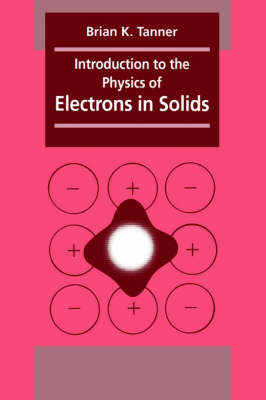
Introduction to the Physics of Electrons in Solids
Seiten
1995
Cambridge University Press (Verlag)
978-0-521-23941-7 (ISBN)
Cambridge University Press (Verlag)
978-0-521-23941-7 (ISBN)
Introduces the behaviour of electrons in solids, starting with the simplest possible model, and introducing higher-level models only when the simple model is inadequate. The book does not begin with complex crystallography, but builds up from a simple example of a free electron in a box.
This book aims to introduce the reader to the behaviour of electrons in solids, starting with the simplest possible model, and introducing higher-level models only when the simple model is inadequate. Unlike other solid state physics texts, this book does not begin with complex crystallography, but instead builds up from the simplest possible model of a free electron in a box. The approach is to introduce the subject through its historical development, and to show how quantum mechanics is necessary for an understanding of the properties of electrons in solids. It does not treat the dynamics of the crystal lattice, but proceeds to examine the consequences of collective behaviour in the phenomena of magnetism and superconductivity. Throughout the mathematics is straightforward and uses standard notation. This text is suitable for a second or third year undergraduate course in physics, and would also be suitable for an introductory solid state course in materials science or materials chemistry.
This book aims to introduce the reader to the behaviour of electrons in solids, starting with the simplest possible model, and introducing higher-level models only when the simple model is inadequate. Unlike other solid state physics texts, this book does not begin with complex crystallography, but instead builds up from the simplest possible model of a free electron in a box. The approach is to introduce the subject through its historical development, and to show how quantum mechanics is necessary for an understanding of the properties of electrons in solids. It does not treat the dynamics of the crystal lattice, but proceeds to examine the consequences of collective behaviour in the phenomena of magnetism and superconductivity. Throughout the mathematics is straightforward and uses standard notation. This text is suitable for a second or third year undergraduate course in physics, and would also be suitable for an introductory solid state course in materials science or materials chemistry.
Preface; Acknowledgements; 1. The classical free electron model; 2. Quantum mechanical free electron model; 3. Application of the Fermi gas model; 4. Energy bands; 5. Experimental evidence for band structure and effective mass; 6. Electrical conduction in semiconductors and insulators; 7. Semiconductor devices; 8. Localized electrons; 9. Magnetism; 10. Superconductivity; Appendices; Index.
| Erscheint lt. Verlag | 30.3.1995 |
|---|---|
| Verlagsort | Cambridge |
| Sprache | englisch |
| Maße | 156 x 235 mm |
| Gewicht | 482 g |
| Themenwelt | Naturwissenschaften ► Physik / Astronomie ► Festkörperphysik |
| ISBN-10 | 0-521-23941-9 / 0521239419 |
| ISBN-13 | 978-0-521-23941-7 / 9780521239417 |
| Zustand | Neuware |
| Informationen gemäß Produktsicherheitsverordnung (GPSR) | |
| Haben Sie eine Frage zum Produkt? |
Mehr entdecken
aus dem Bereich
aus dem Bereich
Quantenmechanik | Festkörperphysik
Buch | Softcover (2024)
De Gruyter Oldenbourg (Verlag)
CHF 179,95


