


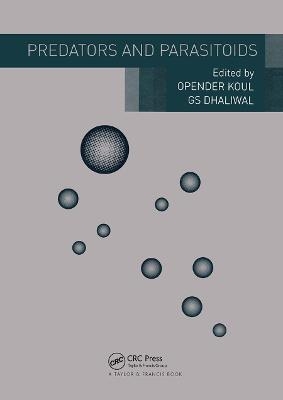
Predators and Parasitoids
Seiten
2019
CRC Press (Verlag)
978-0-367-45455-5 (ISBN)
CRC Press (Verlag)
978-0-367-45455-5 (ISBN)
Their natural enemies largely determine the population size and behavior of many plant-eating insects. Any reduction in enemy number can result in an insect outbreak. Applied biological control is one way to restore biodiversity in many agroecosystems. Predators and Parasitoids addresses the role of natural enemies in pest control. It examines how
Their natural enemies largely determine the population size and dynamic behavior of many plant-eating insects. Any reduction in enemy number can result in an insect outbreak. Applied biological control is thus one strategy for restoring functional biodiversity in many agroecosystems. Predators and Parasitoids addresses the role of natural enemies in pest control as an integrated pest management concept. It examines how Trichogramma, the extensively studied natural enemy of insect pests, has been used as a pest management tool, and it describes important aspects such as the inducible defense mechanisms of plants and the effects that plant diversity can have on herbivores and natural enemies. Specific chapters address recent advances in biological control: the effects of multiparasitism on parasitization; synergism between insect pathogens and entomophagous insects; and the use of exotic insects for weed control. With contributions from leading worldwide experts, Predators and Parasitoids is ideal for graduate students, research scientists and professionals in biological pest control, agriculture, entomology and ecology.
Their natural enemies largely determine the population size and dynamic behavior of many plant-eating insects. Any reduction in enemy number can result in an insect outbreak. Applied biological control is thus one strategy for restoring functional biodiversity in many agroecosystems. Predators and Parasitoids addresses the role of natural enemies in pest control as an integrated pest management concept. It examines how Trichogramma, the extensively studied natural enemy of insect pests, has been used as a pest management tool, and it describes important aspects such as the inducible defense mechanisms of plants and the effects that plant diversity can have on herbivores and natural enemies. Specific chapters address recent advances in biological control: the effects of multiparasitism on parasitization; synergism between insect pathogens and entomophagous insects; and the use of exotic insects for weed control. With contributions from leading worldwide experts, Predators and Parasitoids is ideal for graduate students, research scientists and professionals in biological pest control, agriculture, entomology and ecology.
Koul, Opender; Dhaliwal, G. S.
Predators and Parasitoids: An Introduction. Natural Enemies and Pest Control: An Integrated Pest Management Concept. Biological Control by Augmentation of Natural Enemies: Retrospect and Prospect. Developing Trichogramma as a Pest Management Tool. Tritrophic Interactions: The Inducible Defenses of Plants. Influence of Plant Diversity on Herbivores and Natural Enemies. Effect of Multiparasitism on the Parasitization Behavior of Insect Parasitoids. Synergism Between Insect Pathogens and Entomophagous Insects, and its Potential to Enhance Biological Control Efficacy. Biological Control of Weeds Using Exotic Insects.
| Erscheinungsdatum | 02.12.2019 |
|---|---|
| Verlagsort | London |
| Sprache | englisch |
| Maße | 174 x 246 mm |
| Gewicht | 380 g |
| Themenwelt | Naturwissenschaften ► Biologie ► Zoologie |
| Weitere Fachgebiete ► Land- / Forstwirtschaft / Fischerei | |
| ISBN-10 | 0-367-45455-6 / 0367454556 |
| ISBN-13 | 978-0-367-45455-5 / 9780367454555 |
| Zustand | Neuware |
| Informationen gemäß Produktsicherheitsverordnung (GPSR) | |
| Haben Sie eine Frage zum Produkt? |
Mehr entdecken
aus dem Bereich

aus dem Bereich
wie Bienenvölker unsere Welt gestalten
Buch | Hardcover (2025)
C.H.Beck (Verlag)
CHF 41,85


