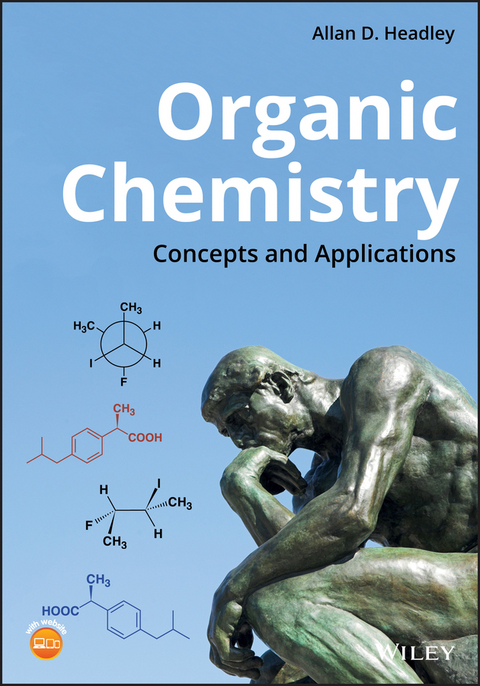
Organic Chemistry (eBook)
John Wiley & Sons (Verlag)
978-1-119-50467-2 (ISBN)

Provides an in-depth study of organic compounds that bridges the gap between general and organic chemistry
Organic Chemistry: Concepts and Applications presents a comprehensive review of organic compounds that is appropriate for a two-semester sophomore organic chemistry course. The text covers the fundamental concepts needed to understand organic chemistry and clearly shows how to apply the concepts of organic chemistry to problem-solving. In addition, the book highlights the relevance of organic chemistry to the environment, industry, and biological and medical sciences. The author includes multiple-choice questions similar to aptitude exams for professional schools, including the Medical College Admissions Test (MCAT) and Dental Aptitude Test (DAT) to help in the preparation for these important exams.
Rather than categorize content information by functional groups, which often stresses memorization, this textbook instead divides the information into reaction types. This approach bridges the gap between general and organic chemistry and helps students develop a better understanding of the material. A manual of possible solutions for chapter problems for instructors and students is available in the supplementary websites. This important book:
• Provides an in-depth study of organic compounds with division by reaction types that bridges the gap between general and organic chemistry
• Covers the concepts needed to understand organic chemistry and teaches how to apply them for problem-solving
• Puts a focus on the relevance of organic chemistry to the environment, industry, and biological and medical sciences
• Includes multiple choice questions similar to aptitude exams for professional schools
Written for students of organic chemistry, Organic Chemistry: Concepts and Applications is the comprehensive text that presents the material in clear terms and shows how to apply the concepts to problem solving.
Allan D. Headley, PhD, is a Professor of Chemistry at Texas A&M University, Commerce, where he teaches various undergraduate and graduate courses in organic chemistry.
Provides an in-depth study of organic compounds that bridges the gap between general and organic chemistry Organic Chemistry: Concepts and Applications presents a comprehensive review of organic compounds that is appropriate for a two-semester sophomore organic chemistry course. The text covers the fundamental concepts needed to understand organic chemistry and clearly shows how to apply the concepts of organic chemistry to problem-solving. In addition, the book highlights the relevance of organic chemistry to the environment, industry, and biological and medical sciences. The author includes multiple-choice questions similar to aptitude exams for professional schools, including the Medical College Admissions Test (MCAT) and Dental Aptitude Test (DAT) to help in the preparation for these important exams. Rather than categorize content information by functional groups, which often stresses memorization, this textbook instead divides the information into reaction types. This approach bridges the gap between general and organic chemistry and helps students develop a better understanding of the material. A manual of possible solutions for chapter problems for instructors and students is available in the supplementary websites. This important book: Provides an in-depth study of organic compounds with division by reaction types that bridges the gap between general and organic chemistry Covers the concepts needed to understand organic chemistry and teaches how to apply them for problem-solving Puts a focus on the relevance of organic chemistry to the environment, industry, and biological and medical sciences Includes multiple choice questions similar to aptitude exams for professional schools Written for students of organic chemistry, Organic Chemistry: Concepts and Applications is the comprehensive text that presents the material in clear terms and shows how to apply the concepts to problem solving.
Allan D. Headley, PhD, is a Professor of Chemistry at Texas A&M University, Commerce, where he teaches various undergraduate and graduate courses in organic chemistry.
Preface
About This Book
This book is written from the students' perspective. Addressing the questions that students of organic chemistry typically have, the errors they typically make, along with some fundamental misconceptions that they typically formulate, are all the focus of this textbook. A major difference between this textbook and the majority of other textbooks is with the presentation of the information. The objective of this textbook is to develop the student's ability to think critically and creatively and equally important to improve the problem‐solving skills of students. The content information is presented in such a way to assist students develop these skills. These are skills critically needed for students of science as they prepare for today's workforce. This approach also gives students the assurance that their opinions and thoughts are valued. As a result, students will become confident as they master the subject material. With this approach, students will quickly realize that it is in their best interest to develop these skills instead of relying on memorization as they approach this course and other science courses. The development of these skills will eventually prepare students to become better scientists. The problems in each chapter and at the end‐of‐chapter problems are designed to get students to solve problems by using their critical thinking skills.
For the majority of textbooks, the vast amount of organic chemistry information is dealt with primarily by categorizing the information into functional group categories. Thus, each of the approximately 20 chapters of a typical organic chemistry textbook is basically an exhaustive study of compounds with the different functional groups found in organic chemistry. This approach does not lend itself to aid students understand and master the vast content information of organic chemistry; this approach only presents large categories of information for students to handle. As a result, some students tend to rely on memorization instead of developing a scientific approach to handle all the information presented. In this textbook, the vast amount of organic chemistry information is not presented by functional group categories, but instead by reaction types; this approach presents much fewer categories of information for students to handle. In this textbook, the content information is divided into eight general categories based on reaction types, and not functional groups. An overview of the eight reaction types that are covered in the textbook is covered in Chapter 6. Since the majority of these types of reactions are the basic reactions covered in general chemistry, this approach provides a much better method to bridge the gap between general chemistry and organic chemistry. For example, there is a chapter that covers oxidation, a concept covered in general chemistry, but in this textbook, the concept of oxidation is applied to organic molecules that have different functional groups. Thus, after students have learned the concept of oxidation, they will be better prepared to apply that concept to a wide variety of organic molecules. The first part of the textbook covers relevant concepts of chemistry and the later sections deal with the applications of the concepts learned to the reactions of a wide cross section of molecules with different functional groups, hence the title of the textbook – Organic Chemistry: Concepts and Applications.
The first chapter covers the description of the atom and molecules; the next two chapters give a basic description of functional groups and the nomenclature of organic molecules so that students can readily recognize different types of molecules and learn the language of organic chemistry encountered in later chapters. The philosophy is that once students are able to recognize different functional groups, they will be better able to predict and communicate the various outcomes of different reactions encountered in organic chemistry. As a result, students will be able to apply their creative thinking skills to solve various problems encountered in this course. Since students are taught early in the textbook how to recognize the different reaction types, they will not only recognize the connection with general chemistry and organic chemistry but also how to apply the knowledge gained from general chemistry to new concepts that will be learned in organic chemistry.
Another aspect that this textbook covers is the importance and relevance of organic chemistry to our environment, the pharmaceutical and chemical industries, and biological and physical sciences. For example, in the study of the properties and the types of reactions that alkanes undergo, students will recognize the relevance of using different types of reactions to convert fossil and petroleum products into important compounds, such as polymers, pharmaceutical products, everyday household chemicals, insecticides, and herbicides. Also, the importance and significance of reactive intermediates including radicals are discussed. As a result, throughout the textbook, there are various “Did you Know?” sections. In these sections, students are shown the importance and the relevance of the content material being covered to the environment; often times, this is information that students may not have realized or know. There is a supplemental package that accompanies this text that includes multiple‐choice questions similar to those of most national standardized tests and there are answers and detailed explanations for the questions. This supplemental package is included since most students who take organic chemistry eventually take an aptitude test for professional schools, including the Medical College Admissions Test (MCAT) for medical school, Dental Aptitude Test (DAT) for dental school, Pharmacy College Admission Test (PCAT) for pharmacy school, or the GRE subject test for most graduate programs. Organic chemistry makes up a large percentage of these exams since students' critical, analytical, and creative skills are needed to be successful in organic chemistry and these programs.
In summary, this textbook offers a new approach to not only teach organic chemistry but also as a guide to assist students to become better scientists by developing their critical, analytical, and creative thinking skills. These skills will prepare students for today's job market, which relies heavily on the creative application of knowledge.
To the Student of Organic Chemistry
Chemistry is all around us and plays a very important role in just about every aspect of our everyday lives. Our society benefits from chemistry, especially organic chemistry, in many ways. A large percentage of just about everything around us is derived through a process that involves chemistry. For example, a large percentage of the clothes that we wear are synthetic polymers; the plastic containers for milk, water, and other liquids are made from polymers, which are different types of polymers from the kind that are used to make some of the clothes that we wear. So, it is important to understand and learn how chemistry can be used to benefit our everyday lives, and how chemists can utilize chemistry to improve the quality of our lives and solve various problems. In order to succeed in this course, you must have a positive attitude about chemistry. The same is true for any of your other courses and anything that you want to succeed at in life. Can you imagine an athlete who wants to be the best at his or her sport keeps saying that they just do not like the game or thinks that the game that they are playing is extremely difficult and that they will never master that particular game! I am of the impression that such an individual will not be very successful at that particular sport. As a result, this cannot be the approach to succeed at mastering something that needs to be mastered. A very positive approach must be taken in order to be successful in organic chemistry. One way of achieving the goal of benefiting the maximum from organic chemistry is to become involved in chemistry; get to know, understand, and appreciate its benefits to society. This approach will require constant and persistent work on this subject. Develop a schedule for study and try to study consistently for at least five to six hours per week. Depending on your background in chemistry, some students may require a bit more time. Most people who succeed at a particular discipline have to put aside a large percentage of time to practice and perfect their skills. Each member of the football team must practice regularly so that the team can be the best in the conference and the nation. We can learn something from their approach to achieve success – they set aside time to practice regularly. Whether the discipline is baseball, football, cheerleading, or chemistry, success appears to come from disciplined and consistent hard work. Like anything that we do in life that we are successful at, we must dedicate time in order to achieve perfection. An important aspect of time dedicated toward mastering organic chemistry is to attend classes and taking good notes. Just hearing the subject being discussed goes a long way. As you start to master the subject, you will require less time to understand the different topics of organic chemistry and you will be able to spend more time analyzing and applying the concepts learned.
There are strategies that have been proven to be useful in order to be successful in organic chemistry. It may sound simple, but the first strategy to succeed in organic chemistry is to attend lectures and it is important to attend...
| Erscheint lt. Verlag | 19.11.2019 |
|---|---|
| Sprache | englisch |
| Themenwelt | Naturwissenschaften ► Chemie ► Organische Chemie |
| Schlagworte | applications of organic chemistry • Chemical bonds • chemical formulas • Chemie • Chemistry • concepts of organic chemistry • heteroatomic functional groups • Hydrocarbons • <p>Guide to organic chemistry • Medical Science • Medizin • Organic Chemistry • organic nomenclature</p> • Organische Chemie • Pharmaceutical & Medicinal Chemistry • Pharmazeutische u. Medizinische Chemie • understanding atoms • understanding molecules |
| ISBN-10 | 1-119-50467-8 / 1119504678 |
| ISBN-13 | 978-1-119-50467-2 / 9781119504672 |
| Informationen gemäß Produktsicherheitsverordnung (GPSR) | |
| Haben Sie eine Frage zum Produkt? |
 EPUB (Adobe DRM)
Kopierschutz: Adobe-DRM
Adobe-DRM ist ein Kopierschutz, der das eBook vor Mißbrauch schützen soll. Dabei wird das eBook bereits beim Download auf Ihre persönliche Adobe-ID autorisiert. Lesen können Sie das eBook dann nur auf den Geräten, welche ebenfalls auf Ihre Adobe-ID registriert sind.
Details zum Adobe-DRM
Dateiformat: EPUB (Electronic Publication)
EPUB ist ein offener Standard für eBooks und eignet sich besonders zur Darstellung von Belletristik und Sachbüchern. Der Fließtext wird dynamisch an die Display- und Schriftgröße angepasst. Auch für mobile Lesegeräte ist EPUB daher gut geeignet.
Systemvoraussetzungen:
PC/Mac: Mit einem PC oder Mac können Sie dieses eBook lesen. Sie benötigen eine
eReader: Dieses eBook kann mit (fast) allen eBook-Readern gelesen werden. Mit dem amazon-Kindle ist es aber nicht kompatibel.
Smartphone/Tablet: Egal ob Apple oder Android, dieses eBook können Sie lesen. Sie benötigen eine
Geräteliste und zusätzliche Hinweise
Buying eBooks from abroad
For tax law reasons we can sell eBooks just within Germany and Switzerland. Regrettably we cannot fulfill eBook-orders from other countries.
aus dem Bereich