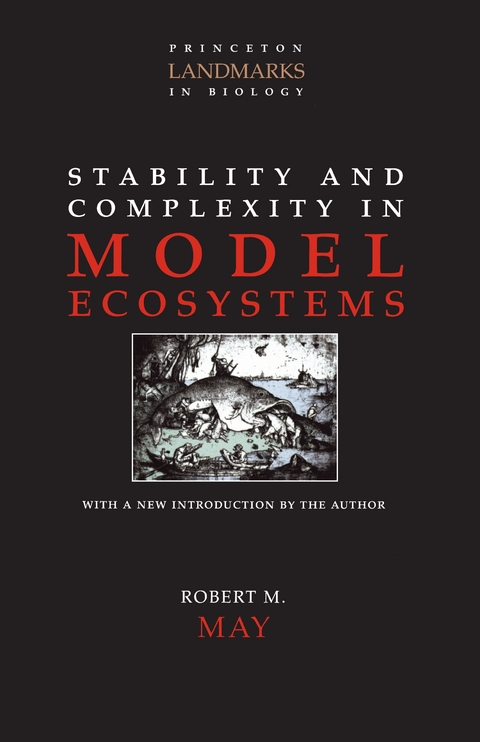
Stability and Complexity in Model Ecosystems (eBook)
Princeton University Press (Verlag)
978-0-691-20691-2 (ISBN)

| Erscheint lt. Verlag | 31.12.2019 |
|---|---|
| Reihe/Serie | Princeton Landmarks in Biology | Princeton Landmarks in Biology |
| Sprache | englisch |
| Themenwelt | Naturwissenschaften ► Biologie ► Humanbiologie |
| Naturwissenschaften ► Biologie ► Ökologie / Naturschutz | |
| Schlagworte | Almost surely • Approximation • autocorrelation • balance of nature • Biological constraints • Biomass (ecology) • Boundary value problem • Calculation • Carrying Capacity • central limit theorem • chaos theory • character displacement • coefficient • Commensalism • community matrix • competitive exclusion principle • Complex conjugate • complex plane • Control Theory • Correlation and dependence • Covariance matrix • Density dependence • Determinacy • Deterministic system • Diagram (category theory) • differential equation • Dimension • Dynamical system • ecological niche • Ecological Stability • Ecology • ecosystem • Ecosystem model • Efficiency of conversion • Eigenvalues and Eigenvectors • Energy flow (ecology) • Equation • Equilibrium Point • Equipartition theorem • Essential Matrix • Essential singularity • expected value • Forecasting • fragility • Free parameter • functional response • group selection • idealization • Information Theory • Ising Model • Joint probability distribution • Likelihood Function • Limit cycle • limiting similarity • linear equation • Linear Function • Linearization • logarithm • logistic function • logistic map • Lotka–Volterra equations • Lyapunov function • Markov Chain • maximum sustainable yield • Moment (mathematics) • Multivariate normal distribution • nonlinear system • Obligate • Paradox of enrichment • Parameter • Parameter Space • Population cycle • population dynamics • Population model • predation • Predictability • Probability • Probability Distribution • Proportionality (mathematics) • Quantity • Regression Analysis • Schematic • shape parameter • smoothing • spatial heterogeneity • Special case • Stability Theory • standard deviation • stationary distribution • statistical significance • stochastic • stochastic differential equation • Structural Stability • symmetry • Theorem • theory • Thermodynamic Limit • Trophic level • Variable (mathematics) • Variance |
| ISBN-10 | 0-691-20691-0 / 0691206910 |
| ISBN-13 | 978-0-691-20691-2 / 9780691206912 |
| Informationen gemäß Produktsicherheitsverordnung (GPSR) | |
| Haben Sie eine Frage zum Produkt? |
 PDF (Adobe DRM)
Kopierschutz: Adobe-DRM
Adobe-DRM ist ein Kopierschutz, der das eBook vor Mißbrauch schützen soll. Dabei wird das eBook bereits beim Download auf Ihre persönliche Adobe-ID autorisiert. Lesen können Sie das eBook dann nur auf den Geräten, welche ebenfalls auf Ihre Adobe-ID registriert sind.
Details zum Adobe-DRM
Dateiformat: PDF (Portable Document Format)
Mit einem festen Seitenlayout eignet sich die PDF besonders für Fachbücher mit Spalten, Tabellen und Abbildungen. Eine PDF kann auf fast allen Geräten angezeigt werden, ist aber für kleine Displays (Smartphone, eReader) nur eingeschränkt geeignet.
Systemvoraussetzungen:
PC/Mac: Mit einem PC oder Mac können Sie dieses eBook lesen. Sie benötigen eine
eReader: Dieses eBook kann mit (fast) allen eBook-Readern gelesen werden. Mit dem amazon-Kindle ist es aber nicht kompatibel.
Smartphone/Tablet: Egal ob Apple oder Android, dieses eBook können Sie lesen. Sie benötigen eine
Geräteliste und zusätzliche Hinweise
Buying eBooks from abroad
For tax law reasons we can sell eBooks just within Germany and Switzerland. Regrettably we cannot fulfill eBook-orders from other countries.
aus dem Bereich