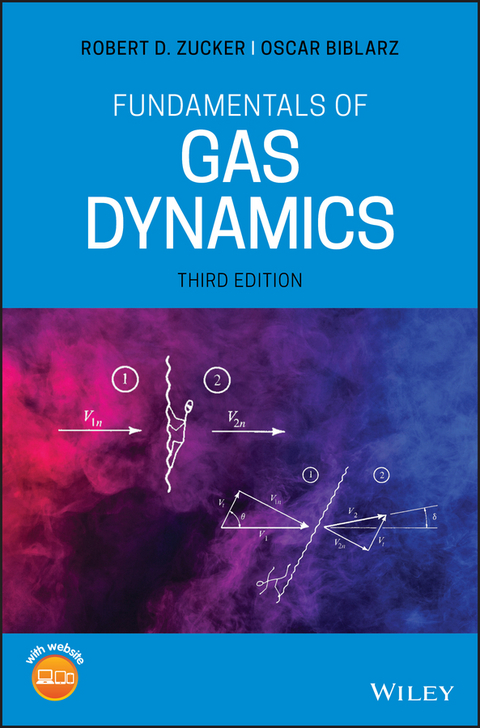
Fundamentals of Gas Dynamics (eBook)
John Wiley & Sons (Verlag)
978-1-119-48169-0 (ISBN)

New edition of the popular textbook, comprehensively updated throughout and now includes a new dedicated website for gas dynamic calculations
The thoroughly revised and updated third edition of Fundamentals of Gas Dynamics maintains the focus on gas flows below hypersonic. This targeted approach provides a cohesive and rigorous examination of most practical engineering problems in this gas dynamics flow regime. The conventional one-dimensional flow approach together with the role of temperature-entropy diagrams are highlighted throughout.
The authors-noted experts in the field-include a modern computational aid, illustrative charts and tables, and myriad examples of varying degrees of difficulty to aid in the understanding of the material presented. The updated edition of Fundamentals of Gas Dynamics includes new sections on the shock tube, the aerospike nozzle, and the gas dynamic laser. The book contains all equations, tables, and charts necessary to work the problems and exercises in each chapter. This book's accessible but rigorous style:
- Offers a comprehensively updated edition that includes new problems and examples
- Covers fundamentals of gas flows targeting those below hypersonic
- Presents the one-dimensional flow approach and highlights the role of temperature-entropy diagrams
- Contains new sections that examine the shock tube, the aerospike nozzle, the gas dynamic laser, and an expanded coverage of rocket propulsion
- Explores applications of gas dynamics to aircraft and rocket engines
- Includes behavioral objectives, summaries, and check tests to aid with learning
Written for students in mechanical and aerospace engineering and professionals and researchers in the field, the third edition of Fundamentals of Gas Dynamics has been updated to include recent developments in the field and retains all its learning aids.
The calculator for gas dynamics calculations is available at https://www.oscarbiblarz.com/gascalculator
DR. ROBERT D. ZUCKER (deceased) was a Professor of Aeronautics at the Naval Postgraduate School, Monterey, California, USA. He was an active member of the American Society for Engineering Education and also a member of the AIAA.
DR. OSCAR BIBLARZ is a Professor Emeritus at the Naval Postgraduate School, Monterey, California, USA. He has extensive teaching and research experience and his main research areas have been in aerospace propulsion, fluid mechanics and gas lasers. He is a member of the AIAA.
New edition of the popular textbook, comprehensively updated throughout and now includes a new dedicated website for gas dynamic calculations The thoroughly revised and updated third edition of Fundamentals of Gas Dynamics maintains the focus on gas flows below hypersonic. This targeted approach provides a cohesive and rigorous examination of most practical engineering problems in this gas dynamics flow regime. The conventional one-dimensional flow approach together with the role of temperature-entropy diagrams are highlighted throughout. The authors noted experts in the field include a modern computational aid, illustrative charts and tables, and myriad examples of varying degrees of difficulty to aid in the understanding of the material presented. The updated edition of Fundamentals of Gas Dynamics includes new sections on the shock tube, the aerospike nozzle, and the gas dynamic laser. The book contains all equations, tables, and charts necessary to work the problems and exercises in each chapter. This book s accessible but rigorous style: Offers a comprehensively updated edition that includes new problems and examples Covers fundamentals of gas flows targeting those below hypersonic Presents the one-dimensional flow approach and highlights the role of temperature-entropy diagrams Contains new sections that examine the shock tube, the aerospike nozzle, the gas dynamic laser, and an expanded coverage of rocket propulsion Explores applications of gas dynamics to aircraft and rocket engines Includes behavioral objectives, summaries, and check tests to aid with learning Written for students in mechanical and aerospace engineering and professionals and researchers in the field, the third edition of Fundamentals of Gas Dynamics has been updated to include recent developments in the field and retains all its learning aids. The calculator for gas dynamics calculations is available at www.oscarbiblarz.com/gascalculator
DR. ROBERT D. ZUCKER (deceased) was a Professor of Aeronautics at the Naval Postgraduate School, Monterey, California, USA. He was an active member of the American Society for Engineering Education and also a member of the AIAA. DR. OSCAR BIBLARZ is a Professor Emeritus at the Naval Postgraduate School, Monterey, California, USA. He has extensive teaching and research experience and his main research areas have been in aerospace propulsion, fluid mechanics and gas lasers. He is a member of the AIAA.
To the Student
You do not need much background to enter the fascinating world of gas dynamics. However, it will be assumed that you have been exposed to college‐level courses in calculus and thermodynamics. Specifically, you are expected to know the following:
- Simple differentiation and integration, logarithms, and series expansions
- The meaning of a partial derivative
- Vectors and the significance of a dot product
- How to draw and interpret free‐body diagrams
- How to resolve a force or other vector into its components
- Newton's second law of motion and the units related to force and mass
- About properties of fluids, particularly perfect gases
- The zeroth, first, and second laws of thermodynamics
The first six prerequisites are very specific; the last two cover quite a bit of territory. In fact, a background in thermodynamics is so important to the study of gas dynamics that a review of the necessary concepts for control mass analysis is contained in Chapter 1. If you have recently completed a course in thermodynamics, you may skip most of Section 1.4, but you should read the questions at the end of the chapter. If you can answer these, press on! If any difficulties arise, refer back to the material in the chapter. Many of these equations will be used throughout the rest of the book. You may even gain more confidence by working some of the review problems in Chapter 1. In this third edition, Section 1.3 is new; it covers the often‐unstated background for why we prefer to use nondimensional quantities in gas dynamics and requires reading.
In Chapters 2 and 3 we convert the fundamental laws into a form needed for control volume analysis. If you have had a good course in fluid mechanics, much of this material should be familiar to you. A section on constant‐density fluids is included to show the general applicability in that field and to tie in with any previous work that you have done in this area. If you have not studied fluid mechanics, do not worry. All the material that you need to know in this field is included. Because several special concepts are developed that are not treated in many thermodynamics and fluid mechanics courses, read these chapters even if you have the relevant background. They introduce the notation used, form the backbone of gas dynamics, and are referred to frequently in later chapters.
In Chapter 4, you are introduced to the characteristics of compressible fluids. Then in the following chapters, various basic flow phenomena are analyzed one by one: varying area, normal and oblique shocks, supersonic expansions and compressions, duct friction, and heat transfer. A wide variety of practical engineering problems can be solved using these concepts, and many of these problems are covered throughout the text. Examples of these include the off‐design operation of supersonic nozzles, supersonic wind tunnels, blast waves and shock tubes, supersonic airfoils, some methods of flow measurement, and the choking from either friction or thermal effects. You will find that supersonic flows bring about special problems in that they do not seem to follow your intuition. In Chapter 11, you will be exposed to what goes on at the molecular level and a discussion of a laser based purely on gas dynamics. You will see how molecular structure at high temperatures affects real gas behavior and learn some relatively simple techniques to handle these situations.
Aircraft propulsion systems (with their air inlets, afterburners, and exit nozzles) represent a noteworthy application of nearly all the basic gas dynamics flow situations. Thus, in Chapter 12, we describe and analyze common air-breathing propulsion systems, including turbojets, turbofans, and turboprops. Other propulsion systems, such as rockets, ramjets, and pulsejets, are also covered.
A number of chapters contain material that shows how to use computer software in certain calculations. The aim is to indicate how particular software might be applied as a means of getting answers by using the same equations that could be worked manually or through the tables. The computer utility MAPLE is our choice, but if you have not studied it, do not worry. All the gas dynamics is presented in the sections preceding such applications so that all computer sections may be omitted. For students who have access to the “Word Wide Web,” a Gasdynamics Calculator has been developed that can reproduce Appendices D, G, H, I, and J for all applicable values of γ. Access to a Web browser will allow students to view complementary figures and photographs that are presented in this book.
This book has been especially written for you, the student. We hope that its informal style will put you at ease and motivate you to keep reading on. Student comments on the previous editions indicate that this objective has been accomplished. Once you have read the first chapter, the remaining chapters follow a similar format. The following suggestions may help you optimize your study time. When you start each chapter, read the Introduction, as this will give you the general idea of what the chapter is all about. The next section contains a set of learning objectives (beginning with Chapter 2). These tell exactly what you should be able to do after completing the chapter successfully. Some objectives are marked optional, as they are only for the most serious students. Merely scan the objectives, as they would not mean much at first. However, they will indicate important things to look for. As you read the material, you may occasionally be asked to do something—complete a derivation, fill in a chart, draw a diagram, etc. Make an honest attempt to follow these instructions before proceeding further. You will not be asked to do something that you have not the background to do, and your active participation will help solidify important concepts and provide feedback on your progress.
As you complete each section, look back to see if any of the enumerated objectives have been covered. If so, make sure that you can do them. Write out the answers; these will help you in later studies. You may wish to make your own summary of important points in each chapter, and then see how well it agrees with the summary provided. After having worked a representative group of problems, you are ready to check your knowledge by taking the test at the end of the chapter. This should always be treated as a closed‐book affair, with the exception of tables and charts in the appendices. If you have any difficulties with the check test, you should go back and restudy the appropriate sections. Do not proceed to the next chapter without completing the previous one satisfactorily.
Not all chapters are of the same length, most of them being a little long to tackle all at once. You might find it easier to break them into “bite‐sized” pieces according to the Correlation Table that follows. Work on some problems on the first group of objectives and sections before proceeding. You should spend time on each study session working through the material. Learning can be fun; however, knowledge does not come free. We hope that this book will make the task of exploring gas dynamics more doable and more enjoyable.
Correlation Table for Sections, Objectives, and Problems
| Chapter | Sections | Optional Section | Objectives | Optional Objectives | Problems | Optional Problem |
| 1 | 1–3 | Q: 1–8 | Q: 1–9P: 1–6 |
| 4 | Q: 10–34 |
| 4 | P: 1–5 |
| 2 | 1–5 | 1–3, 5 | 4 | 1–3, 5–6 | 4 |
| 6 | 7, 9 | 6,... |
| Erscheint lt. Verlag | 31.10.2019 |
|---|---|
| Sprache | englisch |
| Themenwelt | Naturwissenschaften ► Chemie ► Technische Chemie |
| Naturwissenschaften ► Physik / Astronomie ► Mechanik | |
| Technik ► Maschinenbau | |
| Technik ► Umwelttechnik / Biotechnologie | |
| Schlagworte | adiabatic flow • Aeronautic & Aerospace Engineering • analysis of gas dynamics • Conservation of Energy • conservation of mass • fluid mechanics • <p>Understanding gas dynamics regimes • Luft- u. Raumfahrttechnik • mach number • Maschinenbau • mechanical engineering • perfect gases</p> • principles of gas dynamics • sonic speed • Strömungsmechanik • thermodynamic concepts • thermodynamics • Thermodynamik • the stagnation concepts • wave propagation |
| ISBN-10 | 1-119-48169-4 / 1119481694 |
| ISBN-13 | 978-1-119-48169-0 / 9781119481690 |
| Informationen gemäß Produktsicherheitsverordnung (GPSR) | |
| Haben Sie eine Frage zum Produkt? |
 EPUB (Adobe DRM)
Kopierschutz: Adobe-DRM
Adobe-DRM ist ein Kopierschutz, der das eBook vor Mißbrauch schützen soll. Dabei wird das eBook bereits beim Download auf Ihre persönliche Adobe-ID autorisiert. Lesen können Sie das eBook dann nur auf den Geräten, welche ebenfalls auf Ihre Adobe-ID registriert sind.
Details zum Adobe-DRM
Dateiformat: EPUB (Electronic Publication)
EPUB ist ein offener Standard für eBooks und eignet sich besonders zur Darstellung von Belletristik und Sachbüchern. Der Fließtext wird dynamisch an die Display- und Schriftgröße angepasst. Auch für mobile Lesegeräte ist EPUB daher gut geeignet.
Systemvoraussetzungen:
PC/Mac: Mit einem PC oder Mac können Sie dieses eBook lesen. Sie benötigen eine
eReader: Dieses eBook kann mit (fast) allen eBook-Readern gelesen werden. Mit dem amazon-Kindle ist es aber nicht kompatibel.
Smartphone/Tablet: Egal ob Apple oder Android, dieses eBook können Sie lesen. Sie benötigen eine
Geräteliste und zusätzliche Hinweise
Buying eBooks from abroad
For tax law reasons we can sell eBooks just within Germany and Switzerland. Regrettably we cannot fulfill eBook-orders from other countries.
aus dem Bereich