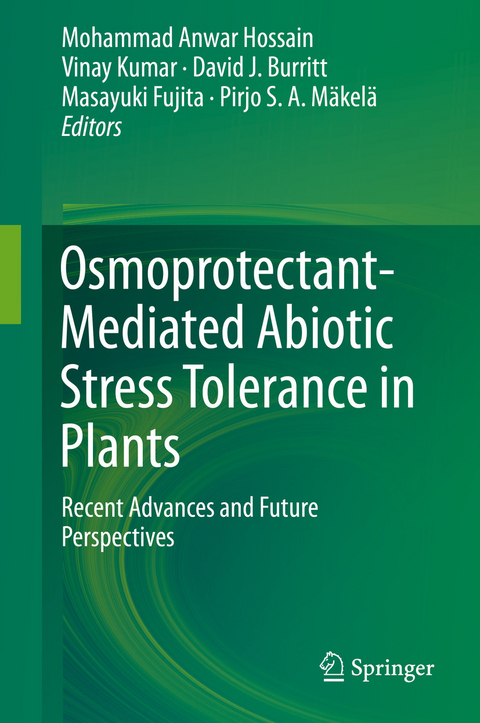
Osmoprotectant-Mediated Abiotic Stress Tolerance in Plants (eBook)
342 Seiten
Springer International Publishing (Verlag)
978-3-030-27423-8 (ISBN)
In nature, plants are constantly challenged by various abiotic and biotic stresses that can restrict their growth, development and yields. In the course of their evolution, plants have evolved a variety of sophisticated and efficient mechanisms to sense, respond to, and adapt to changes in the surrounding environment. A common defensive mechanism activated by plants in response to abiotic stress is the production and accumulation of compatible solutes (also called osmolytes). This include amino acids (mainly proline), amines (such as glycinebetaine and polyamines), and sugars (such as trehalose and sugar alcohols), all of which are readily soluble in water and non-toxic at high concentrations. The metabolic pathways involved in the biosynthesis and catabolism of compatible solutes, and the mechanisms that regulate their cellular concentrations and compartmentalization are well characterized in many important plant species. Numerous studies have provided evidence that enhanced accumulation of compatible solutes in plants correlates with increased resistance to abiotic stresses. New insights into the mechanisms associated with osmolyte accumulation in transgenic plants and the responses of plants to exogenous application of osmolyte, will further enhance our understanding of the mechanisms by which compatible solutes help to protect plants from damage due to abiotic stress and the potential roles compatible solutes could play in improving plants growth and development under optimal conditions for growth. Although there has been significant progress made in understanding the multiple roles of compatible solute in abiotic stress tolerance, many aspects associated with compatible solute-mediated abiotic stress responses and stress tolerance still require more research. As well as providing basic up-to-date information on the biosynthesis, compartmentalization and transport of compatible solute in plants, this book will also give insights into the direct or indirect involvement of these key compatible solutes in many important metabolic processes and physiological functions, including their antioxidant and signaling functions, and roles in modulating plant growth, development and abiotic stress tolerance.
In this book, Osmoprotectant-mediated abiotic stress tolerance in plants: recent advances and future perspectives, we present a collection of 16 chapters written by leading experts engaged with compatible solute-induced abiotic stress tolerance in plants. The main objective of this volume is to promote the important roles of these compatible solutes in plant biology, by providing an integrated and comprehensive mix of basic and advanced information for students, scholars and scientists interested in, or already engaged in, research involving osmoprotectant. Finally, this book will be a valuable resource for future environmental stress-related research, and can be considered as a textbook for graduate students and as a reference book for front-line researchers working on the relationships between osmoprotectant and abiotic stress responses and tolerance in plants.
?Dr. Mohammad Anwar Hossain is a Professor in the Department of Genetics and Plant Breeding, Bangladesh Agricultural University, Mymensingh-2202, Bangladesh. He received his B.Sc. in Agriculture and M.S. in Genetics and Plant Breeding from Bangladesh Agricultural University, Bangladesh. He also received an M.S. in Agriculture from Kagawa University, Japan in 2008 and a Ph.D. in Abiotic Stress Physiology and Molecular Biology from Ehime University, Japan in 2011 through Monbukagakusho scholarship. As a JSPS postdoctoral researcher he has worked on isolating low phosphorus stress tolerant genes from rice at the university of Tokyo, Japan during the period of 2015-2017. His current research interests include the isolation and characterization of abiotic stress responsive genes and proteins, physiological and molecular mechanisms of abiotic stress response and tolerance with special reference to oxidative stress, antioxidants and methylglyoxal metabolism and signaling, generation of stress tolerant and nutrient efficient plants through breeding and biotechnology and cross-stress tolerance in plants. He has over 50 peer-reviewed publications and has edited 9 books, including this one, published by CRC press, Springer, and Elsevier.
| Erscheint lt. Verlag | 1.11.2019 |
|---|---|
| Zusatzinfo | XI, 342 p. 44 illus., 41 illus. in color. |
| Sprache | englisch |
| Themenwelt | Naturwissenschaften ► Biologie ► Botanik |
| Schlagworte | compatible solutes • environmental stress • Genetic Mechanisms • Molecular mechanisms • Stress tolerance |
| ISBN-10 | 3-030-27423-3 / 3030274233 |
| ISBN-13 | 978-3-030-27423-8 / 9783030274238 |
| Informationen gemäß Produktsicherheitsverordnung (GPSR) | |
| Haben Sie eine Frage zum Produkt? |
 PDF (Wasserzeichen)
DRM: Digitales Wasserzeichen
Dieses eBook enthält ein digitales Wasserzeichen und ist damit für Sie personalisiert. Bei einer missbräuchlichen Weitergabe des eBooks an Dritte ist eine Rückverfolgung an die Quelle möglich.
Dateiformat: PDF (Portable Document Format)
Mit einem festen Seitenlayout eignet sich die PDF besonders für Fachbücher mit Spalten, Tabellen und Abbildungen. Eine PDF kann auf fast allen Geräten angezeigt werden, ist aber für kleine Displays (Smartphone, eReader) nur eingeschränkt geeignet.
Systemvoraussetzungen:
PC/Mac: Mit einem PC oder Mac können Sie dieses eBook lesen. Sie benötigen dafür einen PDF-Viewer - z.B. den Adobe Reader oder Adobe Digital Editions.
eReader: Dieses eBook kann mit (fast) allen eBook-Readern gelesen werden. Mit dem amazon-Kindle ist es aber nicht kompatibel.
Smartphone/Tablet: Egal ob Apple oder Android, dieses eBook können Sie lesen. Sie benötigen dafür einen PDF-Viewer - z.B. die kostenlose Adobe Digital Editions-App.
Buying eBooks from abroad
For tax law reasons we can sell eBooks just within Germany and Switzerland. Regrettably we cannot fulfill eBook-orders from other countries.
aus dem Bereich