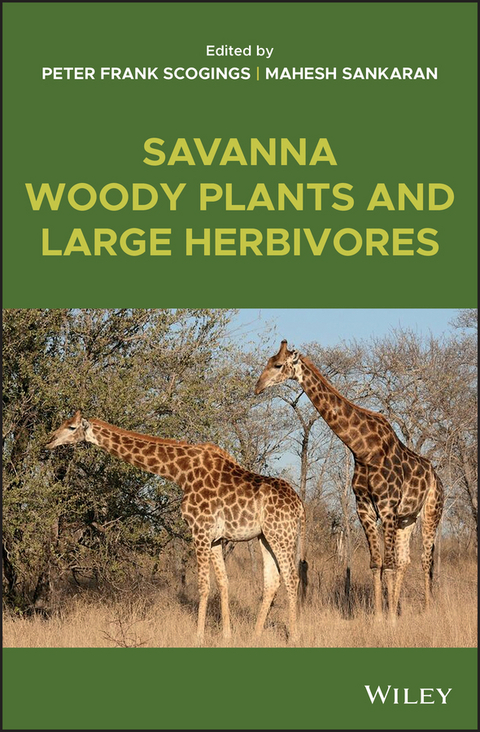
Savanna Woody Plants and Large Herbivores (eBook)
John Wiley & Sons (Verlag)
978-1-119-08113-5 (ISBN)
Insights on current research and recent developments in understanding global savanna systems
Increasingly recognized as synonymous with tropical grassy biomes, savannas are found in tropical and sub-tropical climates as well as warm, temperate regions of North America. Savanna Woody Plants and Large Herbivores examines the interactions between woody plants and browsing mammals in global savannas-focusing primarily on the C4 grassy ecosystems with woody components that constitute the majority of global savannas-and discusses contemporary savanna management models and applications.
This much-needed addition to current research examines topics including the varying behavior of browsing mammals, the response to browsing by woody species, and the factors that inhibit forage intake. Contributions from an international team of active researchers and experts compare and contrast different savanna ecosystems, offering a global perspective on savanna functioning, the roles of soil and climate in resource availability and organism interaction, and the possible impacts of climate change across global savannas.
- Fills a gap in literature on savanna management issues, including biodiversity conservation and animal production
- Applies concepts developed in other biomes to future savanna research
- Complements contemporary books on savanna or large herbivore ecology
- Focuses on the woody component of savanna ecosystems and large herbivore interactions in savannas
- Compares tree-mammal systems of savannas and other eco-systems of temperate and boreal regions
- Provides numerous case studies of plant-mammal interactions from various savanna ecosystems
Savanna Woody Plants and Large Herbivores is a valuable addition to those in fields such as ecology, wildlife and conservation biology, natural resource management, and environmental science.
PETER FRANK SCOGINGS is Associate Professor, School of Life Sciences, University of KwaZulu-Natal, South Africa.
MAHESH SANKARAN is Reader, National Centre for Biological Sciences, India, and Lecturer, Institute of Integrative & Comparative Biology, Faculty of Biological Sciences, University of Leeds, UK.
Insights on current research and recent developments in understanding global savanna systems Increasingly recognized as synonymous with tropical grassy biomes, savannas are found in tropical and sub-tropical climates as well as warm, temperate regions of North America. Savanna Woody Plants and Large Herbivores examines the interactions between woody plants and browsing mammals in global savannas focusing primarily on the C4 grassy ecosystems with woody components that constitute the majority of global savannas and discusses contemporary savanna management models and applications. This much-needed addition to current research examines topics including the varying behavior of browsing mammals, the response to browsing by woody species, and the factors that inhibit forage intake. Contributions from an international team of active researchers and experts compare and contrast different savanna ecosystems, offering a global perspective on savanna functioning, the roles of soil and climate in resource availability and organism interaction, and the possible impacts of climate change across global savannas. Fills a gap in literature on savanna management issues, including biodiversity conservation and animal production Applies concepts developed in other biomes to future savanna research Complements contemporary books on savanna or large herbivore ecology Focuses on the woody component of savanna ecosystems and large herbivore interactions in savannas Compares tree-mammal systems of savannas and other eco-systems of temperate and boreal regions Provides numerous case studies of plant-mammal interactions from various savanna ecosystems Savanna Woody Plants and Large Herbivores is a valuable addition to those in fields such as ecology, wildlife and conservation biology, natural resource management, and environmental science.
PETER FRANK SCOGINGS is Associate Professor, School of Life Sciences, University of KwaZulu-Natal, South Africa. MAHESH SANKARAN is Reader, National Centre for Biological Sciences, India, and Lecturer, Institute of Integrative & Comparative Biology, Faculty of Biological Sciences, University of Leeds, UK.
Preface
“Savanna” has different meanings for different people, and the term has continued to elude a widely agreed definition (Lehmann and Parr 2016). “Savanna” continues to be used extensively to label any vegetation comprising a continuous herbaceous layer and a discontinuous woody layer of variable density and height (e.g. Furley 2016). However, in the past decade, it has become increasingly recognized that savannas are synonymous with “C4 grassy biomes” or “tropical grassy biomes” (e.g. Bond et al. 2008; Parr et al. 2014), i.e. biomes containing herbaceous vegetation dominated by graminoids using the C4 photosynthetic pathway. As such, savannas are largely tropical and sub‐tropical ecosystems, but are also found within warm temperate climates of North America and Asia (see Edwards et al. 2010). Although reference is occasionally made in this book to savannas where C3 grasses dominate the herbaceous layer, and to savannas that are seasonally flooded grasslands, the scope of this book is the majority of global savannas, which are C4 grassy ecosystems with a woody component.
The specific focus of this book is on the ecology of woody plants and associated herbivores in savannas. Advancement of the understanding of interactions between woody plants and browsing mammals in savannas, and the application thereof in models for savanna management, whether for biodiversity conservation or animal production purposes, has been neglected for far too long. Rather, to put it bluntly, it has been commonly assumed that all browsing mammals behave the same and all woody species respond in the same way to browsing, and that forage intake is inhibited by the same factors in both grasses and woody plants. For various reasons, books on savannas have tended to not include anything substantial about the interactions between woody plants and browsing mammals, except for the impacts of elephants on vegetation and how browsing affects the woody–grass interaction. One of these reasons is that, for a long time, the vast majority of understanding of browse–browser interactions was developed in other biomes, for example, boreal forests (Rooke et al. 2004). Hence, books on large herbivore ecology have also tended to contain very little information on browsing in savannas. This is a noteworthy omission from the literature, given the rich diversity of woody species and the abundance of large herbivores, whether domestic or wild, in savannas of the world.
This book is intended to complement, rather than compete with, other contemporary books on either savanna ecology or large herbivore ecology. The feature that distinguishes this book from others is its focus on the woody component of savanna ecosystems and, in particular, the woody plant–large herbivore interactions in savannas. A further defining feature of this book is the contrasts made among different systems: savannas within continents, savannas on different continents, and, to some extent, savannas compared with other biomes where woody plants and browsing mammals occur. As such, lead authors were encouraged to (i) collaborate across continents to develop global perspectives; (ii) consider how development of concepts in other woody biomes could contribute to developing the understanding of savanna functioning; (iii) consider the roles of soils and climate (traditionally seen as the main determinants); and (iv) consider possible impacts of climate change. Inevitably, the extent to which these “terms of reference” where adhered varies from chapter to chapter; most chapters emphasize some aspects more than others.
Broadly, the first section comprises general chapters that introduce readers to contemporary views and debates about what savannas are, where they are found, and why they are important to understand, while being attentive to the woody component. Among the chapters about each continent, readers will note that each chapter has a different angle or focus, depending on the main direction that research on each continent has taken due to different circumstances among continents. So, for example, the chapter on African and Asian savannas places emphasis on determinants of savannas, including herbivory; the chapter on Australian savannas has a focus on Late Pleistocene human impacts, megafauna extinctions and recent introductions of ungulates (see Williams et al. [2017] for details of climate, soils, and vegetation of Australian savannas); the chapter on South American savannas is detailed in its descriptions of floristic composition; and the chapter on North American savannas places emphasis on the roles of fire and herbivory in recent management of savannas. All the continent‐specific chapters deal with the roles of resources (soils and climate) and fire, as well as human impacts, to greater or lesser extent, but the role of extant native browsers is limited to the chapter on Africa and Asia.
The second section comprises chapters that update readers about the ecology and evolution of animals that are closely associated with woody plants in savannas. The third section comprises chapters that focus on the ecology and evolution of woody plants in relation to browsing mammals in savannas. There is no single chapter devoted to the evolution of woody plants in savannas, as this is touched on in many of the chapters. The final section consists of chapters on modeling savannas for management purposes, and a concluding synthesis. Thus, when taken together, there is scope for inferring impacts of introduced, wild or domestic, browsers on different continents, as well as inferring impacts of browser removal from savannas. Such information is useful for managing conservation programs, as well as managing domestic livestock farming or feral animal control programs.
The expected readership is international and primarily includes advanced students, researchers, and academics in fields such as plant ecology, animal ecology, rangeland ecology, wildlife biology, conservation biology, and natural resource management. General readers might include geographers, evolutionary biologists, and informed members of the general public. For the reader, this book provides comprehensive insights into recent advances in the understanding of global savannas, especially in areas of research that have been neglected in other books, or are emerging. For example, substantial advances have been made in understanding drivers at the boundaries of savannas (Accatino and de Michele 2013; Rosatto et al. 2013). The recognition that savannas on different continents function differently is a significant recent advance (Lehmann et al. 2014). Yet, similarities between savannas and forests in certain aspects of their functioning are also emerging (Scogings et al. 2013; Churski et al. 2017). The understanding of interactions between browsing mammals and woody plants in savannas is increasing. The important role of small‐ and medium‐sized mammal herbivores has recently been emphasized (Sankaran et al. 2013; O'Kane et al. 2014). Research into these interactions has started to follow new and exciting trajectories. For example, it has been recognized in recent years that better knowledge of the complex mixtures of secondary metabolites in woody plants, and their heritability, is needed to gain better understanding of such interactions (Wallis et al. 2012; de Gabriel et al. 2014). Understanding of the responses of plants to resources in savannas is also increasing (Tomlinson et al. 2013; Barbosa et al. 2014; Vadigi and Ward 2014). While updating the reader comprehensively, future directions for research are highlighted, as well as how concepts developed in one biome may be applicable in another, either as frameworks for future research, or in managing biomes for biodiversity conservation.
We are grateful for the efforts made by numerous reviewers who contributed to improving each chapter: Sally Archibald, David Augustine, Sumanta Bagchi, Daryl Codron, Garry Cook, Ben Cousins, Joris Cromsigt, Kevin Duffy, Johan du Toit, Augusto Franco, Hervé Fritz, Jake Goheen, Iain Gordon, Juan Gowda, Ricardo Holdo, Bill Hoffmann, Lindsay Hutley, Christine Janis, Felicia Keesing, Greg Kiker, Mike Lawes, Norman Owen‐Smith, Adam Pellegrini, Jayashree Ratnam, Christina Skarpe, Lisa Shipley, Julius Tjelele, Kyle Tomlinson, Joe Veldman, and Ben Wigley.
References
- Accatino, F. and de Michele, C. (2013). Humid savanna–forest dynamics: a matrix model with vegetation–fire interactions and seasonality. Ecological Modelling 265: 170–179.
- Barbosa, E.R.M., van Langevelde, F., Tomlinson, K.W. et al. (2014). Tree species from different functional groups respond differently to environmental changes during establishment. Oecologia 174: 1345–1357.
- Bond, W.J., Silander, J.A., Ranaivonasy, J., and Ratsirarson, J. (2008). The antiquity of Madagascar's grasslands and the rise of C₄ grassy biomes. Journal of Biogeography 35: 1743–1758.
- Churski, M., Bubnicki, J.W., Jęzdrzejewska, B. et al. (2017). Brown world forests: increased ungulate browsing keeps temperate trees in recruitment bottlenecks in resource hotspots. New Phytologist 214: 158–168.
- De Gabriel, J.L., Moore, B.D., Felton, A.M. et al. (2014). Translating nutritional ecology from the laboratory to the field: milestones in linking plant chemistry to population regulation in mammalian browsers. Oikos 123: 298–308.
- Edwards, E.J., Osborne, C.P., Strömberg, C.A.E. et al. (2010)....
| Erscheint lt. Verlag | 16.10.2019 |
|---|---|
| Sprache | englisch |
| Themenwelt | Naturwissenschaften ► Biologie ► Botanik |
| Naturwissenschaften ► Biologie ► Ökologie / Naturschutz | |
| Naturwissenschaften ► Geowissenschaften ► Geologie | |
| Schlagworte | African savannas • Animal ecology • Animal Science & Zoology • Asian savannas • Australian savannas • Biowissenschaften • Conservation Science • Life Sciences • <p>savanna ecology • Mahesh Sankaran</p> • Miocene savannas • Naturschutzbiologie • North American savannas • Ökologie / Tiere • Peter Frank Scogings • Pliocene savannas • savanna anthropogenic impacts • savanna biodiversity • savanna biology • savanna browser populations • savanna browser-trap • savanna browsing • savanna browsing effects • savanna browsing herbivores • savanna browsing lawn • savanna carnivores • savanna climate • savanna climate change • savanna comparisons • savanna conservation • savanna demographic bottleneck • savanna determinants • savanna distributions • savanna ecosystem models • Savanna ecosystems • savanna evolution • savanna fire • savanna fire-trap • savanna functions • savanna herbivore behavior • savanna herbivore evolution • savanna herbivores • savanna interactions • savanna livestock • savanna management • savanna megabrowsers • savanna mesobrowsers • savanna mixed-feeders • savanna non-ruminants • savanna nutrient cycling • savanna organisms • savanna plant architecture • savanna plant defence • savanna plant ecophysiology • savanna plant functional groups • savanna plant functional traits • savanna plant growth • savanna precipitation • savanna rainfall • savanna regions • savanna research • savanna resource availability • savanna resource management • savanna resources • savanna ruminants • savanna socio-economy • savanna soil, savanna climate change • savanna species • savanna tree–grass interaction • savanna tri-trophic interactions • savanna trophic cascades • savanna ungulates • savanna vegetation • savanna wildlife • savanna woody plants • Savanna Woody Plants and Large Herbivores • South American savannas • Zoologie |
| ISBN-10 | 1-119-08113-0 / 1119081130 |
| ISBN-13 | 978-1-119-08113-5 / 9781119081135 |
| Informationen gemäß Produktsicherheitsverordnung (GPSR) | |
| Haben Sie eine Frage zum Produkt? |
 EPUB (Adobe DRM)
Kopierschutz: Adobe-DRM
Adobe-DRM ist ein Kopierschutz, der das eBook vor Mißbrauch schützen soll. Dabei wird das eBook bereits beim Download auf Ihre persönliche Adobe-ID autorisiert. Lesen können Sie das eBook dann nur auf den Geräten, welche ebenfalls auf Ihre Adobe-ID registriert sind.
Details zum Adobe-DRM
Dateiformat: EPUB (Electronic Publication)
EPUB ist ein offener Standard für eBooks und eignet sich besonders zur Darstellung von Belletristik und Sachbüchern. Der Fließtext wird dynamisch an die Display- und Schriftgröße angepasst. Auch für mobile Lesegeräte ist EPUB daher gut geeignet.
Systemvoraussetzungen:
PC/Mac: Mit einem PC oder Mac können Sie dieses eBook lesen. Sie benötigen eine
eReader: Dieses eBook kann mit (fast) allen eBook-Readern gelesen werden. Mit dem amazon-Kindle ist es aber nicht kompatibel.
Smartphone/Tablet: Egal ob Apple oder Android, dieses eBook können Sie lesen. Sie benötigen eine
Geräteliste und zusätzliche Hinweise
Buying eBooks from abroad
For tax law reasons we can sell eBooks just within Germany and Switzerland. Regrettably we cannot fulfill eBook-orders from other countries.
aus dem Bereich