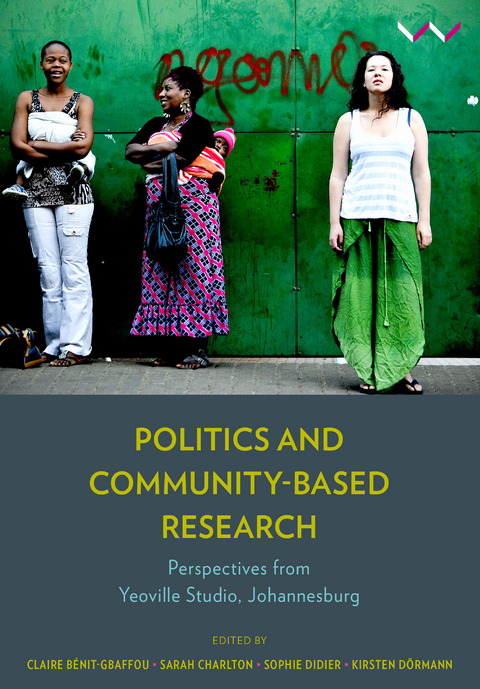
Politics and Community-Based Research (eBook)
Wits University Press (Verlag)
978-1-77614-386-3 (ISBN)
Politics and Community-Based Research: Perspectives from Yeoville Studio, Johannesburg provides a textured analysis of a contested urban space that will resonate with other contested urban spaces around the world and challenges researchers involved in such spaces to work in creative and politicised ways. This edited collection is built around the experiences of Yeoville Studio, a research initiative based at the School of Architecture and Planning at the University of the Witwatersrand, Johannesburg. Through themed, illustrated stories of the people and places of Yeoville, the book presents a nuanced portrait of the vibrance and complexity of a post-apartheid, peri-central neighbourhood that has often been characterised as a 'slum' in Johannesburg. These narratives are interwoven with theoretical chapters by scholars from a diversity of disciplinary backgrounds, reflecting on the empirical experiences of the Studio and examining academic research processes. These chapters unpack the engagement of the Studio in Yeoville, including issues of trust, the need to align policy with lived realities and social needs, the political dimensions of the knowledge produced and the ways in which this knowledge was, and could be used.
Acknowledgements Section A Introducing the book Chapter 1 Why tell the story of Yeoville Studio? – Claire Bénit-Gbaffou Chapter 2 Introducing Yeoville: Context and representations – Sophie Didier and Claire Bénit-Gbaffou Chapter 3 Exploring the politics of community-engaged research – Claire Bénit-Gbaffou Section B Narrating: The politics of constructing local identities Chapter 4 Introduction – Sophie Didier Chapter 5 Being young in Yeoville – Potsiso Phasha Chapter 6 Africa Week Festival in Yeoville: Reclaiming a social and political space through art – Pauline Guinard Chapter 7 Love stories – Willy-Claude Hebandjoko, Claire Bénit-Gbaffou and Shahid Vawda Chapter 8 Constructing Yeoville community: Public meetings, local leadership and managing xenophobic discourse – Claire Bénit-Gbaffou and Eulenda Mkwanazi Chapter 9 Yeoville as a transgressional space: Voëlvry and the Afrikaner counterculture of the 1980s – Maria Suriano, William Dewar and Clara Pienaar-Lewis Chapter 10 Leaving Yeoville – Sophie Didier and Ophélie Arrazouaki Chapter 11 The Yeoville Stories project: Looking for public history in Johannesburg – Sophie Didier and Naomi Roux Section C Recommending: From understanding micro-politics to imagining policy Chapter 12 Introduction – Sarah Charlton Chapter 13 My place in Yeoville: Housing stories – Kirsten Dörmann, Mpho Matsipa and Claire Bénit-Gbaffou Chapter 14 Urban compounding in Johannesburg – Kirsten Dörmann and Solam Mkhabela Chapter 15 Community land trusts and social inclusion – Heinz Klug and Neil Klug Chapter 16 Building stories – Claire Bénit-Gbaffou Chapter 17 Learning from low-income living in an inner-city suburb to inform policy – Sarah Charlton Chapter 18 Sharing a flat in Yeoville: Trajectories, experiences, relationships – Simon Sizwe Mayson Chapter 19 Running a spaza shop – Mamokete Matjomane Chapter 20 Integrating the ‘community’ in the governance of urban informality at the neighbourhood level – Mamokete Matjomane and Claire Bénit-Gbaffou Section D Politicising: Community-based research and the politics of knowledge Chapter 21 Introduction – Claire Bénit-Gbaffou Chapter 22 Street trader stories – Nicolette Pingo Chapter 23 Designing with informality: Towards an urban design framework for Yeoville’s main street – Abdul Abed Chapter 24 Street photography and the politics of representation: A portrait of Muller Street – Claire Bénit-Gbaffou and Sally Gaule Chapter 25 Knowledge construction in a multidisciplinary perspective: Portraying Natal-Saunders Street – Solam Mkhabela, Claire Bénit-Gbaffou and Kirsten Dörmann Chapter 26 Knowledge capital and urban community politics in Yeoville – Obvious Katsaura Chapter 27 Activists in their own words – Eulenda Mkwanazi and Nicolette Pingo Chapter 28 Knowledge production and the politics of community engagement: Working with informal traders in Yeoville and beyond – Claire Bénit-Gbaffou Contributors Photography credits Acronyms List of tables and figures Index
| Erscheint lt. Verlag | 1.10.2019 |
|---|---|
| Verlagsort | Johannesburg |
| Sprache | englisch |
| Themenwelt | Naturwissenschaften ► Geowissenschaften ► Geografie / Kartografie |
| Sozialwissenschaften ► Pädagogik | |
| Sozialwissenschaften ► Politik / Verwaltung ► Staat / Verwaltung | |
| Sozialwissenschaften ► Soziologie | |
| ISBN-10 | 1-77614-386-8 / 1776143868 |
| ISBN-13 | 978-1-77614-386-3 / 9781776143863 |
| Informationen gemäß Produktsicherheitsverordnung (GPSR) | |
| Haben Sie eine Frage zum Produkt? |
 EPUB (Adobe DRM)
Kopierschutz: Adobe-DRM
Adobe-DRM ist ein Kopierschutz, der das eBook vor Mißbrauch schützen soll. Dabei wird das eBook bereits beim Download auf Ihre persönliche Adobe-ID autorisiert. Lesen können Sie das eBook dann nur auf den Geräten, welche ebenfalls auf Ihre Adobe-ID registriert sind.
Details zum Adobe-DRM
Dateiformat: EPUB (Electronic Publication)
EPUB ist ein offener Standard für eBooks und eignet sich besonders zur Darstellung von Belletristik und Sachbüchern. Der Fließtext wird dynamisch an die Display- und Schriftgröße angepasst. Auch für mobile Lesegeräte ist EPUB daher gut geeignet.
Systemvoraussetzungen:
PC/Mac: Mit einem PC oder Mac können Sie dieses eBook lesen. Sie benötigen eine
eReader: Dieses eBook kann mit (fast) allen eBook-Readern gelesen werden. Mit dem amazon-Kindle ist es aber nicht kompatibel.
Smartphone/Tablet: Egal ob Apple oder Android, dieses eBook können Sie lesen. Sie benötigen eine
Geräteliste und zusätzliche Hinweise
Buying eBooks from abroad
For tax law reasons we can sell eBooks just within Germany and Switzerland. Regrettably we cannot fulfill eBook-orders from other countries.
aus dem Bereich