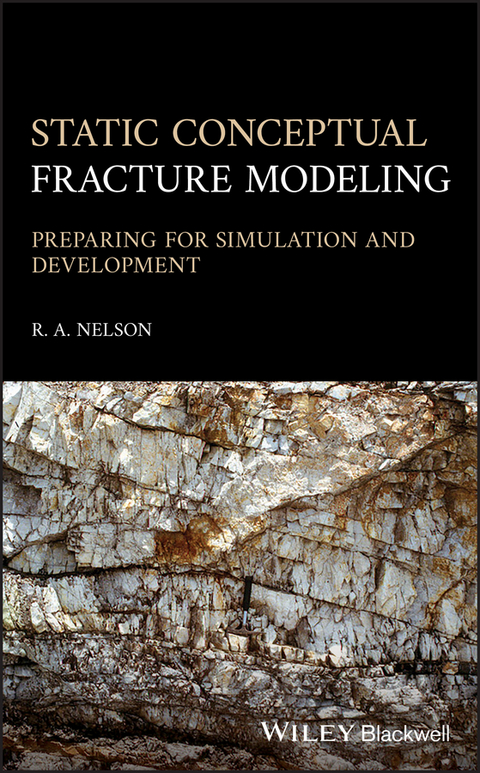
Static Conceptual Fracture Modeling (eBook)
208 Seiten
John Wiley & Sons (Verlag)
9781119596943 (ISBN)
Static Conceptual Fracture Modelling: Preparing for Simulation and Development describes all the fracture and reservoir parameters needed to create the fracture database for effective modelling and how to generate the data and parameter distributions. The material covered in this volume highlights not only natural fracture system quantification and formatting, but also describes best practices for managing technical teams charged with creating the SCFM. This book will become a must on the shelf for all reservoir modelers.
RONALD A. NELSON specializes in evaluation of naturally fractured reservoirs and structural geology. He has over 40 years of experience in the oil and gas industry, working in technical specialties, research, and exploration for Amoco, BP, and as an independent consultant. Over the years Dr Nelson has taught over 100 industry courses in fractured reservoirs and structural geology for a variety of organizations domestically and internationally. He has been an AAPG "Distinguished Lecturer" twice, and an "SPE Distinguished Author" once.
Foreword xi
Symbols and Abbreviations xiii
Acknowledgments xv
1 Purpose and Scope 1
2 What is a Static Conceptual Fracture Model and Why Do We Build It? 3
3 Fracture Model Creation Workflow 9
4 Gathering Natural Fracture Orientation and Intensity Data Directly 13
4.1 Outcrop Based Data 13
4.1.1 Requirements for Outcrop Selection 14
4.1.2 Data to Be Collected 14
4.1.3 What's Real and Not 16
4.2 Core Based Data 16
4.2.1 Types of Core 18
4.2.2 Data to Be Collected 20
4.2.3 What's Real and Not 22
4.2.4 Quantification 27
5 Gathering Natural Fracture Orientation and Intensity Data Indirectly 35
5.1 Bore Hole Image Log Based Data 35
5.1.1 Tool Types and Resolution 36
5.1.2 Data to Be Collected 38
5.1.3 Quantification 38
5.2 Remote Sensing-based Data 40
5.2.1 Surface Based 40
5.2.2 Basement-Based Geophysical Methods (Potential Fields or Gravity and Magnetic Data) 42
5.3 3D Seismic Fracture Data Collection 43
5.3.1 Detailed Structural Geometry 44
5.3.2 Seismic Attributes 44
5.3.3 Passive Seismic and Hydraulic Fracture Monitoring 47
6 Analyzing the Natural Fracture Data Once Gathered 51
6.1 Correcting for the Difference Between Measurement Orientation and Fracture Set Intensity 51
6.2 Calibration 51
6.3 Determining Natural Fracture Origin from Fracture Distributions and Morphology 59
6.4 Mapping Natural-fracture Orientation and Intensity 67
7 Gathering and Analyzing Structural Data 71
7.1 Structural Surface Maps and Sections 71
7.2 Analysis of Structural Surfaces 71
7.2.1 Discontinuity Analysis 71
7.2.2 Lineation Analysis 75
8 Gathering Constraints on Fracture Aperture 81
8.1 Unstressed 82
8.2 Partially Stressed 85
8.3 Fully Stressed 85
8.4 How the Various Aperture Measures Go Together 89
9 Creation of Natural Fracture Scaling Laws 91
10 Gathering and Analyzing Mechanical Property Distribution Data 95
10.1 Rock Modulus and How It Effects Deformation and Fracturing 96
10.2 Rigidity Modulus Distributions 100
10.2.1 Vertical Distribution in Wells 100
10.2.2 Horizontal Distribution in Wells 102
10.2.3 Map Distributions by Unit and Sub-units 103
11 Locating Fracture Corridors 105
12 Rock Anisotropy and its Importance in Determining Dominant-Fracture Orientation and Relative Intensity 111
13 Determine the In-situ Stress Directions and Magnitudes and their Variation 115
13.1 SHmax Directions and Mapping 116
13.2 SHmax Directions with Depth 119
14 Production Calibration 123
15 Determining the Fractured Reservoir Classification and, Therefore, Which Simulation Style is Most Appropriate 129
16 Use of Reservoir Analogs 135
17 The Importance of 3D Visualization in Data Integration and Static Fracture Model Creation 139
18 Thoughts on History Matching of Simulation Results 143
19 Preparing the Fracture Data for Input to the Gridded Model 145
20 Discussion of Error and Uncertainty in the Modeling Process 149
21 Published Examples of the Process 151
22 Final Comments 155
Appendix A Detailed Static Fracture Modeling Workflow 157
Appendix B How we Use Various Seismic Attributes to Predict Natural Fracture Intensity in the Subsurface, After Nelson (2006) 169
Appendix C How I Learned to Interpret Natural Fractures in Core 173
References 175
Index 183
| Erscheint lt. Verlag | 7.10.2019 |
|---|---|
| Sprache | englisch |
| Themenwelt | Naturwissenschaften ► Geowissenschaften ► Geologie |
| Schlagworte | earth sciences • Geologie u. Geophysik • Geology & Geophysics • Geowissenschaften |
| ISBN-13 | 9781119596943 / 9781119596943 |
| Informationen gemäß Produktsicherheitsverordnung (GPSR) | |
| Haben Sie eine Frage zum Produkt? |
 PDF (Adobe DRM)
Kopierschutz: Adobe-DRM
Adobe-DRM ist ein Kopierschutz, der das eBook vor Mißbrauch schützen soll. Dabei wird das eBook bereits beim Download auf Ihre persönliche Adobe-ID autorisiert. Lesen können Sie das eBook dann nur auf den Geräten, welche ebenfalls auf Ihre Adobe-ID registriert sind.
Details zum Adobe-DRM
Dateiformat: PDF (Portable Document Format)
Mit einem festen Seitenlayout eignet sich die PDF besonders für Fachbücher mit Spalten, Tabellen und Abbildungen. Eine PDF kann auf fast allen Geräten angezeigt werden, ist aber für kleine Displays (Smartphone, eReader) nur eingeschränkt geeignet.
Systemvoraussetzungen:
PC/Mac: Mit einem PC oder Mac können Sie dieses eBook lesen. Sie benötigen eine
eReader: Dieses eBook kann mit (fast) allen eBook-Readern gelesen werden. Mit dem amazon-Kindle ist es aber nicht kompatibel.
Smartphone/Tablet: Egal ob Apple oder Android, dieses eBook können Sie lesen. Sie benötigen eine
Geräteliste und zusätzliche Hinweise
Buying eBooks from abroad
For tax law reasons we can sell eBooks just within Germany and Switzerland. Regrettably we cannot fulfill eBook-orders from other countries.
aus dem Bereich