


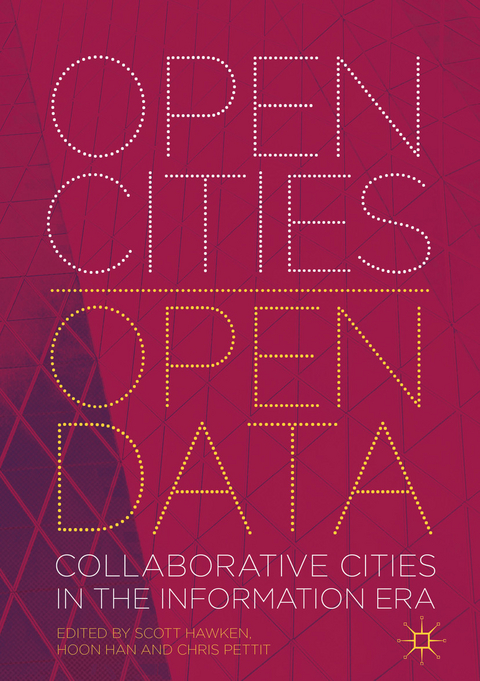
Open Cities | Open Data (eBook)
XLII, 418 Seiten
Springer Singapore (Verlag)
978-981-13-6605-5 (ISBN)
Dr Scott Hawken is an Urban Designer with a passion for new technologies and their potential to improve cities. His work combines advanced geospatial methods and new large scale geospatial datasets to investigate ecosystem services, knowledge economies and other more experiential aspects of cities. He co-convenes the UNSW Smart Cities Research Cluster (SCRC) which seeks to promote and advance the efficient design, planning and delivery of urban environments and services through the use of spatially integrated information and communication technology.
Today the world's largest economies and corporations trade in data and its products to generate value in new disruptive markets. Within these markets vast streams of data are often inaccessible or untapped and controlled by powerful monopolies. Counter to this exclusive use of data is a promising world-wide "e;open-data"e; movement, promoting freely accessible information to share, reuse and redistribute. The provision and application of open data has enormous potential to transform exclusive, technocratic "e;smart cities"e; into inclusive and responsive "e;open-cities"e;.This book argues that those who contribute urban data should benefit from its production. Like the city itself, the information landscape is a public asset produced through collective effort, attention, and resources. People produce data through their engagement with the city, creating digital footprints through social medial, mobility applications, and city sensors. By opening up data there is potential to generate greater value by supporting unforeseen collaborations, spontaneous urban innovations and solutions, and improved decision-making insights. Yet achieving more open cities is made challenging by conflicting desires for urban anonymity, sociability, privacy and transparency. This book engages with these issues through a variety of critical perspectives, and presents strategies, tools and case studies that enable this transformation.
| Erscheint lt. Verlag | 26.9.2019 |
|---|---|
| Zusatzinfo | XLII, 418 p. 101 illus., 1 illus. in color. |
| Sprache | englisch |
| Themenwelt | Mathematik / Informatik ► Informatik ► Datenbanken |
| Naturwissenschaften ► Geowissenschaften ► Geografie / Kartografie | |
| Sozialwissenschaften ► Soziologie ► Spezielle Soziologien | |
| Technik | |
| Schlagworte | adaptive cities • Architecture • collaborative cities • ethical cities • International Open Data Charter • just cities • Open cities • Open Data • Open Data Institute • Remote Sensing/Photogrammetry • resilient cities • smart cities • sustainability • sustainable cities • transparent cities • Urban Design • urban geography and urbanism • urban planning |
| ISBN-10 | 981-13-6605-5 / 9811366055 |
| ISBN-13 | 978-981-13-6605-5 / 9789811366055 |
| Informationen gemäß Produktsicherheitsverordnung (GPSR) | |
| Haben Sie eine Frage zum Produkt? |
 PDF (Wasserzeichen)
DRM: Digitales Wasserzeichen
Dieses eBook enthält ein digitales Wasserzeichen und ist damit für Sie personalisiert. Bei einer missbräuchlichen Weitergabe des eBooks an Dritte ist eine Rückverfolgung an die Quelle möglich.
Dateiformat: PDF (Portable Document Format)
Mit einem festen Seitenlayout eignet sich die PDF besonders für Fachbücher mit Spalten, Tabellen und Abbildungen. Eine PDF kann auf fast allen Geräten angezeigt werden, ist aber für kleine Displays (Smartphone, eReader) nur eingeschränkt geeignet.
Systemvoraussetzungen:
PC/Mac: Mit einem PC oder Mac können Sie dieses eBook lesen. Sie benötigen dafür einen PDF-Viewer - z.B. den Adobe Reader oder Adobe Digital Editions.
eReader: Dieses eBook kann mit (fast) allen eBook-Readern gelesen werden. Mit dem amazon-Kindle ist es aber nicht kompatibel.
Smartphone/Tablet: Egal ob Apple oder Android, dieses eBook können Sie lesen. Sie benötigen dafür einen PDF-Viewer - z.B. die kostenlose Adobe Digital Editions-App.
Buying eBooks from abroad
For tax law reasons we can sell eBooks just within Germany and Switzerland. Regrettably we cannot fulfill eBook-orders from other countries.
aus dem Bereich


