


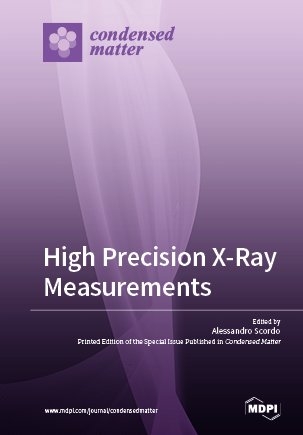
High Precision X-Ray Measurements
Seiten
2019
MDPI (Verlag)
978-3-03921-317-7 (ISBN)
MDPI (Verlag)
978-3-03921-317-7 (ISBN)
- Keine Verlagsinformationen verfügbar
- Artikel merken
Since their discovery in 1895, the detection of X-rays has had a strong impact on and various applications in several fields of science and human life. Impressive efforts have been made to develop new types of detectors and new techniques, aiming to obtain higher precision both in terms of energy and position. Depending on the applications, solid state detectors, microcalorimeters, and various types of spectrometers currently serve as the best options for spectroscopic and imaging detectors. Recent advancements in micron and meV precision have opened the door for groundbreaking applications in fundamental physics, medical science, astrophysics, cultural heritage, and several other fields.
The aim of this Special Issue is to compile an overview, from different communities and research fields, of the most recent developments in X-ray detection and their possible impacts in various sectors, such as in exotic atom measurements, quantum physics studies, XRF, XES, EXAFS, plasma emission spectroscopy, monochromators, synchrotron radiation, telescopes, and space engineering. All the papers included in this Special Issue contribute to emphasizing the importance of X-ray detection in a very broad range of physics topics; most of these topics are covered by the published works, and several others are mentioned in the paper references, providing an interesting and very useful synopsis, from a variety of different communities and research fields, of the most recent developments in X-ray detection and their impact in fundamental research and societal applications.
The aim of this Special Issue is to compile an overview, from different communities and research fields, of the most recent developments in X-ray detection and their possible impacts in various sectors, such as in exotic atom measurements, quantum physics studies, XRF, XES, EXAFS, plasma emission spectroscopy, monochromators, synchrotron radiation, telescopes, and space engineering. All the papers included in this Special Issue contribute to emphasizing the importance of X-ray detection in a very broad range of physics topics; most of these topics are covered by the published works, and several others are mentioned in the paper references, providing an interesting and very useful synopsis, from a variety of different communities and research fields, of the most recent developments in X-ray detection and their impact in fundamental research and societal applications.
| Erscheinungsdatum | 16.09.2019 |
|---|---|
| Verlagsort | Basel |
| Sprache | englisch |
| Maße | 170 x 244 mm |
| Themenwelt | Naturwissenschaften ► Physik / Astronomie ► Angewandte Physik |
| Schlagworte | amylin • beamlines • coherent imaging • Compton camera • Compton Scattering • Free electron lasers • graphite crystals • HAPG • high energy resolution fluorescence detection • Hopg • kaonic atoms • magnetic multilayers • material investigation • Material Science • medical applications • Molybdenum • mosaicity • mosaic spread • Mössbauer spectroscopy • multidisciplinarity • optical instruments and equipment • Optical Materials • Pauli Exclusion Principle • photodetectors • Positron Emission Tomography • Pyrolytic Graphite • quantum foundations • radiation detectors • rocking curve • scintillation detector • Silicon Photomultiplier • soft X-rays • solid-state detectors • standing waves • Strong Interaction • Synchrotron radiation • Thin Films • THz Radiation • TM oxides • underground experiment • von Hamos • XAFS • X- and γ-ray instruments • X- and γ-ray sources, mirrors, gratings, and detectors • XAS • X-Ray • X-ray absorption • X-ray absorption spectroscopy • X-ray and γ-ray spectrometers • x-ray detectors • X-ray diffraction • X-ray Raman • X-ray Reflectivity • X-ray source facilities • X-ray spectroscopy • XRF |
| ISBN-10 | 3-03921-317-2 / 3039213172 |
| ISBN-13 | 978-3-03921-317-7 / 9783039213177 |
| Zustand | Neuware |
| Informationen gemäß Produktsicherheitsverordnung (GPSR) | |
| Haben Sie eine Frage zum Produkt? |
Mehr entdecken
aus dem Bereich



aus dem Bereich


