


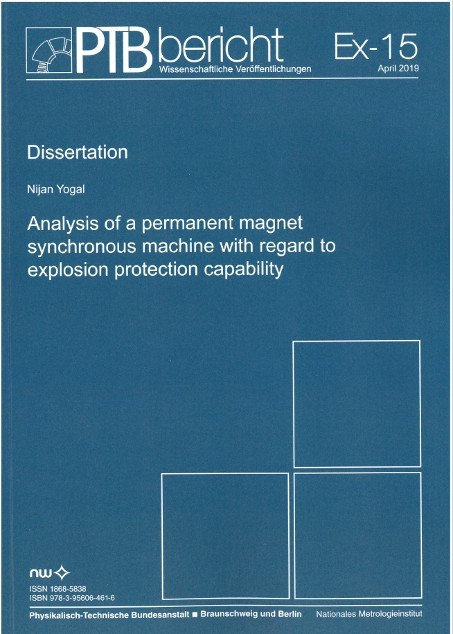
Analysis of a permanent magnet synchronous machine with regard to explosion protecion capability
Seiten
2019
Fachverlag NW in Carl Ed. Schünemann KG
9783956064616 (ISBN)
Fachverlag NW in Carl Ed. Schünemann KG
9783956064616 (ISBN)
- Keine Verlagsinformationen verfügbar
- Artikel merken
Permanent magnet synchronous machines (PMSMs) are used because of their superior
advantages regarding energy efficiency and controllability in industrial applications, very highspeed
drives, aerospace applications and electrical vehicles e.g. in the automotive industry. The
use and demand of these machines are increasing in hazardous areas like mining, chemical and
petrochemical industries as well. In an explosive atmosphere, these electric machines must be
operated with their maximum surface temperature below the ignition temperature of the
surrounding explosive environment. Proper investigations during the design, manufacturing,
and operation of machines should be considered in order to minimize the possibility of an
explosion. An explosion proof electric machine should satisfy safety and failure performance,
explosion-proof performance, as well as low noise and vibration requirements at normal and
failure operation.
The magnetic properties of permanent magnet (PM) materials and non-oriented (NO) electrical
steel sheets materials that are used in the rotor and stator yoke manufacturing greatly influence
the working performance of PMSM. Similarly, these materials are enormously affected by
temperature and frequency. Temperatures that exceed the specification may results in
irreversible demagnetization of PM while higher frequency result in higher iron losses of NO
electrical steel sheets. Demagnetization and higher iron losses increase the temperature of the
PM and core respectively which may result in the hot spots of the machine and could be the
source of ignition. Therefore, proper study and understanding of magnetic properties of such
materials are required. These help engineers, machines manufacturers and designers in
designing robust machines with high tolerance to explosive environment. Investigation of PM
is carried out using thermal endurance and corrosion tests. The non-oriented electrical steel
sheets are measured using ring core specimens test methods. The outcomes of these tests are
compared to the simulated (finite element method) results using the Opera 2D simulation
software.
This work focuses on safe operation of PMSMs, as it undergoes through a series of mechanical,
electrical and thermal tests. These tests methods ensure that no hot surfaces, electrical arcs or
sparks occur during normal operation or there are no possible failure conditions in all inner and
outer parts of the machines that can lead to high energy, responsible for ignition. The PMSM
installed in hazardous areas need to have protection against possibility of ignition. Therefore,
the thermal protection of the PMSM using PTC thermistors sensors are tested so that the PMSM
stops operating in case of higher thermal heating of stator winding. Different influencing input
quantities from the instruments used for measurement in the test bench are studied and the
uncertainty is analysed. While determining the efficiency of the machines the final
measurement uncertainty of the test bench is examined and presented with "Guide to the
Expression of Uncertainty in Measurement" (GUM) procedure. Besides the testing of the
PMSM this work therefore deals mainly with problems concerning the demagnetization of the
PM during abnormal operating condition of PMSM using simulation.
Finally, the practicable testing procedures for PMSMs is developed. The "test rule" briefly
described the requirements, testing (mechanical, electrical and thermal) and installation conditions for VSDs fed rotating PMSMs of the type of protection “Increased Safety” ignition
protection classification. It is analogous to the test rule for explosion-proof asynchronous
machines. In addition, the development of manufacturer-independent "certification rules" for
the explosion-proof PMSMs is included. The results obtained from this work are accumulated
and will probably be integrated in future explosion proof standards IEC 60079-X.
Keywords: Corrosion, Demagnetization, Eddy currents, Electrical steel sheets, Energy
efficiency, Explosion protection, Finite element analysis, Fourier transforms, Frequency
measurement, Hazardous areas, Loss measurement, Magnetic losses, Magnetic materials,
Magnetic properties, Measurement uncertainty, Permanent magnets, Permanent magnet
machines, Soft magnetic materials, Switching frequency, Temperature dependence, Thermal
effects, Thermistors, Variable speed drives.
advantages regarding energy efficiency and controllability in industrial applications, very highspeed
drives, aerospace applications and electrical vehicles e.g. in the automotive industry. The
use and demand of these machines are increasing in hazardous areas like mining, chemical and
petrochemical industries as well. In an explosive atmosphere, these electric machines must be
operated with their maximum surface temperature below the ignition temperature of the
surrounding explosive environment. Proper investigations during the design, manufacturing,
and operation of machines should be considered in order to minimize the possibility of an
explosion. An explosion proof electric machine should satisfy safety and failure performance,
explosion-proof performance, as well as low noise and vibration requirements at normal and
failure operation.
The magnetic properties of permanent magnet (PM) materials and non-oriented (NO) electrical
steel sheets materials that are used in the rotor and stator yoke manufacturing greatly influence
the working performance of PMSM. Similarly, these materials are enormously affected by
temperature and frequency. Temperatures that exceed the specification may results in
irreversible demagnetization of PM while higher frequency result in higher iron losses of NO
electrical steel sheets. Demagnetization and higher iron losses increase the temperature of the
PM and core respectively which may result in the hot spots of the machine and could be the
source of ignition. Therefore, proper study and understanding of magnetic properties of such
materials are required. These help engineers, machines manufacturers and designers in
designing robust machines with high tolerance to explosive environment. Investigation of PM
is carried out using thermal endurance and corrosion tests. The non-oriented electrical steel
sheets are measured using ring core specimens test methods. The outcomes of these tests are
compared to the simulated (finite element method) results using the Opera 2D simulation
software.
This work focuses on safe operation of PMSMs, as it undergoes through a series of mechanical,
electrical and thermal tests. These tests methods ensure that no hot surfaces, electrical arcs or
sparks occur during normal operation or there are no possible failure conditions in all inner and
outer parts of the machines that can lead to high energy, responsible for ignition. The PMSM
installed in hazardous areas need to have protection against possibility of ignition. Therefore,
the thermal protection of the PMSM using PTC thermistors sensors are tested so that the PMSM
stops operating in case of higher thermal heating of stator winding. Different influencing input
quantities from the instruments used for measurement in the test bench are studied and the
uncertainty is analysed. While determining the efficiency of the machines the final
measurement uncertainty of the test bench is examined and presented with "Guide to the
Expression of Uncertainty in Measurement" (GUM) procedure. Besides the testing of the
PMSM this work therefore deals mainly with problems concerning the demagnetization of the
PM during abnormal operating condition of PMSM using simulation.
Finally, the practicable testing procedures for PMSMs is developed. The "test rule" briefly
described the requirements, testing (mechanical, electrical and thermal) and installation conditions for VSDs fed rotating PMSMs of the type of protection “Increased Safety” ignition
protection classification. It is analogous to the test rule for explosion-proof asynchronous
machines. In addition, the development of manufacturer-independent "certification rules" for
the explosion-proof PMSMs is included. The results obtained from this work are accumulated
and will probably be integrated in future explosion proof standards IEC 60079-X.
Keywords: Corrosion, Demagnetization, Eddy currents, Electrical steel sheets, Energy
efficiency, Explosion protection, Finite element analysis, Fourier transforms, Frequency
measurement, Hazardous areas, Loss measurement, Magnetic losses, Magnetic materials,
Magnetic properties, Measurement uncertainty, Permanent magnets, Permanent magnet
machines, Soft magnetic materials, Switching frequency, Temperature dependence, Thermal
effects, Thermistors, Variable speed drives.
| Erscheinungsdatum | 24.07.2019 |
|---|---|
| Reihe/Serie | PTB-Berichte. Thermodynamik und Explosionsschutz ; 15 |
| Verlagsort | Bremen |
| Sprache | englisch |
| Maße | 210 x 297 mm |
| Gewicht | 745 g |
| Themenwelt | Naturwissenschaften ► Physik / Astronomie ► Thermodynamik |
| Schlagworte | Corrosion • Demagnetization • Eddy Currents • Electrical steel sheets • Energy efficients • Explosion • Explosion Protection • finite element analysis • Fourier Transforms • Frequency measurement • Hazardous areas • Loss Measurement • Magenetic losses • magnetic materials • Magnetic properties • Measurement Uncertainty • Permanent magnet machines • Permanent Magnets • PTB • Soft Magnetic Materials • Switching frequency • temperature dependence • thermal effects • Thermistors • Variable speed drives |
| ISBN-13 | 9783956064616 / 9783956064616 |
| Zustand | Neuware |
| Informationen gemäß Produktsicherheitsverordnung (GPSR) | |
| Haben Sie eine Frage zum Produkt? |
Mehr entdecken
aus dem Bereich
aus dem Bereich
zur Materialproblematik der modernen Elektronik
Buch | Hardcover (2025)
Alfred Kröner Verlag
CHF 27,85
Von Energie und Entropie zu Wärmeübertragung und Phasenübergängen
Buch | Softcover (2023)
De Gruyter Oldenbourg (Verlag)
CHF 83,90


