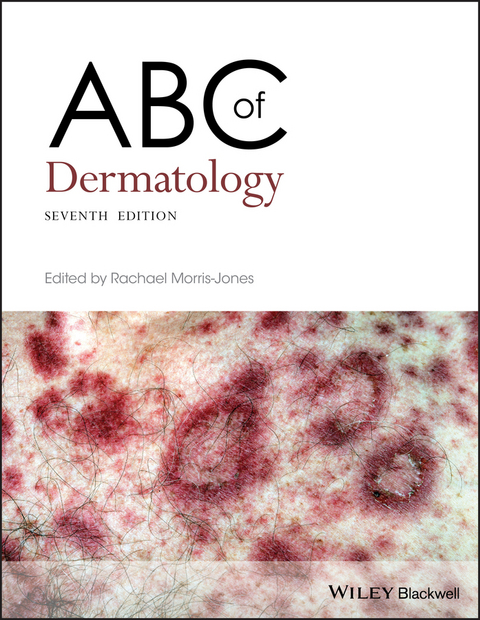
ABC of Dermatology (eBook)
John Wiley & Sons (Verlag)
978-1-119-48900-9 (ISBN)
ABC of Dermatology is the bestselling, practical guide for anyone involved in clinical dermatology. This fully illustrated book helps readers identify, recognise, treat, and manage the common dermatological conditions encountered in daily practice.
The seventh edition has been revised and updated to incorporate current approaches to the management of skin disease, such as the use of new biological agents for treating inflammatory disease and tumours, and new chapters on cosmetic dermatology procedures, genital dermatology and cutting-edge advances in genetics and pathophysiology.
- Presents a practical approach to clinical dermatology that relates skin changes to specific skin conditions and underlying pathology
- Summarises relevant pathological processes, diagnostic features, learning points, and treatment options for a range of conditions
- Offers hundreds of full-colour clinical photographs that illustrate manifestations of skin disease in a multitude of diverse skin tones and ethnic groups
- Covers a wide range of skin management treatments, from simple interventions to sophisticated immunotherapies
- Includes insights on the increasing use of teledermatology by remote doctors
ABC of Dermatology is a must-have guide for GPs, junior doctors, medical students, and primary healthcare professionals.
Rachael Morris-Jones FRCP PhD PCME, Dermatology Consultant, Guy's and St Thomas' NHS Foundation Trust, London, UK
Rachael Morris-Jones FRCP PhD PCME, Dermatology Consultant, Guy's and St Thomas' NHS Foundation Trust, London, UK
List of Contributors vii
Preface ix
Acknowledgements xi
1 Introduction 1
Rachael Morris-Jones
2 Psoriasis 11
Rachael Morris-Jones
3 Management of Psoriasis 19
Rachael Morris-Jones
4 Eczema (Dermatitis) 27
Rachael Morris-Jones
5 Urticaria and Angio-oedema 39
Rachael Morris-Jones
6 Skin and Photosensitivity 43
John S. Ferguson
7 Drug Rashes 51
Sarah Walsh
8 Immunobullous and Other Blistering Disorders 59
Rachael Morris-Jones
9 Connective Tissue Disease, Vasculitis, and Related Disorders 67
Rachael Morris-Jones
10 The Skin and Systemic Disease 75
Rachael Morris-Jones
11 Leg Ulcers 87
Rachael Morris-Jones
12 Acne, Rosacea, and Hidradenitis Suppurativa 95
Rachael Morris-Jones
13 Bacterial Infections 105
Rachael Morris-Jones
14 Viral Infections 113
Rachael Morris-Jones
15 HIV and the Skin 123
Rachael Morris-Jones
16 Fungal Infections 131
Rachael Morris-Jones
17 Insect Bites and Infestations 139
Rachael Morris-Jones
18 Tropical Dermatology 147
Rachael Morris-Jones
19 Hair and Scalp 157
Kapil Bhargava and David Fenton
20 Diseases of the Nails 165
David de Berker
21 Genital Dermatoses 175
Fiona Lewis
22 Benign Skin Tumours 183
Rachael Morris-Jones
23 Premalignant and Malignant Skin Lesions 195
Rachael Morris-Jones
24 Practical Procedures and Skin Surgery 207
Raj Mallipeddi
25 Lasers, Intense Pulsed Light, and Photodynamic Therapy 215
Alun Evans and Saqib J. Bashir
26 Cosmetic Dermatology 223
Emma Craythorne
27 Wounds, Dressings, and Bandages 231
Bernadette Byrne
28 Formulary 245
Karen Watson and Aisling Ryan
Index 255
CHAPTER 1
Introduction
Rachael Morris‐Jones
Guy’s and St Thomas’ NHS Foundation Trust, London, UK
OVERVIEW
- The clinical features of skin lesions are related to the underlying pathological processes.
- Skin conditions broadly fall into three clinical groups: (i) those with a well‐defined appearance and distribution; (ii) those with a characteristic pattern but with a variety of underlying clinical conditions; (iii) those with a variable presentation and no constant association with underlying conditions.
- Skin lesions may be the presenting feature of serious systemic disease, and a significant proportion of skin conditions threaten the health, well‐being, and even the life of the patient.
- Clinical descriptive terms such as macule, papule, nodule, plaque, induration, atrophy, bulla, and erythema relate to what is observed at the skin surface and reflect the pathological processes underlying the affected skin.
- The significance of morphology and distribution of skin lesions in different clinical conditions are discussed.
Introduction
The aim of this book is to provide an insight for the non‐dermatologist into the pathological processes, diagnosis, and management of skin conditions. Dermatology is a broad specialty, with over 2000 different skin diseases, the most common of which are introduced here. Pattern recognition is key to successful history‐taking and examination of the skin by experts, usually without the need for complex investigations. However, for those with less dermatological experience, working from first principles can go a long way in determining the diagnosis and management of patients with less severe skin disease. Although dermatology is a clinically oriented subject, an understanding of the cellular changes underlying the skin disease can give helpful insights into the pathological processes. This understanding aids the interpretation of clinical signs and overall management of cutaneous disease. Skin biopsies can be a useful adjuvant to reaching a diagnosis; however, clinico‐pathological correlation is essential in order that interpretation of the clinical and pathological patterns is put into the context of the patient.
Interpretation of clinical signs on the skin in the context of underlying pathological processes is a theme running through the chapters. This helps the reader develop a deeper understanding of the subject and should form some guiding principles that can be used as tools to help assess almost any skin eruption.
Clinically, cutaneous disorders fall into three main groups.
- Those that generally present with a characteristic distribution and morphology that leads to a specific diagnosis – such as chronic plaque psoriasis (Figure 1.1), basal cell carcinoma, and atopic dermatitis.
- A characteristic pattern of skin lesions with variable underlying causes – such as erythema nodosum (Figure 1.2) and erythema multiforme.
- Skin rashes that can be variable in their presentation and/or underlying causes – such as lichen planus and urticaria.
Figure 1.1 Psoriasis with nail changes.
Figure 1.2 Erythema nodosum in pregnancy.
A holistic approach in dermatology is essential as cutaneous eruptions may be the first indicator of an underlying internal disease. Patients may, for example, first present with a photosensitive rash on the face, but deeper probing may reveal symptoms of joint pains etc. leading to the diagnosis of systemic lupus erythematosus. Similarly, a patient with underlying coeliac disease may first present with blistering on the elbows (dermatitis herpetiformis). It is therefore important not only to take a thorough history (Box 1.1) of the skin complaint but in addition to ask about any other symptoms the patient may have and examine the entire patient carefully.
Box 1.1 Dermatology history‐taking
- Where – site of initial lesion(s) and subsequent distribution
- How long – continuous or intermittent?
- Trend – better or worse?
- Previous episodes – timing? Similar/dissimilar? Other skin conditions?
- Who else – Family members/work colleagues/school friends affected?
- Symptoms – Itching, burning, scaling, or blisters? Any medication or other illnesses?
- Treatment – prescription or over‐the‐counter? Frequency/time course/compliance?
The significance of skin disease
Seventy per cent of the people in developing countries suffer skin disease at some point in their lives, but of these, 3 billion people in 127 countries do not have access to even basic skin services. In developed countries the prevalence of skin disease is also high; up to 15% of general practice consultations in the United Kingdom are concerned with skin complaints. Many patients never seek medical advice and will use the internet to self‐ diagnose and self‐treat using over‐the‐counter preparations.
The skin is the largest organ of the body; it provides an essential living biological barrier and is the aspect of ourselves that we present to the outside world. It is therefore not surprising that there is great interest in ‘skin care’ and ‘skin problems’, with an associated ever‐expanding cosmetics industry and so‐called cosmeceuticals. At the other end of the spectrum, impairment of the normal functions of the skin can lead to acute and chronic illness with considerable disability and sometimes the need for hospital treatment.
Malignant change can occur in any cell in the skin, resulting in a wide variety of different tumours, the majority of which are benign. Recognition of typical benign tumours saves the patient unnecessary investigations and the anxiety involved in waiting to see a specialist or waiting for biopsy results. Malignant skin cancers are usually only locally invasive, but distant metastases can occur. It is important therefore to recognise the early features of lesions such as melanoma (Figure 1.3) and squamous cell carcinoma before they disseminate.
Figure 1.3 Superficial spreading melanoma.
Underlying systemic disease can be heralded by changes on the skin surface, the significance of which can be easily missed by the unprepared mind. So, in addition to concentrating on the skin changes, the overall health and demeanour of the patient should be assessed. Close inspection of the whole skin, nails, and mucous membranes should be the basis of routine skin examination. The general physical condition of the patient should also be determined as indicated.
Most skin diseases, however, do not signify any systemic disease and are often considered ‘harmless’ in medical terms. However, due to the very visual nature of skin disorders, they can cause a great deal of psychological distress, social isolation, and occupational difficulties, which should not be underestimated. A validated measure of how much skin disease affects patients' lives can be made using the Dermatology Life Quality Index (DLQI). A holistic approach to the patient both physically and psychologically is therefore highly desirable.
Descriptive terms of clinical inspection
All specialties have their own common terms, and familiarity with a few of those used in dermatology aids with diagnostic skills as they relate to the underlying pathology. The most important are defined below.
- Macule (Figure 1.4). Derived from the Latin for a stain, the term macule is used to describe changes in colour (Figure 1.5) without any elevation above the surface of the surrounding skin. There may be an increase in pigments such as melanin, giving a black or brown colour. Loss of melanin leads to a white macule. Vascular dilatation and inflammation produce erythema. A macule with a diameter greater than 2 cm is called a patch.
- Papules and nodules (Figure 1.6). A papule is a circumscribed, raised lesion, of epidermal or dermal origin, 0.5–1.0 cm in diameter (Figure 1.7). A nodule (Figure 1.8) is similar to a papule but greater than 1.0 cm in diameter. A vascular papule or nodule is known as a haemangioma.
- A plaque (Figure 1.9) is a circumscribed, superficial, elevated plateau area 1.0–2.0 cm in diameter (Figure 1.10).
- Vesicles and bullae (Figure 1.11) are raised lesions that contain clear fluid (blisters) (Figure 1.12). A bulla is a vesicle larger than 0.5 cm. They may be superficial within the epidermis or situated in the dermis below it. The more superficial the vesicles/bullae, the more likely they are to break open.
- Lichenification is a hard thickening of the skin with accentuated skin markings (Figure 1.13). It commonly results from chronic inflammation and rubbing of the skin.
- Discoid lesions. These are ‘coin‐shaped’ lesions (Figure 1.14).
- Pustules. The term pustule is applied to lesions containing purulent material – which may be due to infection – or sterile pustules (inflammatory polymorphs) (Figure 1.15) that are seen in pustular psoriasis and pustular drug...
| Erscheint lt. Verlag | 3.7.2019 |
|---|---|
| Reihe/Serie | ABC Series |
| ABC Series | ABC Series |
| Sprache | englisch |
| Themenwelt | Medizin / Pharmazie ► Gesundheitsfachberufe |
| Medizin / Pharmazie ► Medizinische Fachgebiete | |
| Studium ► 2. Studienabschnitt (Klinik) ► Humangenetik | |
| Naturwissenschaften ► Chemie | |
| Schlagworte | Clinical Dermatology • Cosmetic / Esthetic Dermatology • Dermatologie • Dermatology • dermatology diagnosis • dermatology handbook • dermatology immunotherapy, teledermatology</p> • dermatology reference • dermatology student • dermatology textbook • dermatology treatment • Kosmetische u. Ästhetische Dermatologie • <p>dermatology guide • Medical Science • Medical Specialty Education • Medizin • Medizinstudium • Medizinstudium / Einzelne Fächer • Skin Disease • skin disorder |
| ISBN-10 | 1-119-48900-8 / 1119489008 |
| ISBN-13 | 978-1-119-48900-9 / 9781119489009 |
| Informationen gemäß Produktsicherheitsverordnung (GPSR) | |
| Haben Sie eine Frage zum Produkt? |
 EPUB (Adobe DRM)
Kopierschutz: Adobe-DRM
Adobe-DRM ist ein Kopierschutz, der das eBook vor Mißbrauch schützen soll. Dabei wird das eBook bereits beim Download auf Ihre persönliche Adobe-ID autorisiert. Lesen können Sie das eBook dann nur auf den Geräten, welche ebenfalls auf Ihre Adobe-ID registriert sind.
Details zum Adobe-DRM
Dateiformat: EPUB (Electronic Publication)
EPUB ist ein offener Standard für eBooks und eignet sich besonders zur Darstellung von Belletristik und Sachbüchern. Der Fließtext wird dynamisch an die Display- und Schriftgröße angepasst. Auch für mobile Lesegeräte ist EPUB daher gut geeignet.
Systemvoraussetzungen:
PC/Mac: Mit einem PC oder Mac können Sie dieses eBook lesen. Sie benötigen eine
eReader: Dieses eBook kann mit (fast) allen eBook-Readern gelesen werden. Mit dem amazon-Kindle ist es aber nicht kompatibel.
Smartphone/Tablet: Egal ob Apple oder Android, dieses eBook können Sie lesen. Sie benötigen eine
Geräteliste und zusätzliche Hinweise
Buying eBooks from abroad
For tax law reasons we can sell eBooks just within Germany and Switzerland. Regrettably we cannot fulfill eBook-orders from other countries.
aus dem Bereich