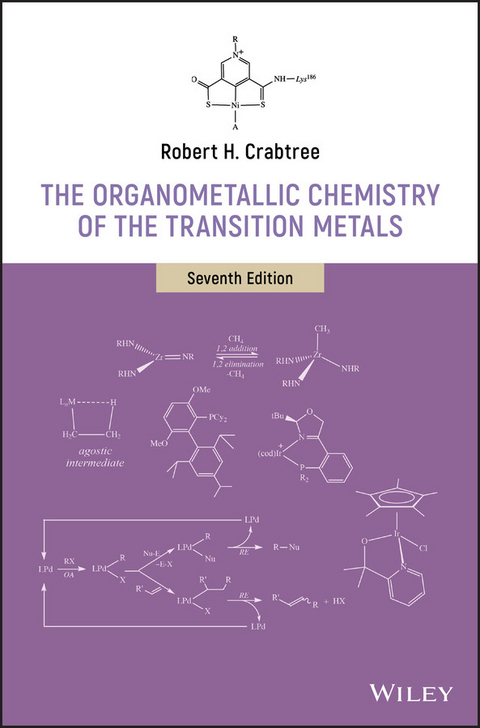
The Organometallic Chemistry of the Transition Metals (eBook)
John Wiley & Sons (Verlag)
978-1-119-46586-7 (ISBN)
Provides vital information on organometallic compounds, their preparation, and use in synthesis, and explores the fundamentals of the field and its modern applications
Fully updated and expanded to reflect recent advances, the new, seventh edition of this bestselling text presents students and professional chemists with a comprehensive introduction to the principles and general properties of organometallic compounds, as well as including practical information on reaction mechanisms and detailed descriptions of contemporary applications. Increased focus is given to organic synthesis applications, nanoparticle science, and green chemistry. This edition features up-to-date examples of fundamental reaction steps and greater emphasis on key topics like oxidation catalysis, CH functionalization, nanoclusters and nanoparticles, and green chemistry. New coverage is added for computational chemistry, energy production, and biochemical aspects of organometallic chemistry.
The Organometallic Chemistry of the Transition Metals, Seventh Edition provides new/enhanced chapter coverage of ligand-assisted additions and eliminations; proton-coupled electron transfer; surface, supported, and cooperative catalysis; green, energy, and materials applications; and photoredox catalysis. It covers coordination chemistry; alkyls and hydrides; Pi-complexes; and oxidative addition and reductive elimination. The book also features sections on insertion and elimination; spectroscopy; metathesis polymerization and bond activation; and more.
- Provides an excellent foundation of the fundamentals of organometallic chemistry
- Includes end-of-chapter problems and their solutions
- Expands and includes up-to-date examples of fundamental reaction steps and focuses on important topics such as oxidation catalysis, CH functionalization, nanoparticles, and green chemistry
- Features all new coverage for computational chemistry, energy production, and biochemical aspects of organometallic chemistry
The Organometallic Chemistry of the Transition Metals, Seventh Edition is an insightful book that will appeal to all advanced undergraduate and graduate students in organic chemistry, organometallic chemistry, inorganic chemistry, and bioinorganic chemistry, as well as any practicing chemist in those fields.
Robert H. Crabtree F.R.S. is Whitehead Professor of Chemistry at Yale, a Fellow of the Royal Society and of the American Chemical Society, and a member of the American Academy and of the National Academy of Sciences.
Robert H. Crabtree F.R.S. is Whitehead Professor of Chemistry at Yale, a Fellow of the Royal Society and of the American Chemical Society, and a member of the American Academy and of the National Academy of Sciences.
List of Abbreviations
| [ ] | Encloses complex molecules or ions |
| □ | Vacant site or labile ligand |
| ° | Degrees Celsius |
| 1°, 2°, 3° | Primary, secondary, tertiary. |
| A | Associative substitution (Section 4.4) |
| acac | Acetylacetonate |
| AIBN | Azobisisobutyronitrile (radical initiator) |
| AO | Atomic orbital |
| Ar | Aryl (e.g. C6H5) |
| at. | Pressure in atmospheres |
| bipy | 2,2′‐Bipyridyl |
| Bu | Butyl |
| cata | Catalyst |
| Chap. | Chapter |
| CIDNP | Chemically induced dynamic nuclear polarization (Section 6.3) |
| CN | Coordination number |
| cod | 1,5‐Cyclooctadiene |
| coe | Cyclooctene |
| cot | Cyclooctatetraene |
| Cp, Cp* | C5H5, C5Me5 |
| Cy | Cyclohexyl |
| ∂+ | Partial positive charge |
| δ | Chemical shift (NMR) |
| Δ | Crystal field splitting (Section 1.4) |
| ΔEN | Electronegativity difference |
| ΔG ‡ ΔH ‡ ΔS ‡ | Free energy, enthalpy and entropy of activation needed to reach the transition state for a reaction. |
| D | Dissociative substitution mechanism (Section 4.3) |
| D–C | Dewar–Chatt model of M(C=C) bonding involving weak back donation (Section 5.1) |
| dσ, dπ | σ‐Acceptor and π‐donor metal orbitals (see Section 1.4) |
| diars | Me2AsCH2CH2AsMe2 |
| dpe or dppe | Ph2PCH2CH2PPh2 |
| dmf | Dimethylformamide |
| dmg | Dimethyl glyoximate |
| dmpe | Me2PCH2CH2PMe2 |
| DMSO | Dimethyl sulfoxide |
| d n | Electron configuration (Section 1.4) |
| η | Hapticity in ligands with contiguous donor atoms (e.g. C2H4. See Section 2.1) |
| E, E+ | Generalized electrophile such as H+ |
| e | Electron, as in 18e rule |
| e.e. | Enantiomeric excess (Section 9.2) |
| en | H2NCH2CH2NH2 |
| eq | Equivalent or equatorial |
| Et | Ethyl |
| EPR | Electron paramagnetic resonance |
| Eq. | Equation |
| eu | Entropy units |
| eV | Electron volt (1 eV = 23 kcal/mol) |
| EXAFS | X‐ray absorption edge fine structure spectroscopy |
| Fig. | Figure |
| Fp | (C5H5)(CO)2Fe |
| fac | Facial (stereochemistry) |
| GC | gas chromatography |
| Hal | Halogen |
| HBpz3 | Tris(pyrazolyl)borate |
| HMPA | Hexamethyl phosphoramide O=P(NMe2)3 |
| HOMO | Highest occupied molecular orbital |
| hs | High spin |
| I | Nuclear spin |
| I | Intermediate substitution mechanism |
| IPR | Isotopic perturbation of resonance (Section 10.8) |
| IR | Infrared |
| κ | Hapticity in ligands with noncontiguous donor atoms (e.g. H2NCH2CH2NH2. See Section 2.1) |
| L | Depending on the context, L can be a generalized ligand of any type, or else a 2e ligand in connection with the L model for ligand binding discussed in Section 2.1) |
| L n M | Metal fragment with n generalized ligands |
| lin | Linear |
| lp | lone pair |
| ls | low spin |
| LUMO | Lowest unoccupied molecular orbital |
| μ | Descriptor for bridging with a superscript for the number of metals bridged, as in M3(μ3‐CO) |
| m‐ | Meta |
| MCP | Metalacyclopropane model of M(C=C) bonding involving strong back donation (Section 5.1) |
| Me | Methyl |
| mer | Meridional (stereochemistry) |
| m r | Reduced mass |
| MO | Molecular orbital |
| ν | Frequency |
| N | Group number of M (=number of valence e in the neutral atom). |
| nbd | Norbornadiene |
| NHC | N‐heterocyclic carbene (Section 4.2) |
| NHE | Normal hydrogen electrode, a common standard potential |
| NMR | Nuclear magnetic resonance (Sections 10.2-10.8) |
| NOE | Nuclear Overhauser effect (Section 10.7) |
| Np | Neopentyl |
| Nu, Nu− | Generalized nucleophile, such as H− |
| o‐ | Ortho |
| OA | Oxidative addition |
| OAc | Acetate |
| oct | Octahedral (Table 2.6) |
| OS | Oxidation state (Section 2.4) |
| oz. | Ounce (28.35g) |
| p‐ | Para |
| PE | Polyethylene |
| PP | Polypropylene |
| Ph | Phenyl |
| pin | Pinacolate |
| PNP | A pincer ligand with one nitrogen and two phosphorus donors |
| py | Pyridine |
| R | Alkyl |
| RE | Reductive elimination |
| RF | Radiofrequency |
| RF | Fluoroalkyl (e.g. CF3) |
| Sec. | Section of the book |
| SET | Single electron transfer (Section 8.6) |
| σ‐CAM | σ‐Complex assisted metathesis |
| solv | Solvent |
| sq. pl. | Square planar |
| sq. py. | Square pyramidal (Table 2.6) |
| T | A structure with three of the ligands disposed as in the letter T. |
| T 1 | Spin–lattice relaxation time |
| tacn | 1,4,7‐Triazacyclononane |
| tacn* | N,N′,N″‐trimethyl‐1,4,7‐triazacyclononane |
| tbe | t‐BuCH=CH2 |
| tet | Tetrahedral |
| thf | Tetrahydrofuran ligand (but THF when a solvent) |
| triphos | MeC(CH2PPh2)3 |
| TBP or trig. bipy | Trigonal bipyramidal (Table 2.6) |
| TMEDA | Me2NCH2CH2NMe2 |
| TMS | Tetramethylsilyl or... |
| Erscheint lt. Verlag | 3.7.2019 |
|---|---|
| Sprache | englisch |
| Themenwelt | Naturwissenschaften ► Chemie ► Organische Chemie |
| Schlagworte | Anorganische Chemie • biotech</p> • Chemie • Chemistry • Inorganic Chemistry • Inorganic Metal Ions • <p>organometallic chemistry • Materials Science • Organic Chemistry • organic molecules • Organische Chemie • Organometallchemie • Organometallic • Organometallic Chemistry • Organometallics • pharmaceuticals • Polymers • Polymer Science • product synthesis • Synthetic Organic Chemistry • transition metals |
| ISBN-10 | 1-119-46586-9 / 1119465869 |
| ISBN-13 | 978-1-119-46586-7 / 9781119465867 |
| Informationen gemäß Produktsicherheitsverordnung (GPSR) | |
| Haben Sie eine Frage zum Produkt? |
 EPUB (Adobe DRM)
Kopierschutz: Adobe-DRM
Adobe-DRM ist ein Kopierschutz, der das eBook vor Mißbrauch schützen soll. Dabei wird das eBook bereits beim Download auf Ihre persönliche Adobe-ID autorisiert. Lesen können Sie das eBook dann nur auf den Geräten, welche ebenfalls auf Ihre Adobe-ID registriert sind.
Details zum Adobe-DRM
Dateiformat: EPUB (Electronic Publication)
EPUB ist ein offener Standard für eBooks und eignet sich besonders zur Darstellung von Belletristik und Sachbüchern. Der Fließtext wird dynamisch an die Display- und Schriftgröße angepasst. Auch für mobile Lesegeräte ist EPUB daher gut geeignet.
Systemvoraussetzungen:
PC/Mac: Mit einem PC oder Mac können Sie dieses eBook lesen. Sie benötigen eine
eReader: Dieses eBook kann mit (fast) allen eBook-Readern gelesen werden. Mit dem amazon-Kindle ist es aber nicht kompatibel.
Smartphone/Tablet: Egal ob Apple oder Android, dieses eBook können Sie lesen. Sie benötigen eine
Geräteliste und zusätzliche Hinweise
Buying eBooks from abroad
For tax law reasons we can sell eBooks just within Germany and Switzerland. Regrettably we cannot fulfill eBook-orders from other countries.
aus dem Bereich