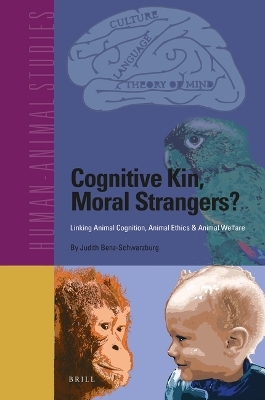
Cognitive Kin, Moral Strangers? Linking Animal Cognition, Animal Ethics & Animal Welfare
In Cognitive Kin, Moral Strangers?, Judith Benz-Schwarzburg reveals the scope and relevance of cognitive kinship between humans and non-human animals. She presents a wide range of empirical studies on culture, language and theory of mind in animals and then leads us to ask why such complex socio-cognitive abilities in animals matter. Her focus is on ethical theory as well as on the practical ways in which we use animals. Are great apes maybe better described as non-human persons? Should we really use dolphins as entertainers or therapists? Benz-Schwarzburg demonstrates how much we know already about animals’ capabilities and needs and how this knowledge should inform the ways in which we treat animals in captivity and in the wild.
Dr. Judith Benz-Schwarzburg is a Senior Researcher at the Messerli Research Institute, Vienna, who works and publishes at the intersection of animal cognition and animal ethics. She is currently leading a research group on animal morality.
Preface and Acknowledgments
Part 1: Introduction
1Socio-Cognitive Abilities in Animals as the Object of Science—and What Has Been Neglected Thus Far
2Questions and Objectives of the Book
Part 2: Socio-Cognitive Abilities in Animals
3The Concept of Cognition and the Concept of Consciousness
4Culture in Animals?
4.1Animal Tool Use and Tool Production: a Widespread Phenomenon
4.2Theoretical Considerations
4.3Culture in Chimpanzees
4.4Culture in Orangutans, Gorillas, and Dolphins
4.5Culture in New Caledonian Crows
4.6Can We Speak Meaningfully of “Culture” in Animals?
5Language in Animals?
5.1Language: the Ultimate Differentia Specifica?
5.2Concept Possession as Prerequisite for Language
5.3Functional and Intentional Aspects of Natural Animal Communication
5.4Propositional Representations and Basic Grammar: First Notes from Language-Teaching Experiments
5.5Can We Speak Meaningfully of “Language” in Animals?
6Theory of Mind in Animals?
6.1Theory of Mind as Everyday Psychology
6.2Theory of Mind Research in Children
6.3Theory of Mind in Animals: What Do Animals Know about Perceptual States and False Beliefs?
6.4Can We Speak Meaningfully of “Theory of Mind” in Animals?
7Summary and Transition
Part 3: The Relevance of Socio-Cognitive Abilities in Animals for Animal Ethics and Animal Welfare
8Kinship and Responsibility: the Moral Status of Animals
8.1Introduction to Basic Concepts in Animal Ethics
8.2Basic Positions in Animal Ethics
8.3“Classical” Arguments in Animal Ethics and Animal Welfare
8.4A “New” Argument: Personhood Rights for Animals
8.5Problems and Limits of Personhood Rights
8.6Opportunities for Personhood Rights: “Cognitive Relatives” as Ambassadors of Species Protection?
9Kinship and Responsibility: the Discrepancy between Ethical Demands and the Status Quo
9.1Case Study: How We Treat Great Apes
9.2Case Study: How We Treat Dolphins
10Summary
Part 4: Discussion
11Cognitive Kinship and the Concept of an Evolutionary Self
11.1Animals as Strangers and Kin at the Same Time
11.2On the Way to a Nature Deficit of a Special Kind
12A Comparison of Arguments
12.1Animal Welfare Arguments vs. Species Conservation Arguments
12.2Utilitarian Pathocentrism vs. Personhood Rights
12.3Rights that Go Beyond the Weighing of Goods
12.4Criteria that Go Beyond the Ability to Consciously Suffer
12.5Painless Killing and Production of Insensitive Animals
13Possibilities of Modifying Personhood Rights for Animals
13.1Toward a Consistently Gradual Understanding
13.2Personhood Status Despite Being a “Gradual” Person?
13.3Species-Specific Inalienable Rights?
13.4Differentiation between Clear and Less Clear Cases?
14Alternative: Turn the Focus Back to the Suffering of Animals?
14.1The Relationship between the Ability to Suffer and Socio-Cognitive Abilities
14.2Socio-Cognitive Abilities, Animal Welfare, and Species Conservation
14.3Indicators of Well-being in Captivity
14.4Enrichment as Occupational Therapy
14.5Cognition—Motivation—Frustration: the Need to Gain Information and Engage in Exploratory Behavior
14.6The Difficulty of Assessing Behavioral Disorders, Using Stereotypies as an Example
14.7The Effects of Enrichment
14.8Enrichment in Captivity as an Ethical Necessity
15Final Evaluation of Personhood Rights for Animals
Acknowledgements
Bibliography
Index
| Erscheinungsdatum | 22.10.2019 |
|---|---|
| Reihe/Serie | Human-Animal Studies ; 23 |
| Übersetzer | Mark Kanak |
| Verlagsort | Leiden |
| Sprache | englisch |
| Maße | 155 x 235 mm |
| Gewicht | 822 g |
| Themenwelt | Geisteswissenschaften ► Philosophie ► Ethik |
| Naturwissenschaften ► Biologie ► Zoologie | |
| ISBN-10 | 90-04-35886-2 / 9004358862 |
| ISBN-13 | 978-90-04-35886-7 / 9789004358867 |
| Zustand | Neuware |
| Informationen gemäß Produktsicherheitsverordnung (GPSR) | |
| Haben Sie eine Frage zum Produkt? |
aus dem Bereich