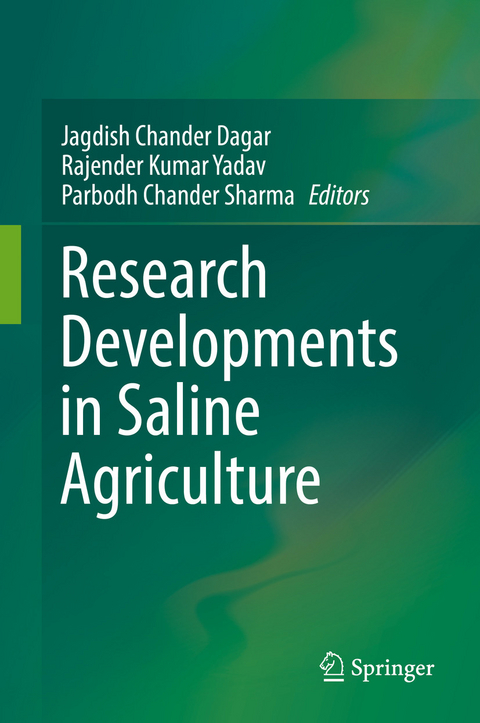
Research Developments in Saline Agriculture (eBook)
XVIII, 926 Seiten
Springer Singapore (Verlag)
978-981-13-5832-6 (ISBN)
Soil and water salinity is a major challenge for the agricultural community and policy makers in terms of meeting the burgeoning population's demand for food and other agricultural commodities. In coastal regions, climate change and sea level rise will aggravate the problem with more and more areas becoming saline due to intrusion of sea water. As such there is a pressing need for modern tools and innovative techniques for the identification of salty soils and poor-quality waters, crop production, soil reclamation and lowering the water table in waterlogged areas. Tackling next-generation problems such as contamination of soil and underground water due to fluoride and arsenic, as well as developing multi-stress tolerant crops is also a high priority. Further, techniques for domesticating halophytes, mangrove-based aquacultures, using seaweed cultures as agricultural crops and integrated farming systems need to be perfected. This book addresses all these aspects in detail, highlighting the diverse solutions to tackle the complex problem of salinity and waterlogging and safer management of poor-quality waters. With chapters written by leading experts, it is a valuable resource for researchers planning future investigations, policy makers, farmers and other stakeholders, and for students wanting insights into vital issues of environment.
Dr Rajender Kumar Yadav is currently Principal Scientist & Head of the Division of Soil and Crop Management, ICAR-Central Soil Salinity Research Institute, Karnal, India. An agronomist by training, he has published 53 research papers in high-impact, peer-reviewed Journals, 46 papers in the proceedings of national and international conferences/symposia and book chapters and written 10 books/bulletins. Dr Yadav received the National Groundwater Augmentation Award (Ministry of Water Resources, Govt. of India), Ganesh Sankar Vidyarthi Puruskar (ICAR), and a Commonwealth Scientific and Industrial Research Organization (CSIRO) Australia fellowship. He is a fellow of the India Society of Agronomy and is involved in a number of major national and international projects. He is a fellow and General Secretary of the Indian Society of Soil Salinity & Water Quality and an member of several scientific professional societies.
Dr Parbodh Chander Sharma is currently Director of the Central Soil Salinity Research Institute, Karnal (India), and was previously program leader for improvement of rice, wheat, Indian mustard and chickpea for salt tolerance and high yield as Head, Division of Crop Improvement. He has made significant contributions to our understanding of the physiological mechanisms under salinity stress in different crops and was involved in developing salt-tolerant, high-yielding genotypes of Indian mustard (CS 56, CS 58 and CS 60), rice (CSR 46) and wheat (KRL 283), as well as improving three popular mega varieties of rice (Pusa 44, PR 114 and Sarjoo 52) for salinity tolerance by introgression of SALTOL QTL following molecular marker assisted backcross breeding. He was also involved in developing crop and resource management practices for sustainable future cereal-based systems in line with conservation agriculture. He has been awarded fellowships of three professional societies and has been the President of the Indian Society of Soil Salinity and Water Quality since 2016. He has published more than 100 research papers in peer-reviewed, research journals.Soil and water salinity is a major challenge for the agricultural community and policy makers in terms of meeting the burgeoning population's demand for food and other agricultural commodities. In coastal regions, climate change and sea level rise will aggravate the problem with more and more areas becoming saline due to intrusion of sea water. As such there is a pressing need for modern tools and innovative techniques for the identification of salty soils and poor-quality waters, crop production, soil reclamation and lowering the water table in waterlogged areas. Tackling next-generation problems such as contamination of soil and underground water due to fluoride and arsenic, as well as developing multi-stress tolerant crops is also a high priority. Further, techniques for domesticating halophytes, mangrove-based aquacultures, using seaweed cultures as agricultural crops and integrated farming systems need to be perfected. This book addresses all these aspects in detail, highlighting the diverse solutions to tackle the complex problem of salinity and waterlogging and safer management of poor-quality waters. With chapters written by leading experts, it is a valuable resource for researchers planning future investigations, policy makers, farmers and other stakeholders, and for students wanting insights into vital issues of environment.
| Erscheint lt. Verlag | 21.6.2019 |
|---|---|
| Zusatzinfo | XVIII, 926 p. 176 illus., 137 illus. in color. |
| Sprache | englisch |
| Themenwelt | Naturwissenschaften ► Biologie ► Ökologie / Naturschutz |
| Naturwissenschaften ► Geowissenschaften ► Geologie | |
| Weitere Fachgebiete ► Land- / Forstwirtschaft / Fischerei | |
| Schlagworte | Biosaline agriculture • climate change • Rehabilitation of salt-affected soils • Rise in sea-level • Waterlogging |
| ISBN-10 | 981-13-5832-X / 981135832X |
| ISBN-13 | 978-981-13-5832-6 / 9789811358326 |
| Informationen gemäß Produktsicherheitsverordnung (GPSR) | |
| Haben Sie eine Frage zum Produkt? |
 PDF (Wasserzeichen)
DRM: Digitales Wasserzeichen
Dieses eBook enthält ein digitales Wasserzeichen und ist damit für Sie personalisiert. Bei einer missbräuchlichen Weitergabe des eBooks an Dritte ist eine Rückverfolgung an die Quelle möglich.
Dateiformat: PDF (Portable Document Format)
Mit einem festen Seitenlayout eignet sich die PDF besonders für Fachbücher mit Spalten, Tabellen und Abbildungen. Eine PDF kann auf fast allen Geräten angezeigt werden, ist aber für kleine Displays (Smartphone, eReader) nur eingeschränkt geeignet.
Systemvoraussetzungen:
PC/Mac: Mit einem PC oder Mac können Sie dieses eBook lesen. Sie benötigen dafür einen PDF-Viewer - z.B. den Adobe Reader oder Adobe Digital Editions.
eReader: Dieses eBook kann mit (fast) allen eBook-Readern gelesen werden. Mit dem amazon-Kindle ist es aber nicht kompatibel.
Smartphone/Tablet: Egal ob Apple oder Android, dieses eBook können Sie lesen. Sie benötigen dafür einen PDF-Viewer - z.B. die kostenlose Adobe Digital Editions-App.
Buying eBooks from abroad
For tax law reasons we can sell eBooks just within Germany and Switzerland. Regrettably we cannot fulfill eBook-orders from other countries.
aus dem Bereich