


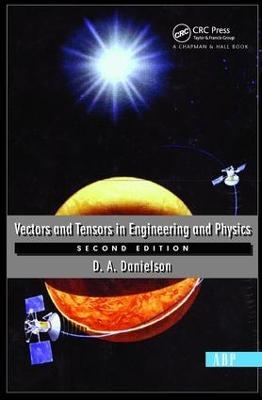
Vectors And Tensors In Engineering And Physics
Second Edition
Seiten
2003
Westview Press Inc (Verlag)
978-0-8133-4080-7 (ISBN)
Westview Press Inc (Verlag)
978-0-8133-4080-7 (ISBN)
Vectors and Tensors in Engineering and Physics develops the calculus of tensor fields and uses this mathematics to model the physical world. This new edition includes expanded derivations and solutions, and new applications, to make this successful text an even more useful and user-friendly book than the first edition.
Vectors and Tensors in Engineering and Physics develops the calculus of tensor fields and uses this mathematics to model the physical world. This new edition includes expanded derivations and solutions, and new applications. The book provides equations for predicting: the rotations of gyroscopes and other axisymmetric solids, derived from Euler's equations for the motion of rigid bodies the temperature decays in quenched forgings, derived from the heat equation the deformed shapes of twisted rods and bent beams, derived from the Navier equations of elasticity the flow fields in cylindrical pipes, derived from the Navier-Stokes equations of fluid mechanics the trajectories of celestial objects, derived from both Newton's and Einstein's theories of gravitation the electromagnetic fields of stationary and moving charged particles, derived from Maxwell's equations the stress in the skin when it is stretched, derived from the mechanics of curved membranes the effects of motion and gravitation upon the times of clocks, derived from the special and general theories of relativity. The book also features over 100 illustrations, complete solutions to over 400 examples and problems, Cartesian components, general components, and components-free notations, lists of notations used by other authors, boxes to highlight key equations, historical notes, and an extensive bibliography.
Vectors and Tensors in Engineering and Physics develops the calculus of tensor fields and uses this mathematics to model the physical world. This new edition includes expanded derivations and solutions, and new applications. The book provides equations for predicting: the rotations of gyroscopes and other axisymmetric solids, derived from Euler's equations for the motion of rigid bodies the temperature decays in quenched forgings, derived from the heat equation the deformed shapes of twisted rods and bent beams, derived from the Navier equations of elasticity the flow fields in cylindrical pipes, derived from the Navier-Stokes equations of fluid mechanics the trajectories of celestial objects, derived from both Newton's and Einstein's theories of gravitation the electromagnetic fields of stationary and moving charged particles, derived from Maxwell's equations the stress in the skin when it is stretched, derived from the mechanics of curved membranes the effects of motion and gravitation upon the times of clocks, derived from the special and general theories of relativity. The book also features over 100 illustrations, complete solutions to over 400 examples and problems, Cartesian components, general components, and components-free notations, lists of notations used by other authors, boxes to highlight key equations, historical notes, and an extensive bibliography.
D. A. Danielson received a B.S. degree in mathematics from the Massachusetts Institute of Technology and the M.S./Ph.D. degrees in applied mathematics from Harvard University. He has been a professor at the University of Virginia and the University of California, and is currently at the Naval Postgraduate School. His research interests include buckling/vibration of structures, waves, and orbits of satellites.
* Vector Algebra * Tensor Algebra * Cartesian Components * General Components * Tensor Fields of One Variable * Tensor Fields * Applications * General Coordinates * Four-Dimensional Spacetime
| Erscheint lt. Verlag | 29.1.2003 |
|---|---|
| Sprache | englisch |
| Maße | 154 x 227 mm |
| Gewicht | 406 g |
| Themenwelt | Mathematik / Informatik ► Mathematik ► Analysis |
| Mathematik / Informatik ► Mathematik ► Angewandte Mathematik | |
| Naturwissenschaften ► Physik / Astronomie | |
| ISBN-10 | 0-8133-4080-2 / 0813340802 |
| ISBN-13 | 978-0-8133-4080-7 / 9780813340807 |
| Zustand | Neuware |
| Informationen gemäß Produktsicherheitsverordnung (GPSR) | |
| Haben Sie eine Frage zum Produkt? |
Mehr entdecken
aus dem Bereich


aus dem Bereich
Festigkeits- und Verformungslehre, Baudynamik, Wärmeübertragung, …
Buch | Hardcover (2025)
De Gruyter Oldenbourg (Verlag)
CHF 125,90


