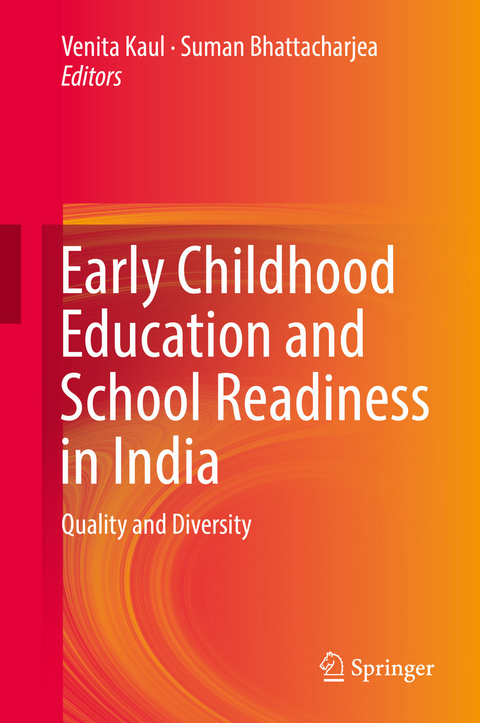
Early Childhood Education and School Readiness in India (eBook)
XXII, 250 Seiten
Springer Singapore (Verlag)
978-981-13-7006-9 (ISBN)
This volume makes a comprehensive assessment of the status and quality of early educational experiences at preschool and early primary grades in India. It raises a serious concern that despite high enrolment in preschools, children's school readiness levels remain low at ages five and six, and raises a vital question---are Indian children getting a sound foundation for school and for later life? It addresses three important issues from the Indian perspective: children's school readiness at age five; families' readiness for school; and, most importantly, the readiness of schools for children.
India is one of many countries across the global South facing an early learning crisis. High quality early childhood education may be key to improving these outcomes for children, yet little is known about early childhood education programs in India and their impact on children's school readiness. This volume is based on a longitudinal, mixed methods research study which is perhaps the first of its kind in India. The study covers public provisions along with steadily expanding private pre-schools and schools in rural India and provides interesting narratives and insights into the multiple pathways children are adopting in these critical early years, particularly in the context of the expanding role of the private sector. Written in a lucid and narrative style, this volume is of interest to a diverse readership of researchers, educationists and early childhood education policy makers and practitioners in terms of both its design and findings.
Venita Kaul, PhD, is Professor Emerita Education and Executive Chair of the Advisory Committee of the Center for Early Childhood Education and Development (CECED), at Ambedkar University Delhi. Prior to this assignment, Professor Kaul was a Senior Education Specialist at The World Bank for over ten years. During her tenure she led several education projects in the South Asian Region. Earlier, Professor Kaul served at the National Council of Educational Research and Training for over 20 years as Professor of Preschool and Elementary Education. She has been a member of several Committees of the Indian government in an advisory capacity, including on the National Advisory Committee constituted by Ministry of Human Resource Development (MHRD) to advise on the implementation of Right to Education (2010); Working Group constituted by Ministry of Women and Child Development (MWCD) to advise on Development of National Policy on ECCE (2010); and a member of the Committee constituted by MHRD to oversee functioning of National Council of Teacher Education which is a statutory body of the government to regulate teacher education in the country. At the international level, she has been a Member of the Steering Group of Asia Pacific Regional Network for ECD and is an invited member of the Forum for Investing in the Young Child. She has also been also on the boards of a number of well-known NGOs working in the area of education. Professor Kaul has several national and international publications in the area of early childhood education, child development and primary education to her credit.
Suman Bhattacharjea, EdD, is Director, Research at ASER Centre, New Delhi. ASER Centre is the research and assessment unit of Pratham, one of the largest non-governmental organizations in the field of education in the country. Dr Bhattacharjea has led or participated in several major studies examining different aspects of the education system in India with particular emphasis on generating actionable evidence with respect to children's learning outcomes at the pre-primary, primary, and secondary stage. She has also been closely involved with efforts to convert research findings into capacity building modules for non-academic audiences. Dr Bhattacharjea holds a bachelor's degree in Economics from the University of Delhi, and master's and doctoral degrees in education from the Harvard University Graduate School of Education. She has worked as a software developer, a high school teacher, an education specialist, and a researcher. She has extensive experience in the fields of education, gender, and women's rights, and has worked with government, private, non-government and international organizations in several countries, including India, the United States, Pakistan and Mexico. She has taught courses on research design, gender and education.
This volume makes a comprehensive assessment of the status and quality of early educational experiences at preschool and early primary grades in India. It raises a serious concern that despite high enrolment in preschools, children's school readiness levels remain low at ages five and six, and raises a vital question---are Indian children getting a sound foundation for school and for later life? It addresses three important issues from the Indian perspective: children's school readiness at age five; families' readiness for school; and, most importantly, the readiness of schools for children. India is one of many countries across the global South facing an early learning crisis. High quality early childhood education may be key to improving these outcomes for children, yet little is known about early childhood education programs in India and their impact on children's school readiness. This volume is based on a longitudinal, mixed methods research study which is perhaps the first of its kind in India. The study covers public provisions along with steadily expanding private pre-schools and schools in rural India and provides interesting narratives and insights into the multiple pathways children are adopting in these critical early years, particularly in the context of the expanding role of the private sector. Written in a lucid and narrative style, this volume is of interest to a diverse readership of researchers, educationists and early childhood education policy makers and practitioners in terms of both its design and findings.
| Erscheint lt. Verlag | 3.6.2019 |
|---|---|
| Zusatzinfo | XXII, 250 p. 68 illus., 40 illus. in color. |
| Sprache | englisch |
| Themenwelt | Naturwissenschaften |
| Sozialwissenschaften ► Pädagogik ► Vorschulpädagogik | |
| Sozialwissenschaften ► Soziologie ► Spezielle Soziologien | |
| Schlagworte | dropouts at primary level • early childhood care • early learning crisis • families and early childhood care • Indian Early Childhood Education Impact study • optimization of children's learning • public provisions for early childhood education • quality of early educational experience • School Readiness |
| ISBN-10 | 981-13-7006-0 / 9811370060 |
| ISBN-13 | 978-981-13-7006-9 / 9789811370069 |
| Informationen gemäß Produktsicherheitsverordnung (GPSR) | |
| Haben Sie eine Frage zum Produkt? |
 PDF (Wasserzeichen)
DRM: Digitales Wasserzeichen
Dieses eBook enthält ein digitales Wasserzeichen und ist damit für Sie personalisiert. Bei einer missbräuchlichen Weitergabe des eBooks an Dritte ist eine Rückverfolgung an die Quelle möglich.
Dateiformat: PDF (Portable Document Format)
Mit einem festen Seitenlayout eignet sich die PDF besonders für Fachbücher mit Spalten, Tabellen und Abbildungen. Eine PDF kann auf fast allen Geräten angezeigt werden, ist aber für kleine Displays (Smartphone, eReader) nur eingeschränkt geeignet.
Systemvoraussetzungen:
PC/Mac: Mit einem PC oder Mac können Sie dieses eBook lesen. Sie benötigen dafür einen PDF-Viewer - z.B. den Adobe Reader oder Adobe Digital Editions.
eReader: Dieses eBook kann mit (fast) allen eBook-Readern gelesen werden. Mit dem amazon-Kindle ist es aber nicht kompatibel.
Smartphone/Tablet: Egal ob Apple oder Android, dieses eBook können Sie lesen. Sie benötigen dafür einen PDF-Viewer - z.B. die kostenlose Adobe Digital Editions-App.
Buying eBooks from abroad
For tax law reasons we can sell eBooks just within Germany and Switzerland. Regrettably we cannot fulfill eBook-orders from other countries.
aus dem Bereich