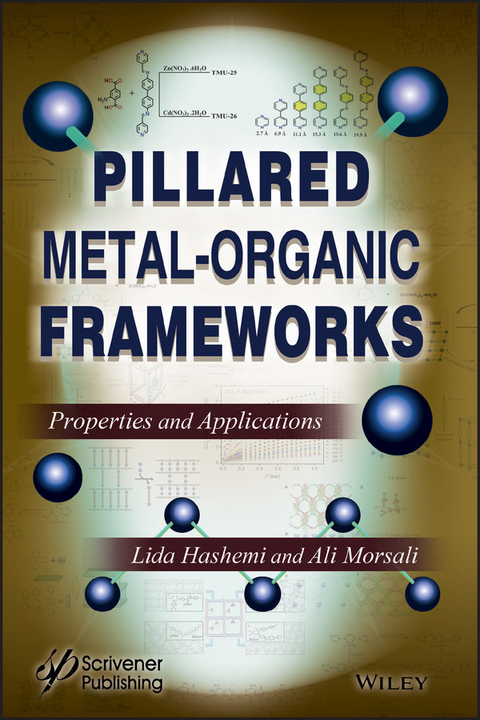
Pillared Metal-Organic Frameworks (eBook)
300 Seiten
John Wiley & Sons (Verlag)
978-1-119-46039-8 (ISBN)
Pillared metal organic frameworks are a class of MOFs composed of inorganic secondary building units (SBUs) and two sets of organic linkers, generally oxygen- and nitrogen-donor ligands. Typically, in the structure of pillared MOFs, the oxygen-donor struts link the metal clusters into a two-dimensional (2D) sheet and the N-donor struts pillar the sheets to generate a three-dimensional (3D) framework. Thus, the construction of MOFs by utilizing two sets of organic linkers could provide an extra possibility for further tuning of MOF's pore walls. A variety of functional groups including imine, amide and heterocycles were successfully incorporated into bidentate pillar ligand skeleton. Interestingly, by using pillaring linkers with different length, a wide diversity of metal-organic frameworks with tunable pore dimensions and topologies can be obtained. In this book, we introduce pillared metal organic frameworks with their properties and applications.
Lida Hashemi is a postdoctoral researcher at Tarbiat Modarers University, Tehran, Iran. She obtained her PhD in inorganic chemistry from the same university in 2014. She has published 30 articles in international journals and has one patent to her name. Her research interests are coordination chemistry, nanotechnology and metal-organic frameworks. Ali Morsali is Master in Inorganic Chemistry in Tarbiat Modares University, Tehran, Iran. He obtained his PhD in 2003 in Inorganic Chemistry from the same university. He has published more than 400 articles in international journals as well as 5 patents. He has received numerous national awards. Amongst his research interests are coordination chemistry and metal-organic frameworks.
Preface ix
Abbreviations xi
1 Introduction to Metal-Organic Frameworks 1
1.1 What are the Metal-Organic Frameworks? 1
1.2 Synthesis of Metal-Organic Frameworks 5
1.3 Structural Highlights of Metal-Organic Frameworks 6
1.4 Expansion of Metal-Organic Frameworks Structures 10
1.5 High Thermal and Chemical Stability 11
1.6 Applications of Metal-Organic Frameworks 12
1.6.1 Gas (Hydrogen and Methane) Storage in MOFs 13
1.6.1.1 Hydrogen Storage in MOFs 14
1.6.1.2 Methane Storage in MOFs 16
1.6.2 Carbon Dioxide Capture in MOFs 16
1.6.2.1 Capacity for CO2 17
1.6.2.2 Enthalpy of Adsorption 18
1.6.2.3 Selectivity for CO2 19
1.6.3 Post-Combustion Capture 20
1.6.3.1 Ideal Adsorbed Solution Theory (IAST) 21
1.6.3.2 Metal-Organic Frameworks for CO2 /N2 Separation 21
1.6.4 Pre-Combustion Capture 25
1.6.4.1 Metal-Organic Frameworks as Adsorbents 26
1.6.5 Selective Gas Adsorption in MOFs 28
1.6.6 Useful Gas Separations in MOFs 29
1.6.7 Catalysis in MOFs 30
1.6.8 Magnetic Properties of MOFs 30
1.6.9 Luminescence and Sensors in MOFs 31
1.6.9.1 Luminescence in MOFs 32
1.6.9.2 Sensors in MOFs 34
1.6.10 Drug Storage and Delivery in MOFs 37
1.6.10.1 Drug-Delivery Methods 37
1.6.11 MOFs; Precursors for Preparation of Nano-Materials 39
1.7 Conclusion 40
References 40
2 Pillar-Layer Metal-Organic Frameworks 45
2.1 Introduction 45
2.2 Topology and Diversity in Pillar-Layered MOFs 49
2.3 Synthesis Methods in Pillar-Layered MOFs 51
2.4 Linkers in Pillar-Layered MOFs 55
2.5 Conclusion 55
References 56
3 Rigid and Flexible Pillars 59
3.1 Introduction 59
3.2 Conclusion 71
References 71
4 Introduction to N-donor Pillars 77
4.1 Introduction 77
4.2 Bipyridine 78
4.3 Dabco 131
4.4 Imidazole and Pyrazole 134
4.5 Triazole and Tetrazole 138
4.6 Pyrazine and Pipyrazine 141
4.7 Amide, Imide, Amin and Azine/Azo Spacer 143
4.8 Conclusion 149
References 150
5 Introduction to Aromatic and Aliphatic Pillars 157
5.1 Introduction 157
5.2 Non-Interpentrated Frameworks 162
5.3 Frameworks with Interpenetration 165
5.4 Control over Interpenetration 166
5.5 Conclusion 170
References 171
6 Introduction to O-Donor Pillars 177
6.1 Introduction 177
6.2 Conclusion 251
References 251
7 Stability and Interpenetration in Pillar-Layer MOFs 255
7.1 Stability in Pillar-Layer MOFs 255
7.2 Interpenetration in Pillar-Layer MOFs 262
7.3 Conclusion 269
References 270
8 Properties and Applications of Pillar-Layer MOFs 275
8.1 Introduction 275
8.2 Gas Storage and Separation in Pillar-Layer MOFs 276
8.2.1 Two Dimensional Networks Based on Mixed Linkers 278
8.2.1.1 2D Interdigitated Networks 279
8.2.1.2 2D Pillared-Bilayer Networks 280
8.2.2 Three Dimensional Frameworks with Mixed Linkers 282
8.2.2.1 Anionic Linker (Other Than Carboxylate) Based Frameworks 282
8.2.2.2 Carboxylate Linker Based Frameworks 284
8.3 Catalysis in Pillar-Layer MOFs 289
8.4 Adsorptive Removal and Separation of Chemicals in Pillar-Layer MOFs 298
8.4.1 Adsorptive Removal of Harmful Gases 302
8.4.2 Capture of Volatile Organic Compounds 310
8.4.3 Adsorptive Removal of Iodine 317
8.5 Sensing in Pillar-Layer MOFs 322
8.6 Conclusion 329
References 329
Glossary 341
Subject Index 349
| Erscheint lt. Verlag | 16.4.2019 |
|---|---|
| Sprache | englisch |
| Themenwelt | Naturwissenschaften ► Chemie ► Organische Chemie |
| Naturwissenschaften ► Physik / Astronomie | |
| Schlagworte | Charakterisierung von Polymeren • Materials Science • Materialwissenschaften • Nanomaterialien • nanomaterials • Nanotechnologie • nanotechnology • Polymer characterization • Polymer Science & Technology • Polymerwissenschaft u. -technologie • Poröse Materialien • Porous Materials |
| ISBN-10 | 1-119-46039-5 / 1119460395 |
| ISBN-13 | 978-1-119-46039-8 / 9781119460398 |
| Informationen gemäß Produktsicherheitsverordnung (GPSR) | |
| Haben Sie eine Frage zum Produkt? |
 PDF (Adobe DRM)
Kopierschutz: Adobe-DRM
Adobe-DRM ist ein Kopierschutz, der das eBook vor Mißbrauch schützen soll. Dabei wird das eBook bereits beim Download auf Ihre persönliche Adobe-ID autorisiert. Lesen können Sie das eBook dann nur auf den Geräten, welche ebenfalls auf Ihre Adobe-ID registriert sind.
Details zum Adobe-DRM
Dateiformat: PDF (Portable Document Format)
Mit einem festen Seitenlayout eignet sich die PDF besonders für Fachbücher mit Spalten, Tabellen und Abbildungen. Eine PDF kann auf fast allen Geräten angezeigt werden, ist aber für kleine Displays (Smartphone, eReader) nur eingeschränkt geeignet.
Systemvoraussetzungen:
PC/Mac: Mit einem PC oder Mac können Sie dieses eBook lesen. Sie benötigen eine
eReader: Dieses eBook kann mit (fast) allen eBook-Readern gelesen werden. Mit dem amazon-Kindle ist es aber nicht kompatibel.
Smartphone/Tablet: Egal ob Apple oder Android, dieses eBook können Sie lesen. Sie benötigen eine
Geräteliste und zusätzliche Hinweise
Buying eBooks from abroad
For tax law reasons we can sell eBooks just within Germany and Switzerland. Regrettably we cannot fulfill eBook-orders from other countries.
aus dem Bereich