


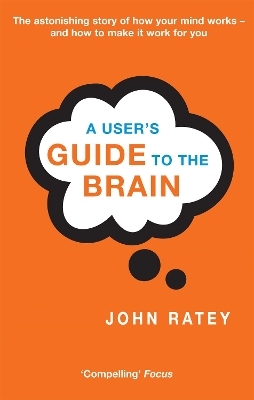
A User's Guide To The Brain
Seiten
2003
Abacus (Verlag)
978-0-349-11296-1 (ISBN)
Abacus (Verlag)
978-0-349-11296-1 (ISBN)
A remarkable new book that shows in what ways the structure and chemistry of our brains determines our perceptions, emotions and behaviour, and what we can do to shape its functions to our advantage.
Bringing order and relevance to the cascade of recent brain findings, Dr John Ratey explains the brain's most important systems, the role they play in determining how we interact with the world and ways in which we can influence their operations for the better. Throughout, he illustrates his points with vivid and often surprising examples drawn from his own practice, research and everyday life. Ratey answers such compelling questions as: What does it mean to be linguistically ambidextrous? How does a mother's cradling of her child on her left shoulder relate to the development of language skills? Why does listening to music while doing homework improve accuracy? Why do people like spicy foods? He also analyses the ways in which things can go wrong, detailing causes and treatments for diseases such as autism, Parkinson's and Alzheimer's, as well as numerous neurological disorders. As Dr. Ratey demonstrates throughout the book, the brain is astonishingly flexible, able to be retrained and reprogrammed. Like a muscle, it responds to use, adapting to new demands and conditions, allowing, as the title of the book suggests, the guidance of the user.
Bringing order and relevance to the cascade of recent brain findings, Dr John Ratey explains the brain's most important systems, the role they play in determining how we interact with the world and ways in which we can influence their operations for the better. Throughout, he illustrates his points with vivid and often surprising examples drawn from his own practice, research and everyday life. Ratey answers such compelling questions as: What does it mean to be linguistically ambidextrous? How does a mother's cradling of her child on her left shoulder relate to the development of language skills? Why does listening to music while doing homework improve accuracy? Why do people like spicy foods? He also analyses the ways in which things can go wrong, detailing causes and treatments for diseases such as autism, Parkinson's and Alzheimer's, as well as numerous neurological disorders. As Dr. Ratey demonstrates throughout the book, the brain is astonishingly flexible, able to be retrained and reprogrammed. Like a muscle, it responds to use, adapting to new demands and conditions, allowing, as the title of the book suggests, the guidance of the user.
John J Ratey is an Assistant Professor of Psychiatry at Harvard Medical School and Executive Director of Research at Medfield State Hospital.
| Erscheint lt. Verlag | 5.6.2003 |
|---|---|
| Verlagsort | London |
| Sprache | englisch |
| Maße | 200 x 130 mm |
| Gewicht | 284 g |
| Themenwelt | Sachbuch/Ratgeber ► Natur / Technik |
| Medizin / Pharmazie ► Medizinische Fachgebiete ► Psychiatrie / Psychotherapie | |
| Naturwissenschaften ► Biologie ► Humanbiologie | |
| Naturwissenschaften ► Biologie ► Zoologie | |
| ISBN-10 | 0-349-11296-7 / 0349112967 |
| ISBN-13 | 978-0-349-11296-1 / 9780349112961 |
| Zustand | Neuware |
| Informationen gemäß Produktsicherheitsverordnung (GPSR) | |
| Haben Sie eine Frage zum Produkt? |
Mehr entdecken
aus dem Bereich



aus dem Bereich
Zwischen Normvariante, Persönlichkeitsstörung und …
Buch | Softcover (2022)
Kohlhammer (Verlag)
CHF 49,95
Menschen mit psychischer Erkrankung wirksam unterstützen
Buch | Hardcover (2023)
Psychiatrie Verlag
CHF 48,95


