


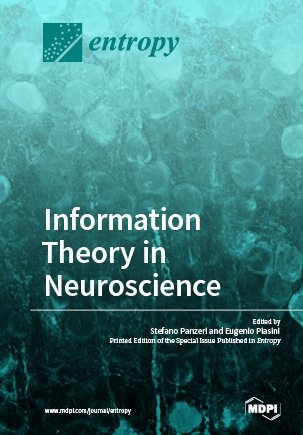
Information Theory in Neuroscience
Seiten
2019
MDPI (Verlag)
978-3-03897-664-6 (ISBN)
MDPI (Verlag)
978-3-03897-664-6 (ISBN)
- Keine Verlagsinformationen verfügbar
- Artikel merken
As the ultimate information processing device, the brain naturally lends itself to being studied with information theory. The application of information theory to neuroscience has spurred the development of principled theories of brain function, and has led to advances in the study of consciousness, as well as to the development of analytical techniques to crack the neural code—that is, to unveil the language used by neurons to encode and process information. In particular, advances in experimental techniques enabling the precise recording and manipulation of neural activity on a large scale now enable for the first time the precise formulation and the quantitative testing of hypotheses about how the brain encodes and transmits the information used for specific functions across areas.
This Special Issue presents twelve original contributions on novel approaches in neuroscience using information theory, and on the development of new information theoretic results inspired by problems in neuroscience.
This Special Issue presents twelve original contributions on novel approaches in neuroscience using information theory, and on the development of new information theoretic results inspired by problems in neuroscience.
| Erscheinungsdatum | 05.04.2019 |
|---|---|
| Verlagsort | Basel |
| Sprache | englisch |
| Maße | 170 x 244 mm |
| Themenwelt | Mathematik / Informatik ► Mathematik ► Allgemeines / Lexika |
| Mathematik / Informatik ► Mathematik ► Angewandte Mathematik | |
| Naturwissenschaften | |
| Schlagworte | brain network • Categorical Perception • Channel capacity • complex networks • connectome • Consciousness • Decoding • discrete Markov chains • Discrimination • eigenvector centrality • entorhinal cortex • Feedforward networks • free-energy principle • functional connectome • Gibbs measures • goodness • graph theoretical analysis • graph theory • higher-order correlations • hippocampus • Independent Component Analysis • infomax principle • information entropy production • Information Theory • integrated information • integrated information theory • internal model hypothesis • Ising Model • latching • maximum entropy • Maximum Entropy Principle • minimum information partition • mismatched decoding • mutual information • mutual information decomposition • Navigation • network eigen-entropy • neural code • Neural Coding • neural information propagation • neural network • neural population coding • Neuroscience • noise correlations • orderness • perceived similarity • perceptual magnet • Potts model • Principal Component Analysis • pulse-gating • Queyranne’s algorithm • Recursion • Redundancy • Representation • spike-time precision • spike train statistics • Submodularity • synergy • unconscious inference |
| ISBN-10 | 3-03897-664-4 / 3038976644 |
| ISBN-13 | 978-3-03897-664-6 / 9783038976646 |
| Zustand | Neuware |
| Informationen gemäß Produktsicherheitsverordnung (GPSR) | |
| Haben Sie eine Frage zum Produkt? |
Mehr entdecken
aus dem Bereich



aus dem Bereich
ein Übungsbuch für Fachhochschulen
Buch | Hardcover (2023)
Carl Hanser (Verlag)
CHF 23,75


