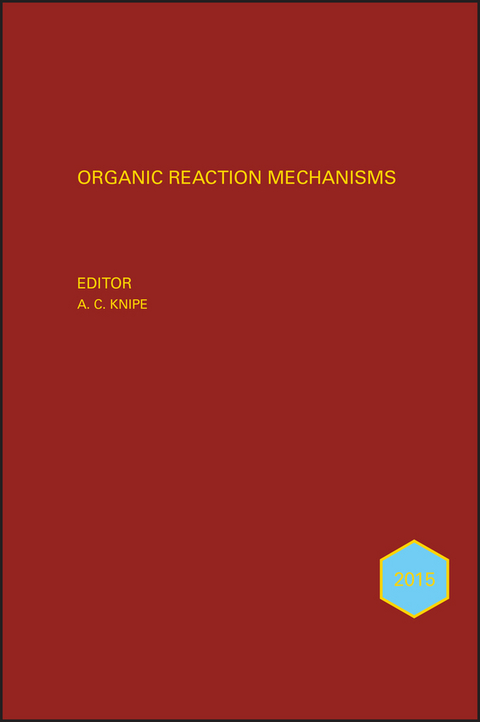
Organic Reaction Mechanisms 2015 (eBook)
John Wiley & Sons (Verlag)
978-1-119-12507-5 (ISBN)

Organic Reaction Mechanisms 2015, the 51st annual volume in this highly successful and unique series, surveys research on organic reaction mechanisms described in the available literature dated 2015. The following classes of organic reaction mechanisms are comprehensively reviewed:
- Reaction of Aldehydes and Ketones and their Derivatives
- Reactions of Carboxylic, Phosphoric, and Sulfonic Acids and their Derivatives
- Oxidation and Reduction
- Carbenes and Nitrenes
- Nucleophilic Aromatic Substitution
- Electrophilic Aromatic Substitution
- Carbocations
- Nucleophilic Aliphatic Substitution
- Carbanions and Electrophilic Aliphatic Substitution
- Elimination Reactions
- Polar Addition Reactions
- Cycloaddition Reactions
- Molecular Rearrangements
An experienced team of authors compile these reviews every year, so that the reader can rely on a continuing quality of selection and presentation.
Professor A.C. Knipe, School of BMS, The University of Ulster, Northern Ireland.
Organic Reaction Mechanisms 2015, the 51st annual volume in this highly successful and unique series, surveys research on organic reaction mechanisms described in the available literature dated 2015. The following classes of organic reaction mechanisms are comprehensively reviewed: Reaction of Aldehydes and Ketones and their Derivatives Reactions of Carboxylic, Phosphoric, and Sulfonic Acids and their Derivatives Oxidation and Reduction Carbenes and Nitrenes Nucleophilic Aromatic Substitution Electrophilic Aromatic Substitution Carbocations Nucleophilic Aliphatic Substitution Carbanions and Electrophilic Aliphatic Substitution Elimination Reactions Polar Addition Reactions Cycloaddition Reactions Molecular Rearrangements An experienced team of authors compile these reviews every year, so that the reader can rely on a continuing quality of selection and presentation.
Professor A.C. Knipe, School of BMS, The University of Ulster, Northern Ireland.
1. Reactions of Aldehydes and Ketones and Their Derivatives by B. A. Murray 1
2. Reactions of Carboxylic, Phosphoric, and Sulfonic Acids and their Derivatives by C. T. Bedford 73
3. Oxidation and Reduction by R. N. Mehrotra 107
4. Carbenes and Nitrenes by E. Gras and S. Chassaing 219
5. Aromatic Substitution by M. R. Crampton 251
6. Carbocations by D. A. Klumpp 335
7. Nucleophilic Aliphatic Substitution by K. C. Westaway 365
8. Carbanions and Electrophilic Aliphatic Substitution by M. L. Birsa 403
9. Elimination Reactions by M. L. Birsa 419
10. Addition Reactions: Polar Additions by A. C. Knipe 429
11. Addition Reactions: Cycloaddition by N. Dennis 517
12. Molecular Rearrangement by J. M. Coxon 567
Author Index 635
Subject Index 679
CHAPTER 1
Reactions of Aldehydes and Ketones and Their Derivatives
B. A. Murray
Department of Science, Dublin, Ireland
- Formation and Reactions of Acetals and Related Species
- Reactions of Glucosides
- Reactions of Ketenes
- Formation and Reactions of Nitrogen Derivatives
- Imines: Synthesis, and General and Iminium Chemistry
- Mannich, Mannich‐type, and Nitro‐Mannich Reactions
- Other ‘Name’ Reactions of Imines
- Synthesis of Azacyclopropanes and Azirines
- Alkylations, Arylations, Allylations, and Additions of Other C‐Nucleophiles
- Miscellaneous Additions to Imines
- Oxidation and Reduction of Imines
- Other Reactions of Imines
- Oximes, Hydrazones, and Related Species
- C−C Bond Formation and Fission: Aldol and Related Reactions
- Reviews of Aldols, and General Reviews of Asymmetric Catalysis
- Asymmetric Aldols
- The Mukaiyama Aldol
- The Baylis–Hillman Reaction and its Morita Variant
- Other Aldol and Aldol‐type Reactions
- Allylation and Related Reactions
- Alkynylations
- The Stetter and Benzoin Reactions
- Michael Addition and Miscellaneous Condensations
- Other Addition Reactions
- Enolization, Reactions of Enolates, and Related Reactions
- Oxidation and Reduction of Carbonyl Compounds
- Other Reactions
- References
Formation and Reactions of Acetals and Related Species
Lutetium(III) triflate catalyses acetalization of acetone with glycerol, (HOCH2)2−CH(OH), giving a regioselective preference for the 1,3‐dioxolane product (1, ‘solketal’), as against the six‐membered‐ring 1,3‐dioxane alternative. Density functional theory () studies have identified a constrained hemiacetal intermediate to explain the selectivity.(1)
To assist in using glycerol by‐product from biodiesel manufacturing, a quantum mechanics () study of its acetalization with acetone has been undertaken, using benzenesulfonic acid as catalyst.(2)
Nucleophilic substitutions of acetals such as (2) with a remote benzyloxy group can be highly diastereoselective, an effect which increases as the reactivity of the nucleophile is increased, in violation of the reactivity/selectivity principle. The result has been explained in terms of multiple conformers of a reactive intermediate leading to the product.(3)
Acetophenones undergo mild one‐step α‐haloacetalization in ethylene glycol, using 1,3‐dihalo‐5,5‐dimethylhydantoins (3; X = Cl or Br). Temperature and solvent effects have been investigated.(4)
A kinetic study of acetal hydrolysis has examined the effect of 4‐alkoxy groups, with appropriate control of stereochemistry. For example, several acetal series (4) have been prepared with varying ring size (n = 1–4), and either endocyclic oxygen (X = H, Y = O) or exocyclic (X = OBn, Y = CH2), with appropriate non‐cyclic controls such as 4‐benzyloxy‐butanal dimethylacetal. Hydrolysis rate enhancements are of the order of 20‐fold, perhaps 200‐fold when controlled for inductive destabilization. However, rates of solvolysis of related tosylates show much larger effects, including a factor of nearly
106 going from five‐ to eight‐membered rings. It is concluded that neighbouring‐group participation operates in the tosylate solvolysis, but not in the acetal hydrolysis.(5)
Using an amine as a nucleophile carrier, R2N−CH2Nu, a range of progressively more hindered α‐cyanoamines, R2N−CH2−CN (R = Me, Et, i‐Pr, and CyHx), have been tested as cyanating agents of acetals. The congested dicyclohexyl compound proved best: using 2 equiv, together with 2 equiv of trichlorosilane triflate in DCM at 0 °C for 30 min, benzaldehyde dimethyl acetal gave 95% yield of PhCH(OMe)CN. Similar results were obtained for a wide range of acetal types, and indeed for orthoesters (to give the cyanoacetal). Investigation by nuclear magnetic resonance () spectroscopy helped identify an oxocarbenium ion intermediate, Ph−CHO+−Me (as the triflate), upon addition of Cl3SiOTf, and addition of (CyHx)2N−CH2−CN rapidly gave the product, together with an iminium cation, (CyHx)2N+ CH2.(6)
Regioselective monoalkylation of diols is often achieved via dialkylstannylene acetal intermediates. Though slow to form, addition of nucleophiles helps, especially fluoride. The reaction of a fluoride salt (5) with bromomethane has now been studied at several levels of theory in the gas phase, and in DMF solution. In solution state most closely related to experiment, fluorinated monomers and monofluorinated dimers showed similar activation energies. A widely considered ‘Sn−O bond cleavage first’ mechanism did not feature, with C−O bond formation actually well advanced over Sn−O cleavage in the TS. Comparing gas phase with DMF, solvation effects significantly lower the energy of fluoride ion to form (5), but the tetramethylammonium cation stays close to the F atom.(7)
A series of dialkyl acetals, Me2N−CH(OR)2, derived from DMF have been screened for their ability to N‐alkylate 8‐oxoadenosine and guanosine at N(7). Comparative kinetic experiments have been used to explore the mechanism and side‐reaction possibilities.(8)
ortho‐Alkynylbenzaldehyde acetals and thioacetals (6) undergo a range of divergent cyclizations catalysed by palladium(II) or platinum(II) halides. While metal‐triggered C−X cleavage was previously proposed, DFT calculations now point to electrophilic activation of the alkyne as the initiating step. Terminal and non‐terminal alkyne cases are contrasted, and the nature of the heteroatom's effect on the route taken was also studied. The DFT results have led to some literature assignments being challenged, with new experiments reported that validate the new assignments.(9)
Hemithioacetal enantiomers (7) contain an unstable quaternary chiral centre and can equilibrate through their open‐chain ketone–enethiol form (8). Variable temperature and exchange spectroscopy () NMR techniques have been used to measure the rates and barriers for the interconversion, in toluene solvent. A DFT study was also undertaken, but the toluene solvent severely constrains the possibilities in terms of acid–base and hydrogen‐bonding chemistry. A computed barrier of 40 kcal mol−1 is at odds with half that found by NMR. But an alternative path was found to resolve the discrepancy: a ‘solvent molecule’ is available … in the form of another hemithioacetal, which – through a dimer complex – assists the proton transfers.(10)
‘Fmox’, a 3‐Fmoc‐(1,3)‐oxazinane moiety, has been developed as a base‐labile aldehyde‐protecting group. For the example of the doubly protected 3‐aminopropanal (9), deprotection is 100% effected with 1% piperidine in 2 h, while leaving the amine protection intact. The group, like many others, is acid‐labile to the extent of 6% in 20% acetic acid and 93% in 10% TFA, though it survives in 0.1% TFA for 10 min. Protection of the aldehyde (10) requires N‐Fmoc‐3‐amino‐propanol/Na2SO4/HCl(cat.)/50 °C.(11)
Enantiomerically enriched β 2‐amino acids have been accessed in the form of their N,N‐diprotected esters (11) via dual activation of an enal (trans‐R−CHCH−CHO) and an N,O‐acetal (Bn2N−CH2−OMe), the activations being achieved by an N‐heterocyclic carbene () and an in situ‐generated Brønsted acid, respectively. The enal is converted to an azolium enolate, and the acetal to an iminium ion (Bn2N+ CH2) and methanol. Typical conditions are mild base at ambient temperature, giving...
| Erscheint lt. Verlag | 20.2.2019 |
|---|---|
| Reihe/Serie | Organic Reaction Mechanisms |
| Organic Reaction Mechanisms | Organic Reaction Mechanisms |
| Sprache | englisch |
| Themenwelt | Naturwissenschaften ► Chemie ► Organische Chemie |
| Schlagworte | aldehydes • carbanions • carbenes • Carbocations • carboxylic acids • Chemie • Chemistry • Cycloaddition Reactions • electrophilic aliphatic substitution • electrophilic aromatic substitution • elimination reactions • Ketones • Molecular Rearrangements • Nitrenes • nucleophilic aliphatic substitution • nucleophilic aromatic substitution • Organic Chemistry • Organic Reaction Mechanisms • Organische Chemie • Oxidation • Phosphoric Acids • Physical Chemistry • Physical Organic Chemistry • Physikalische Chemie • Physikalische Organische Chemie • Polar Addition Reactions • reduction • Sulfonic Acids |
| ISBN-10 | 1-119-12507-3 / 1119125073 |
| ISBN-13 | 978-1-119-12507-5 / 9781119125075 |
| Informationen gemäß Produktsicherheitsverordnung (GPSR) | |
| Haben Sie eine Frage zum Produkt? |
 EPUB (Adobe DRM)
Kopierschutz: Adobe-DRM
Adobe-DRM ist ein Kopierschutz, der das eBook vor Mißbrauch schützen soll. Dabei wird das eBook bereits beim Download auf Ihre persönliche Adobe-ID autorisiert. Lesen können Sie das eBook dann nur auf den Geräten, welche ebenfalls auf Ihre Adobe-ID registriert sind.
Details zum Adobe-DRM
Dateiformat: EPUB (Electronic Publication)
EPUB ist ein offener Standard für eBooks und eignet sich besonders zur Darstellung von Belletristik und Sachbüchern. Der Fließtext wird dynamisch an die Display- und Schriftgröße angepasst. Auch für mobile Lesegeräte ist EPUB daher gut geeignet.
Systemvoraussetzungen:
PC/Mac: Mit einem PC oder Mac können Sie dieses eBook lesen. Sie benötigen eine
eReader: Dieses eBook kann mit (fast) allen eBook-Readern gelesen werden. Mit dem amazon-Kindle ist es aber nicht kompatibel.
Smartphone/Tablet: Egal ob Apple oder Android, dieses eBook können Sie lesen. Sie benötigen eine
Geräteliste und zusätzliche Hinweise
Buying eBooks from abroad
For tax law reasons we can sell eBooks just within Germany and Switzerland. Regrettably we cannot fulfill eBook-orders from other countries.
aus dem Bereich