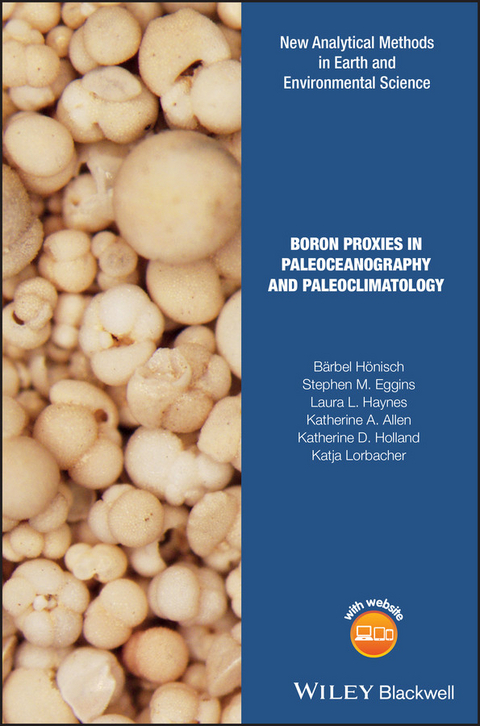
Boron proxies (?11B and B/Ca) were introduced nearly three decades ago, with subsequent strides being made in understanding their mechanistic functioning. This text reviews current knowledge about the aqueous systematics, the inorganic and biological controls on boron isotope fractionation and incorporation into marine carbonates, as well as the analytical techniques for measurement of boron proxies. Laboratory and field calibrations of the boron proxies are summarized, and similarities between modern calibrations are explored to suggest estimates for proxy sensitivities in marine calcifiers that are now extinct. Example applications illustrate the potential for reconstructing paleo-atmospheric pCO2 from boron isotopes. Also explored are the sensitivity of paleo-ocean acidity and pCO2 reconstructions to boron isotope proxy systematics that are currently less well understood, including the elemental and boron isotopic composition of seawater through time, seawater alkalinity, temperature and salinity, and their collective impact on the uncertainty of paleo-reconstructions.
The B/Ca proxy is based on the same mechanistic principles as the boron isotope proxy, but empirical calibrations suggest seawater pH is not the only controlling factor. B/Ca therefore has the potential to provide a second carbonate parameter that could be paired with ?11B to fully constrain the ocean carbonate system, but the associated uncertainties are large. This text reviews and examines what is currently known about the B/Ca proxy systematics. As more scientists embark on characterizing past ocean acidity and atmospheric pCO2, Boron in Paleoceanography and Paleoclimatology provides a resource to introduce geoscientists to the opportunities and complications of boron proxies, including potential avenues to further refine them.
Bärbel Hönisch, Department of Earth and Environmental Sciences and Lamont-Doherty Earth Observatory of Columbia University, USA.
Stephen M. Eggins, Research School of Earth Sciences, The Australian National University, Australia.
Laura L. Haynes, Department of Earth and Environmental Sciences, Columbia University, USA
Katherine A. Allen, School of Earth and Climate Sciences, University of Maine, USA
Katherine D. Holland, College of Physical and Mathematical Sciences, Australian National University, Australia
Katja Lorbacher, Climate and Energy College, University of Melbourne, Australia
Anthropogenic carbon dioxide emissions do not only warm our planet but also acidify our oceans. It is currently unclear to which degree Earth s climate and marine life will be impacted by these changes but information from Earth history, particularly the geochemical signals of past environmental changes stored in the fossil remains of marine organisms, can help us predict possible future changes. This book aims to be a primer for scientists who seek to apply boron proxies in marine carbonates to estimate past seawater carbonate chemistry and atmospheric pCO2. Boron proxies ( 11B and B/Ca) were introduced nearly three decades ago, with subsequent strides being made in understanding their mechanistic functioning. This text reviews current knowledge about the aqueous systematics, the inorganic and biological controls on boron isotope fractionation and incorporation into marine carbonates, as well as the analytical techniques for measurement of boron proxies. Laboratory and field calibrations of the boron proxies are summarized, and similarities between modern calibrations are explored to suggest estimates for proxy sensitivities in marine calcifiers that are now extinct. Example applications illustrate the potential for reconstructing paleo-atmospheric pCO2 from boron isotopes. Also explored are the sensitivity of paleo-ocean acidity and pCO2 reconstructions to boron isotope proxy systematics that are currently less well understood, including the elemental and boron isotopic composition of seawater through time, seawater alkalinity, temperature and salinity, and their collective impact on the uncertainty of paleo-reconstructions. The B/Ca proxy is based on the same mechanistic principles as the boron isotope proxy, but empirical calibrations suggest seawater pH is not the only controlling factor. B/Ca therefore has the potential to provide a second carbonate parameter that could be paired with 11B to fully constrain the ocean carbonate system, but the associated uncertainties are large. This text reviews and examines what is currently known about the B/Ca proxy systematics. As more scientists embark on characterizing past ocean acidity and atmospheric pCO2, Boron in Paleoceanography and Paleoclimatology provides a resource to introduce geoscientists to the opportunities and complications of boron proxies, including potential avenues to further refine them.
Bärbel Hönisch, Department of Earth and Environmental Sciences and Lamont-Doherty Earth Observatory of Columbia University, USA. Stephen M. Eggins, Research School of Earth Sciences, The Australian National University, Australia. Laura L. Haynes, Department of Earth and Environmental Sciences, Columbia University, USA Katherine A. Allen, School of Earth and Climate Sciences, University of Maine, USA Katherine D. Holland, College of Physical and Mathematical Sciences, Australian National University, Australia Katja Lorbacher, Climate and Energy College, University of Melbourne, Australia
Preface vii
Acknowledgments viii
About the Companion Website ix
1 Introduction and Concepts 1
1.1 Why Are we Interested in Reconstructing Marine Carbonate Chemistry? 1
Acknowledgments 8
References 8
Further Reading/Resources 12
2 Boron Systematics 13
2.1 Introduction 14
2.2 What Determines the Sensitivity of delta11B and B/Ca to Marine Carbonate Chemistry? 15
2.3 Boron Proxy Systematics in Synthetic Carbonates 21
2.4 Boron Isotopes in Biogenic Marine Carbonates 42
2.5 Secular Evolution of [BT] and delta¯11B in Seawater 81
2.6 The B/Ca Proxy in Foraminifera 88
References 105
3 Reconstructing Paleo-Acidity, pCO2 and Deep-Ocean [CO3¯2-] 120
3.1 Introduction 120
3.2 Estimating Paleoseawater pH from Boron Isotopes 122
3.3 Estimating Marine Carbonate Chemistry from B/Ca Ratios 150
3.4 Guidelines for Selecting Sediment Core Sites and Sample Sizes 155
References 156
4 Boron Concentration and Isotope Ratio Analysis 165
4.1 Introduction 165
4.2 Inter-Laboratory Comparison Studies 170
4.3 Standard Reference Materials and Data Quality Assurance 172
4.4 Boron Concentration and Isotope Ratio Analysis 175
4.5 Sample Preparation and Cleaning 179
4.6 Boron Separation and Purification 183
4.7 Instrumental Techniques 188
4.8 Laser Ablation-Inductively Coupled Plasma-Mass Spectrometry (LA-ICP-MS) 201
4.9 Secondary Ion Mass Spectrometry (SIMS) 204
4.10 Other Techniques 206
4.11 Outlook and Future Directions 210
References 211
Index 224
1
Introduction and Concepts
Abstract
This chapter presents a brief introduction to marine carbonate chemistry systematics, including definitions of different pH scales. As a starting point, published estimates of Pleistocene and Cenozoic pCO2 reconstructions from boron isotopes and B/Ca ratios in planktic foraminifera are shown in the context of ice core records and reconstructions from terrestrial leaf stomata and marine alkenones. These published boron proxy records form the foundation for discussing boron proxy systematics and sensitivity studies presented in the following chapters.
Keywords: atmospheric pCO2; seawater carbonate chemistry; seawater pH; pH scales
1.1 Why Are we Interested in Reconstructing Marine Carbonate Chemistry?
It has been known since the early studies of Arrhenius (1896) that anthropogenic emissions of carbon dioxide from fossil fuel burning and land use changes will warm our planet, but direct evidence for increasing atmospheric pCO2 levels emerged only in 1958, when Charles Keeling started continuous measurements at the Mauna Loa Observatory on Hawaii and initially observed an average annual value of 315 parts per million (ppm) (Keeling et al. 1976). These atmospheric pCO2 levels varied seasonally, steadily increased year upon year and were finally put into perspective when Raynaud and Barnola (1985) presented the first pCO2 measurements from Antarctic ice cores, which revealed pre‐anthropogenic background levels as low as 260 ppmv (parts per million by volume). Subsequent studies expanded the ice core records to 800 000 years ago and constrained the pre‐industrial range of atmospheric pCO2 to 172–300 ppmv, together with concomitant Antarctic temperature fluctuations of ~12 °C (Barnola et al. 1987; Jouzel et al. 1987; Lüthi et al. 2008; Petit et al. 1999; Siegenthaler et al. 2005). In 2014 atmospheric pCO2 hit 400 ppm for the first time (Dlugokencky and Tans 2017) and levels are projected to climb to 420–940 ppm by the end of this century, depending on future emissions (Figure 1.1).
Figure 1.1 Historical observations and future trends in (a) atmospheric pCO2 (Meinshausen et al. 2011), (b) global sea surface temperature, and (c) surface ocean pH as a function of two CO2 emission scenarios – Representative Concentration Pathways RCP2.6 and RCP8.5. These scenarios represent the full range of possible future CO2 emissions used by scientists to predict future climate trends (see also IPCC 2013). Future sea surface temperature trends are globally averaged multi‐model estimates extracted from CMIP5 numerical experiments (Moss et al. 2010; Taylor et al. 2011), where temperature uncertainties are based on differences between individual model outputs. pH has been calculated in CO2SYS (Pierrot et al. 2006), with K1 and K2 according to Lueker et al. (2000), KSO4 according to Dickson (1990), total [B] after Lee et al. (2010). Calculations have been parameterized using pCO2 and T as displayed in (a) and (b), S = 35, and adopting total alkalinity AT = 2300 μmol kg−1 as the second parameter required for seawater carbonate chemistry calculations. The temperature uncertainties displayed in (b) exert negligible influence on the pH estimates and do not exceed the thickness of the lines displayed in (c). Depending on the actual extent of future emissions, ocean acidification may peak at pH ~ 8.0 (TS, RCP2.6) or fall to pH < 7.3 (TS, RCP8.5). Predicting ocean ecosystem responses to such acidification remains a challenge but may be improved by studying carbonate chemistry perturbations in Earth's geological past.
While discussion of the consequences of rising atmospheric pCO2 initially concentrated on global warming, research over the past two decades has increasingly addressed the dissolution of CO2 in seawater and its consequences for marine life. Briefly, as CO2 dissolves in the ocean, it hydrates and reacts with water to form carbonic acid, which then dissociates into bicarbonate, carbonate, and hydrogen ions according to the following reactions:
The more CO2 dissolves, the more hydrogen ions are created but these ions do not immediately accumulate, as they are buffered by the carbonate ions already in solution:
However, a small fraction of the resulting bicarbonate ions will dissociate, ultimately increasing the hydrogen ion concentration and therefore the acidity of seawater (i.e. lowering pH):
A detailed description of marine carbonate chemistry systematics and calculations can be found in Zeebe and Wolf‐Gladrow (2001); here we will limit the discussion to a few basic details. The reactions between carbonate and hydrogen ions are governed by dissociation constants (K1 and K2), which depend on the thermodynamic seawater properties pressure (p), temperature () and salinity (). The associated shift in carbonate ion speciation is shown in Figure 1.2, which displays the relative concentrations of [CO2], [HCO3−] and [CO32−] versus seawater‐pH at typical surface (T = 25 °C, S = 35, and p = 1 bar) and deep ocean conditions (T = 4 °C, S = 34.8, p = 401 bar). In contrast, the sum of all dissolved inorganic carbon () species and their alkalinity (i.e. the sum of their charges) are independent of T, S, and p when expressed in gravimetric units (i.e. μmol kg−1, as opposed to the volumetric μmol l−1). Because these six parameters are interrelated, the entire carbonate system can be determined if two of its components, in addition to temperature, salinity, and pressure, are known. Several programs facilitate computation of the carbonate system; see Further Reading for details.
Figure 1.2 This Bjerrum plot displays relative concentrations of dissolved carbon species versus seawater‐pH. Relative species concentrations were calculated using the CO2SYS program by Pierrot et al. (2006) with K1 and K2 according to Lueker et al. (2000), KSO4 according to Dickson (1990), total [B] after Lee et al. (2010), and using T = 25 °C, S = 35, p = 1 bar for the sea surface (red lines) and T = 4 °C, S = 34.8 p = 401 bar for the deep ocean (black lines). The modern range of seawater‐pH is indicated by the gray bar.
One aspect that requires specific attention is the choice of pH scale. Four scales have been defined, the National Bureau of Standards (), free hydrogen, seawater, and total scale; they differ in the chemical composition of their respective reference material and pH values determined for identical solutions differ by up to 0.15 units (Table 1.1). While this pH difference may appear small, it has significant consequences for carbon system calculations, as demonstrated in Table 1.1. For example, assuming the same T, S, p, pH, and DIC value to calculate pCO2, but with pH defined on different scales, calculated pCO2 differs by >150 μatm. Such large differences are inacceptable for carbon system determinations and must be avoided by all means. Fortuitously, pH scales are interrelated and values can be converted (see Zeebe and Wolf‐Gladrow 2001), but this is only possible if studies cite the pH scale used. Because the boron equilibrium constants are reported for the total scale (Dickson 1990; Millero 1995), this book will present all data on the total scale.
Table 1.1 Definitions of pH scales, differences in scale‐specific pH values in solutions of the same composition, and differences in pCO2 calculated from solutions of similar composition but assuming pH = 8.10 for all four pH‐scales.
| Scale | Definition | pH value at TA = 2400 μmol kg−1, DIC = 2100 μmol kg−1, T = 25 °C, S = 35, p = 1 bar | pCO2 at pH = 8.10, DIC = 2100 μmol kg−1, T = 25 °C, S = 35, p = 1 bar |
| NBS (μmol kg −1 H2O) | pHNBS = −log aH+ | 8.162 | 513 |
| Free (μmol kg −1 SW) | pHF = −log [H+]F | 8.133 | 477 |
| Total (μmol kg −1 SW) | pHT = −log ([H+]F+[HSO4−]) | 8.025 | 363 |
| Seawater (μmol kg −1 SW) | pHSWS = −log ([H+]F+[HSO4−] + [HF]) | 8.016 | 354 |
Calculations performed using the CO2SYS program (version 2.1) by Pierrot et al. (2006) with K1 and K2 according to Lueker et al. (2000), KSO4 according to Dickson (1990) and total [B] after Lee et al. (2010).
Modern surface ocean pH is ~8.1 (total scale, TS), which is already ~0.1 pH units lower compared to the preindustrial, when atmospheric pCO2...
| Erscheint lt. Verlag | 18.2.2019 |
|---|---|
| Reihe/Serie | Analytical Methods in Earth and Environmental Science |
| Analytical Methods in Earth and Environmental Science | Analytical Methods in Earth and Environmental Science |
| Sprache | englisch |
| Themenwelt | Naturwissenschaften ► Biologie ► Limnologie / Meeresbiologie |
| Naturwissenschaften ► Geowissenschaften ► Hydrologie / Ozeanografie | |
| Naturwissenschaften ► Geowissenschaften ► Meteorologie / Klimatologie | |
| Naturwissenschaften ► Geowissenschaften ► Mineralogie / Paläontologie | |
| Technik | |
| Schlagworte | aqueous systematics • Boron concentration and isotope ratio analysis • Boron proxies, seawater-pH and paleo-pCO2 • Boron systematics • carbonate chemistry, planktic foraminifera • Climatology & Palaeoclimatology • earth sciences • foraminifers, corals and inorganically precipitated calcium carbonate • Geochemie • Geochemie, Mineralogie • Geochemistry & Minerology • Geowissenschaften • Guide to Boron in Paleoceanography and Paleoclimatology • Klimatologie • Klimatologie u. Paläoklimatologie • N-TIMS, P-TIMS, MC-ICP-MS and SIMS • Oceanography & Paleoceanography • Ozeanographie • Ozeanographie u. Paläozeanographie • Paläoozeanographie • Pleistocene sediment records • Reconstructing paleo-acidity, pCO2 and deep-ocean [CO32-] • Resource for understanding Boron in Paleoceanography and Paleoclimatology • Review of Boron in Paleoceanography and Paleoclimatology • seawater boron concentration and isotopic composition • Text on Boron in Paleoceanography and Paleoclimatology • theoretical background of the boron isotope and B/Ca proxies |
| ISBN-13 | 9781119010623 / 9781119010623 |
| Informationen gemäß Produktsicherheitsverordnung (GPSR) | |
| Haben Sie eine Frage zum Produkt? |
 EPUB (Adobe DRM)
Kopierschutz: Adobe-DRM
Adobe-DRM ist ein Kopierschutz, der das eBook vor Mißbrauch schützen soll. Dabei wird das eBook bereits beim Download auf Ihre persönliche Adobe-ID autorisiert. Lesen können Sie das eBook dann nur auf den Geräten, welche ebenfalls auf Ihre Adobe-ID registriert sind.
Details zum Adobe-DRM
Dateiformat: EPUB (Electronic Publication)
EPUB ist ein offener Standard für eBooks und eignet sich besonders zur Darstellung von Belletristik und Sachbüchern. Der Fließtext wird dynamisch an die Display- und Schriftgröße angepasst. Auch für mobile Lesegeräte ist EPUB daher gut geeignet.
Systemvoraussetzungen:
PC/Mac: Mit einem PC oder Mac können Sie dieses eBook lesen. Sie benötigen eine
eReader: Dieses eBook kann mit (fast) allen eBook-Readern gelesen werden. Mit dem amazon-Kindle ist es aber nicht kompatibel.
Smartphone/Tablet: Egal ob Apple oder Android, dieses eBook können Sie lesen. Sie benötigen eine
Geräteliste und zusätzliche Hinweise
Buying eBooks from abroad
For tax law reasons we can sell eBooks just within Germany and Switzerland. Regrettably we cannot fulfill eBook-orders from other countries.
aus dem Bereich